
Vida Lahey is known for her distinctive flower studies

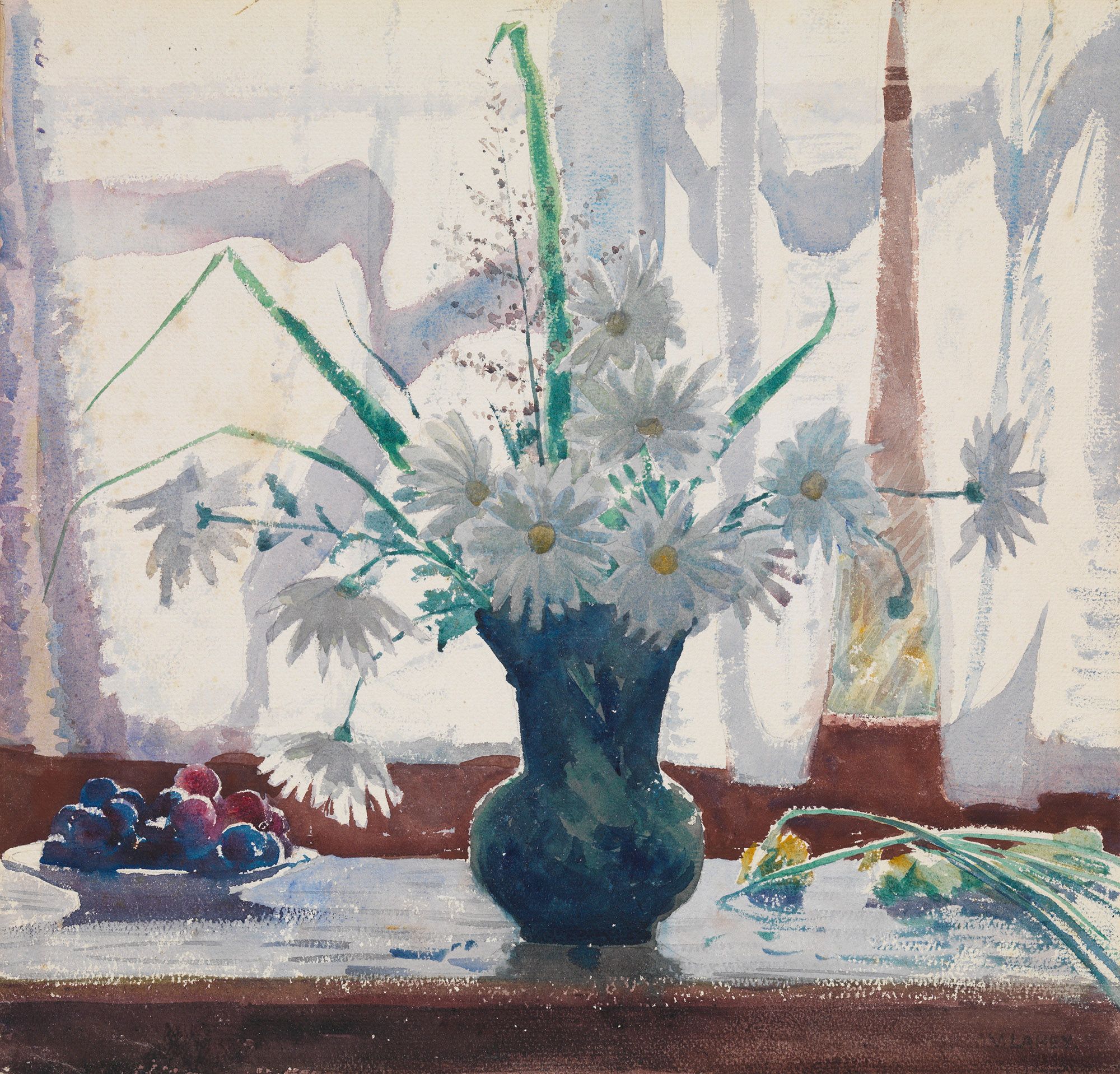
Vida Lahey, Queensland Australia 1882–1968 / Flower study (White daisies, phlox and petrea) 1965 / Watercolour over pencil on wove paper / 33 x 30cm / Gift of the artist’s sister, Mrs M E A Denholm 1969 / Collection: Queensland Art Gallery | Gallery of Modern Art / © QAGOMA / View full image
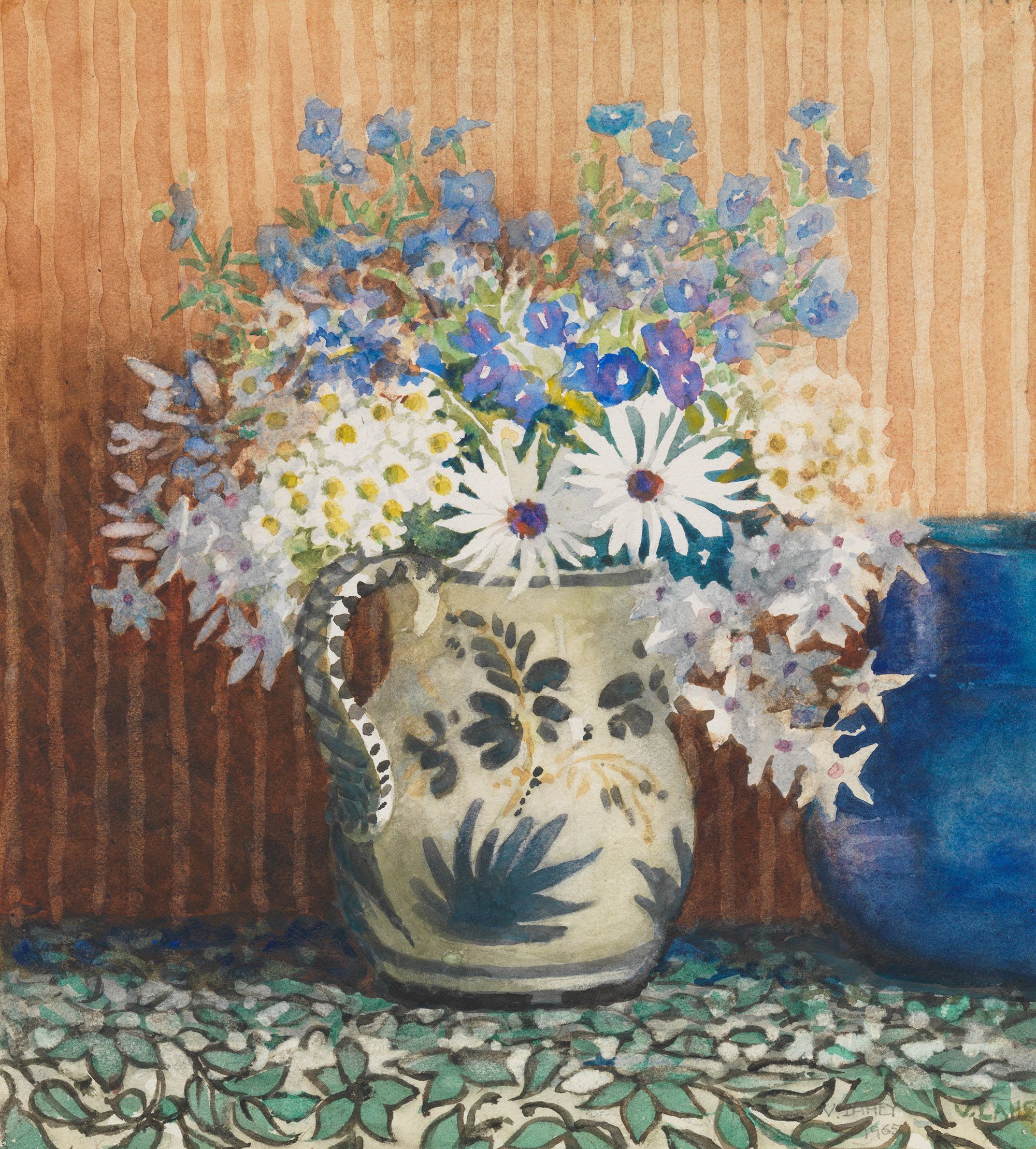
Known as a painter of oils on a wide range of subjects, Queensland born artist (Frances) Vida Lahey (26 August 1882-1968) was also recognised throughout her career as a watercolourist of distinction for floral still lifes, here we have selected a suite of her beautiful flower studies from our Collection.
Lahey was among a new breed of artist — the trained professional — who superseded the Victorian tradition of the genteel lady amateur. One of Australia’s best known woman artists, Lahey was born at Pimpama, a northern suburb of the Gold Coast, and although she studied and travelled widely to London and Europe, she always returned to Brisbane where she lived and painted for most of her life.
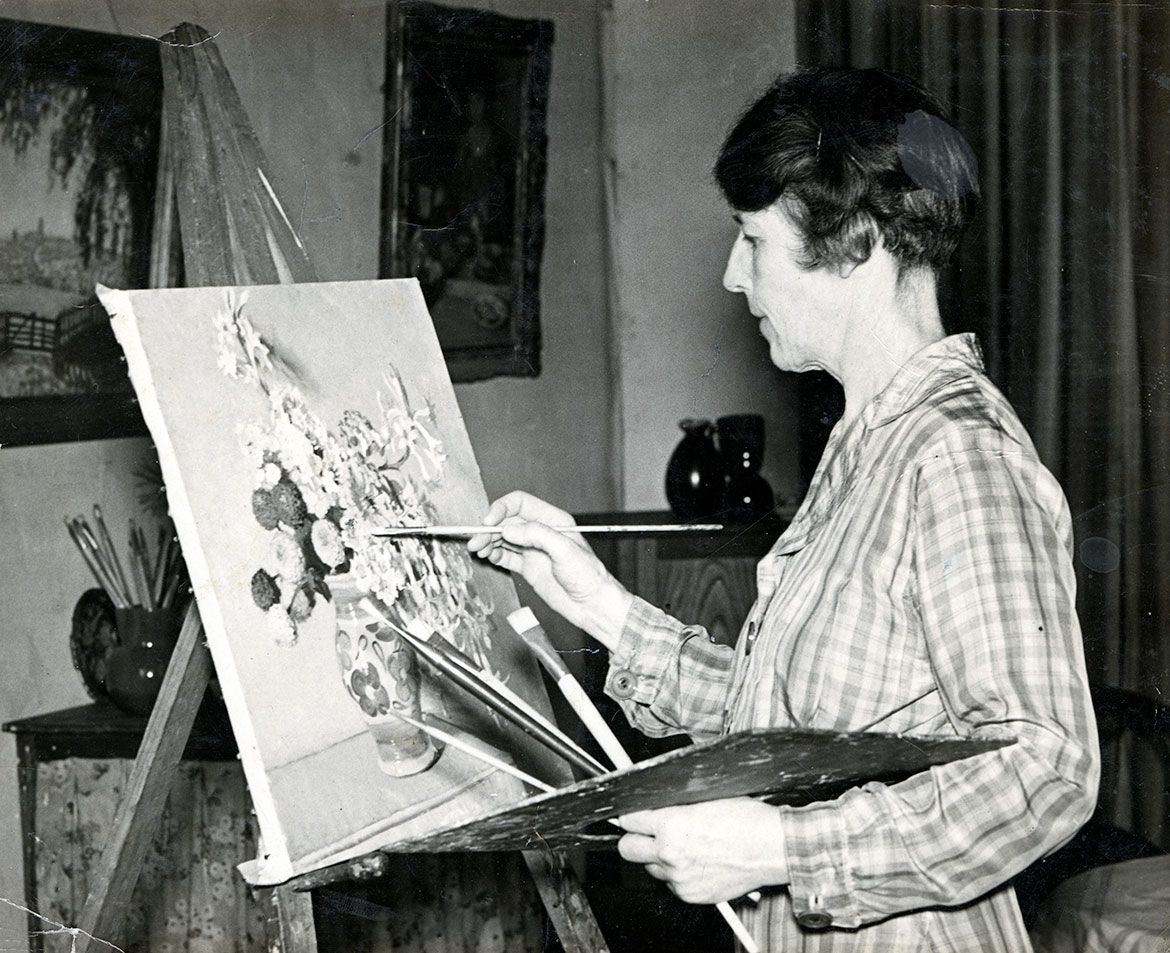
Vida Lahey in her studio, 1941

Vida Lahey in her studio, Telegraph, 25 August 1941 / Daphne Mayo Collection / UQFL119 / Courtesy: The University of Queensland and Queensland Newspapers, Brisbane / View full image
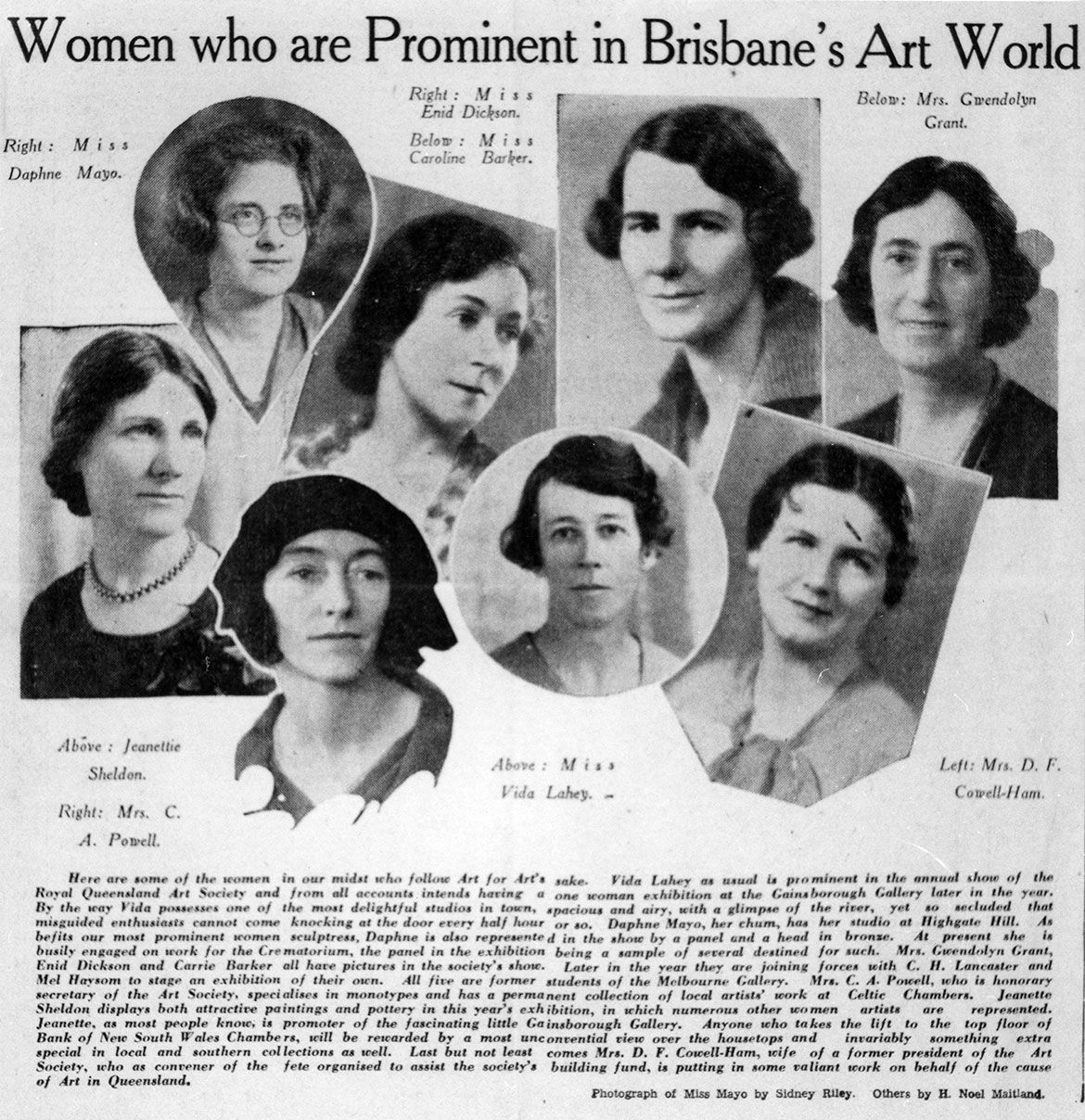
Vida Lahey (centre) profiled in 'Women Prominent in Brisbane’s Art World', 1934

Vida Lahey profiled in ‘Women who are Prominent in Brisbane’s Art World’, published in The Telegraph 8 June 1934 also included Daphne Mayo, Enid Dickson, Caroline Barker, Gwendolyn Grant, Jeanette Sheldon, Mrs Charles Arthur Powell (Gladys Henrietta Dudley née Hobday), and Mrs. D. F. Cowell-Ham / 114526 / Courtesy: John Oxley Library, State Library of Queensland, Brisbane / View full image
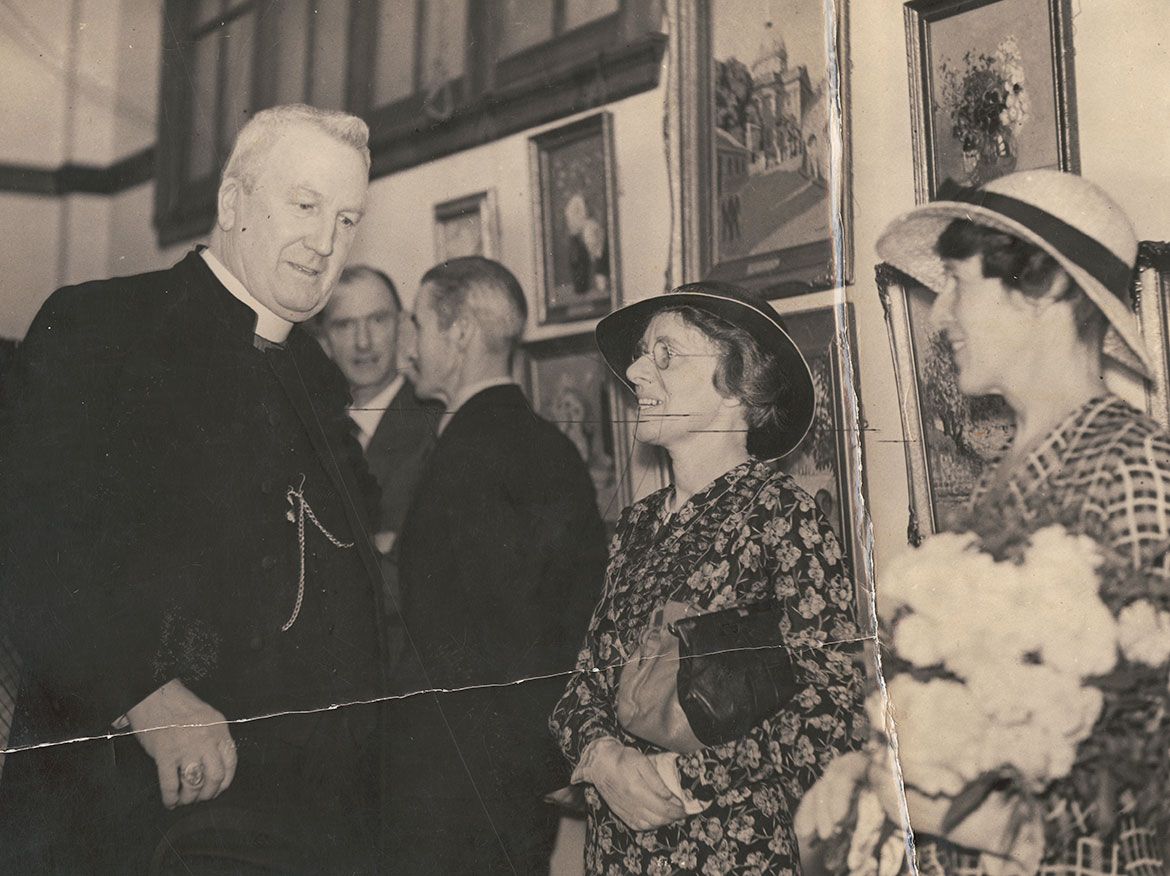
Vida Lahey (right) at the opening of her exhibition at Griffiths Tea Rooms in Brisbane, 1934

(l-r) Archbishop James Duhig, Daphne Mayo and Vida Lahey at the opening of Lahey’s exhibition, Griffiths Tea Rooms, Queen Street, Brisbane, 16 October 1934 / Daphne Mayo Collection, UQFL119 / Courtesy: The University of Queensland, Brisbane / View full image
The art environment in Brisbane was particularly conservative, making Lahey’s vibrant flower studies highly visible expressions of modernist ideas at the Royal Queensland Art Society’s annual exhibitions. Although floral still lifes were a popular genre throughout Australia, Lahey’s handling of brilliant colour was considered exceptional.
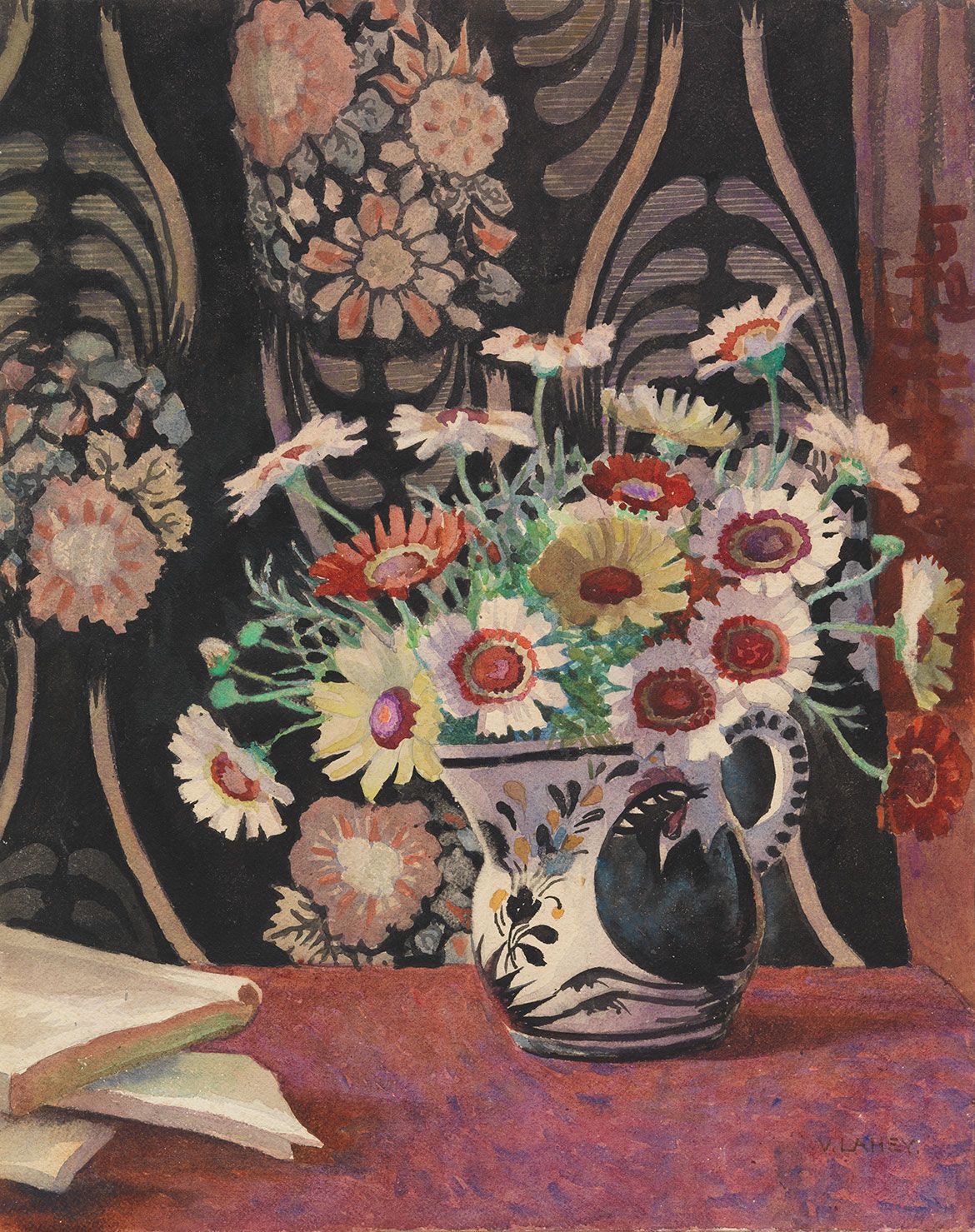
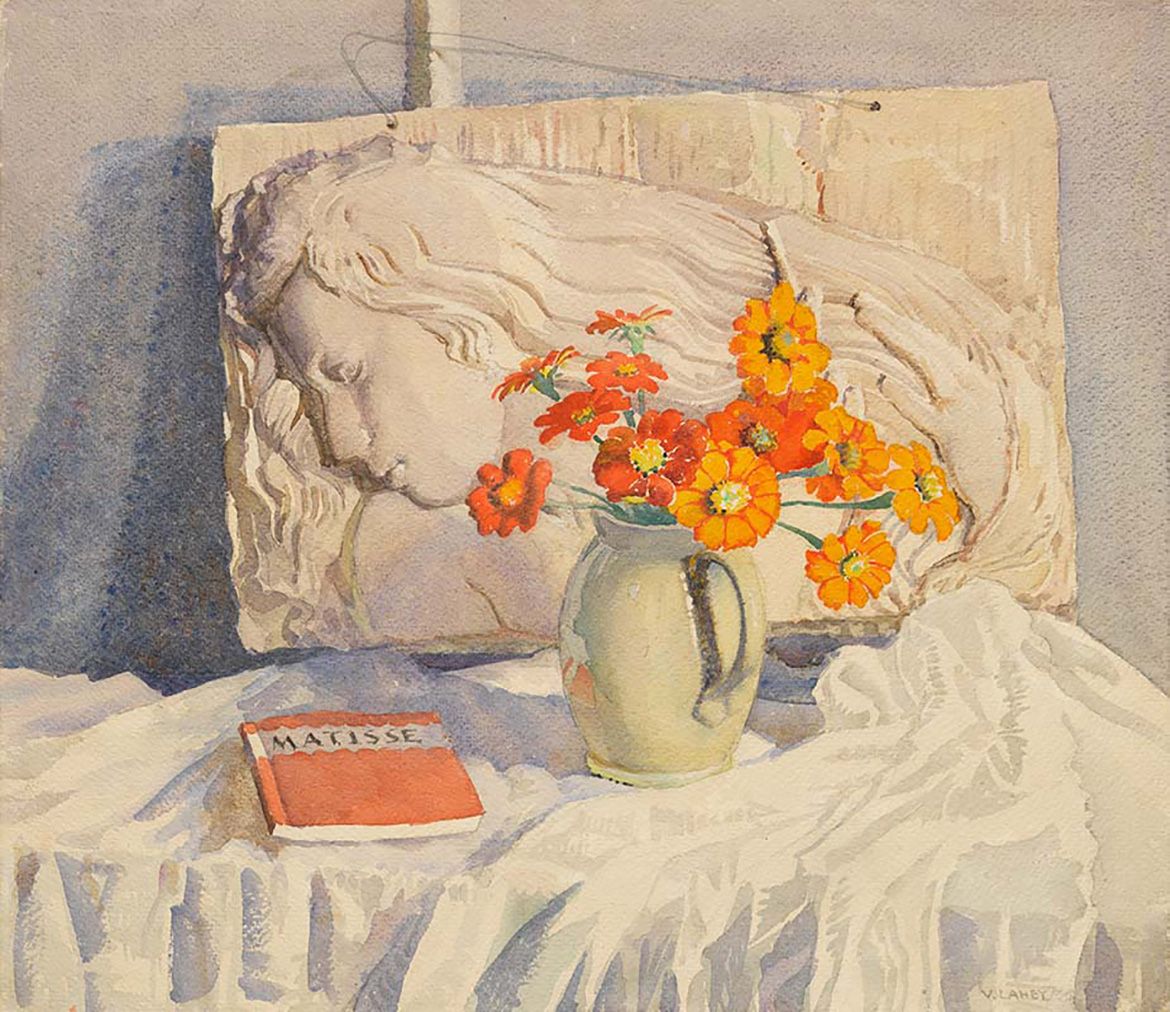
Various groupings can be made of Lahey’s flower studies — one by the artist herself — is using the same vase over a period for different studies, here we look at two such groupings: The cretonne curtain 1933 and Flower study (White daisies, phlox and petrea) 1965; then Art and nature 1934 and Crocus and sunflowers 1955.
The cretonne curtain 1933

Vida Lahey, Queensland Australia 1882–1968 / The cretonne curtain 1933 / Watercolour and gouache over pencil on wove paper on cardboard / 49.8 x 40cm / Gift of Ann Gruen in memory of her mother, Margaret Darvall 1970 / Collection: Queensland Art Gallery | Gallery of Modern Art / © QAGOMA / View full image
Flower study (White daisies, phlox and petrea) 1965

Vida Lahey, Queensland Australia 1882–1968 / Flower study (White daisies, phlox and petrea) 1965 / Watercolour over pencil on wove paper / 33 x 30cm / Gift of the artist’s sister, Mrs M E A Denholm 1969 / Collection: Queensland Art Gallery | Gallery of Modern Art / © QAGOMA / View full image
This same jug — imported from Germany by notable Brisbane businessman Carl Zoeller — can be seen in The cretonne curtain 1933 (illustrated), and again much later in Flower study (White daisies, phlox and petrea) 1965 (illustrated), and indeed appears in many of Lahey’s works. Of interest, the flowers in Flower study, the blue flowering climber Petrea (also known as ‘Purple Wreath’) was a favourite of Lahey’s mother, the blossoms retaining their colour for many weeks before slowly fading.
Art and nature 1934

Vida Lahey, Queensland Australia 1882–1968 / Art and nature 1934 / Watercolour over pencil on cardboard / 52.5 x 60.6cm / Gift of the Queensland Art Fund 1950 in memory of Miss Madge Roe (1891-1938) / Collection: Queensland Art Gallery | Gallery of Modern Art / © QAGOMA / View full image
Crocus and sunflowers 1955

Vida Lahey, Queensland Australia 1882–1968 / Crocus and sunflowers 1955 / Watercolour over pencil on thin cream wove paper / 50.4 x 40.2cm / Bequest of George Brown 1977 / Collection: Queensland Art Gallery | Gallery of Modern Art / © QAGOMA / View full image
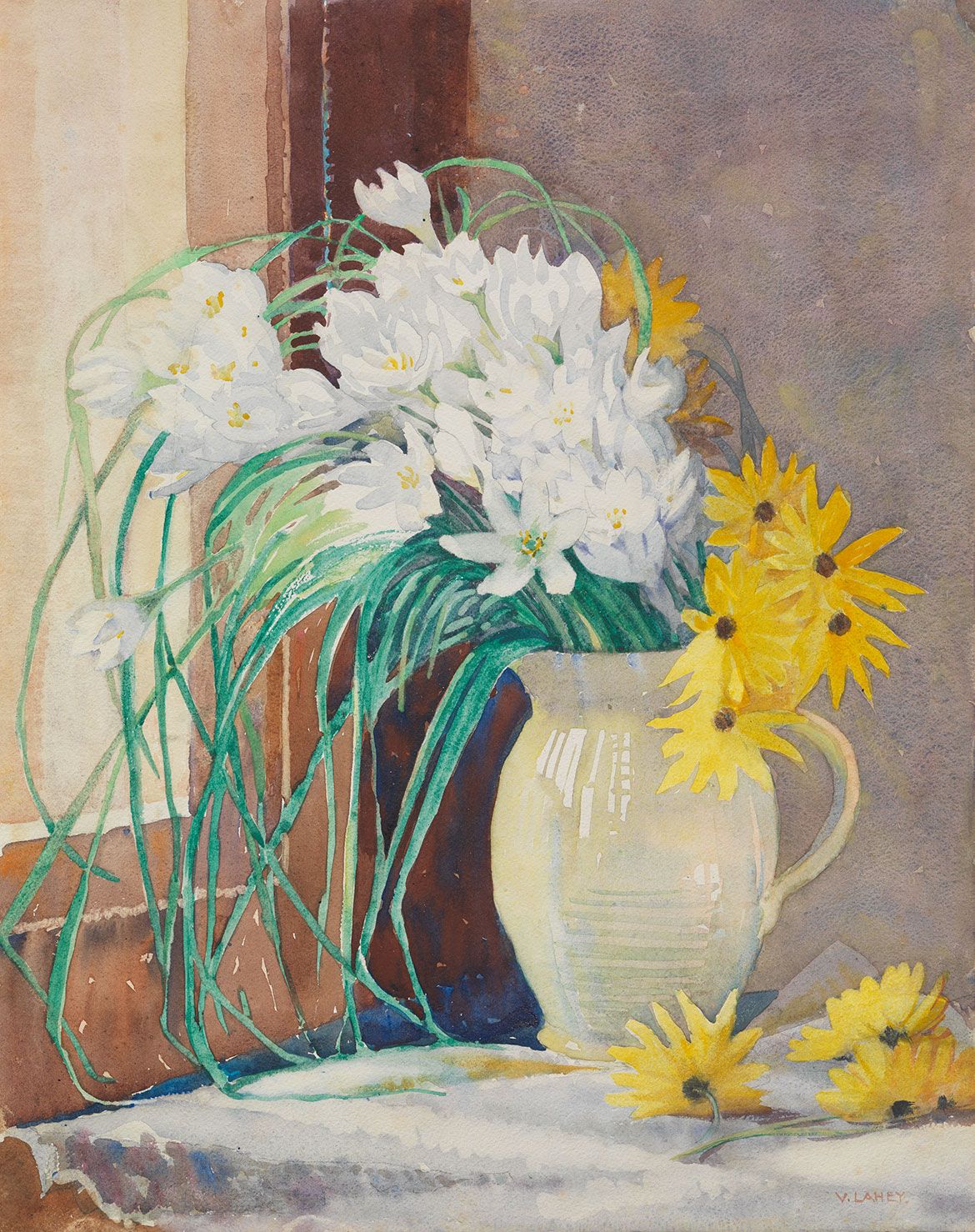
Art and nature 1934 (illustrated), an exploration of the ‘white on white’ technique, is one of Lahey’s most complex still life paintings, commenting on the clash in painting of traditionalism and modernism, represented by a classical plaster bas relief by her close friend and Brisbane contemporary sculptor Daphne Mayo, a book on Matisse, and the brilliantly coloured Mexican sunflower which yield dozens of daisy-like blooms. The same jug is used in Crocus and sunflowers 1955 (illustrated), with the shapes of strap-like leaves and jug forming an ellipse against a simple background of wall and window.
Delve into the QAGOMA Collection
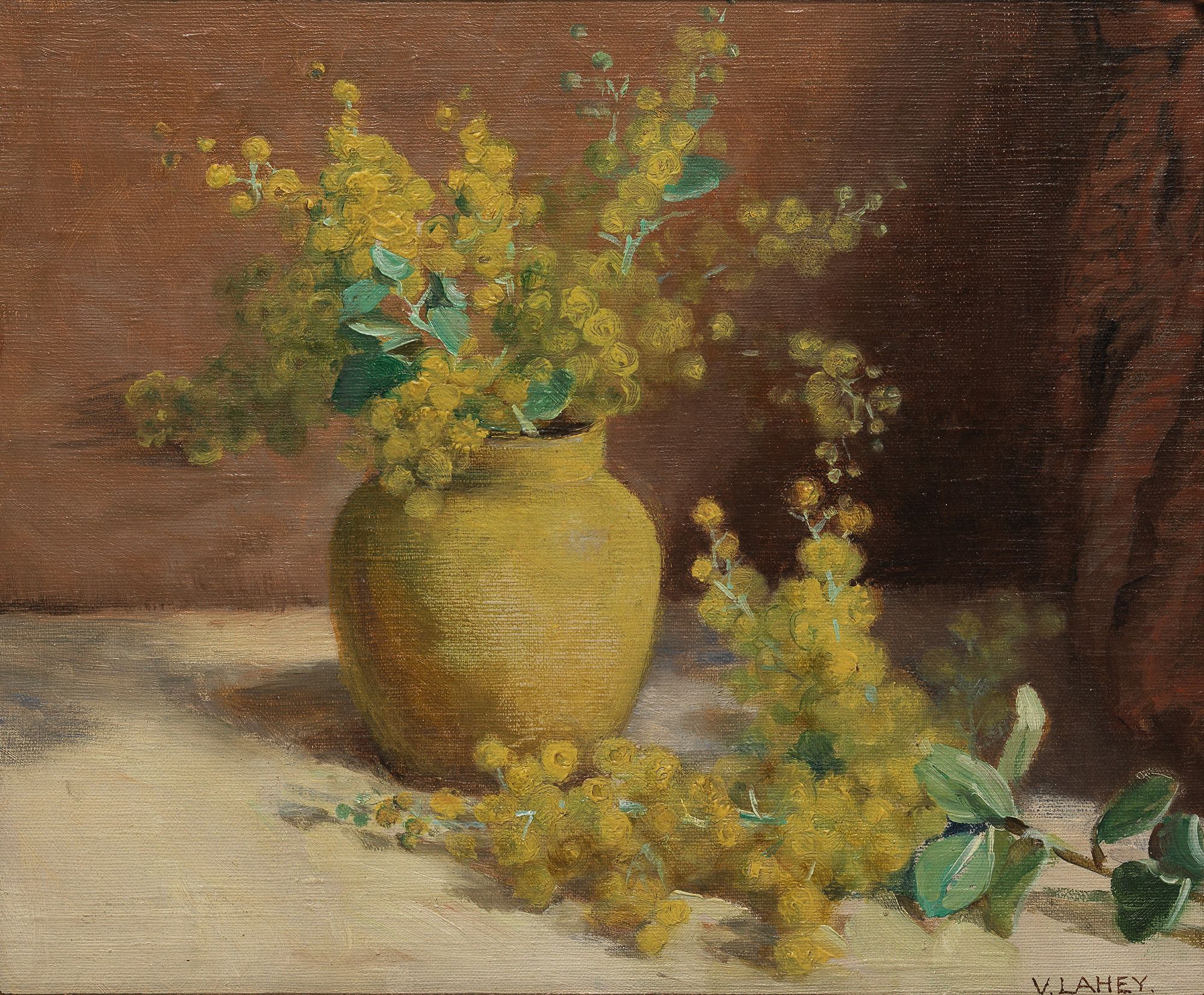
Australian floral subjects have been popular since the 1890s, and after Australia attained nationhood through the federation of its six states in 1901, sentiments of national pride, and patriotism soon developed with the Wattle a favourite floral subject and emblem of Australia. In Lahey’s lifetime, the Wattle Day League founded in Sydney in 1909, and a Queensland branch established in 1912, it is possible that Lahey painted Wattle in a yellow vase c.1912-15 (illustrated) for a promotional Wattle Day event at the time.
Wattle in a yellow vase 1912-15

Vida Lahey, Queensland Australia 1882–1968 / Wattle in a yellow vase c.1912-15 / Oil on canvas on plywood / 24 x 29cm / Gift of the Estate of Shirley Lahey through the QAG Foundation 2012 / Collection: Queensland Art Gallery | Gallery of Modern Art / © QAGOMA / View full image
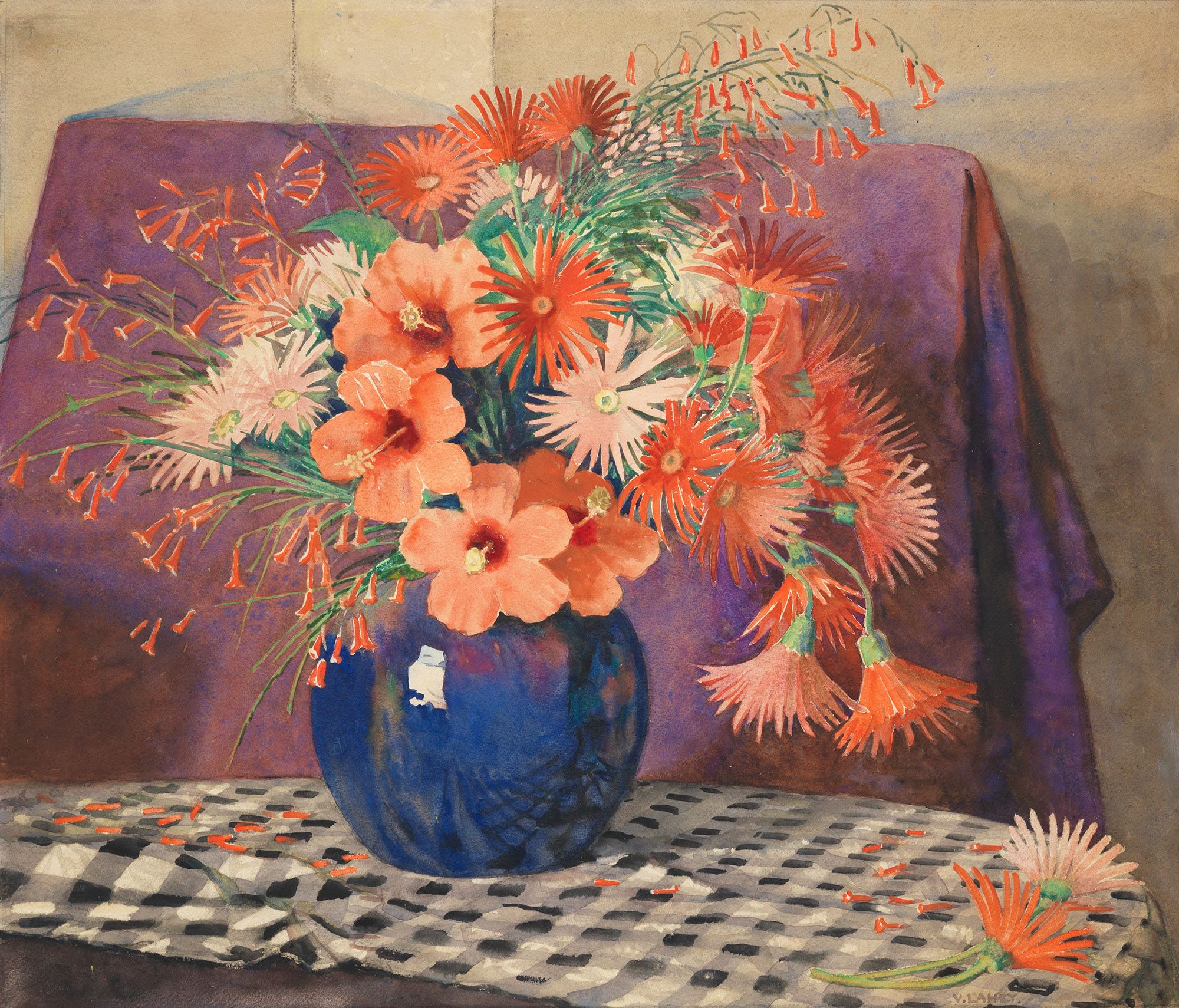
Hibiscus, gerbera and russelia 1936

Vida Lahey, Queensland Australia 1882–1968 / Hibiscus, gerbera and russelia 1936 / Watercolour over pencil on wove paper / 61 x 71.2cm / Gift of the Godfrey Rivers Trust 1937 / Collection: Queensland Art Gallery | Gallery of Modern Art / © QAGOMA / View full image
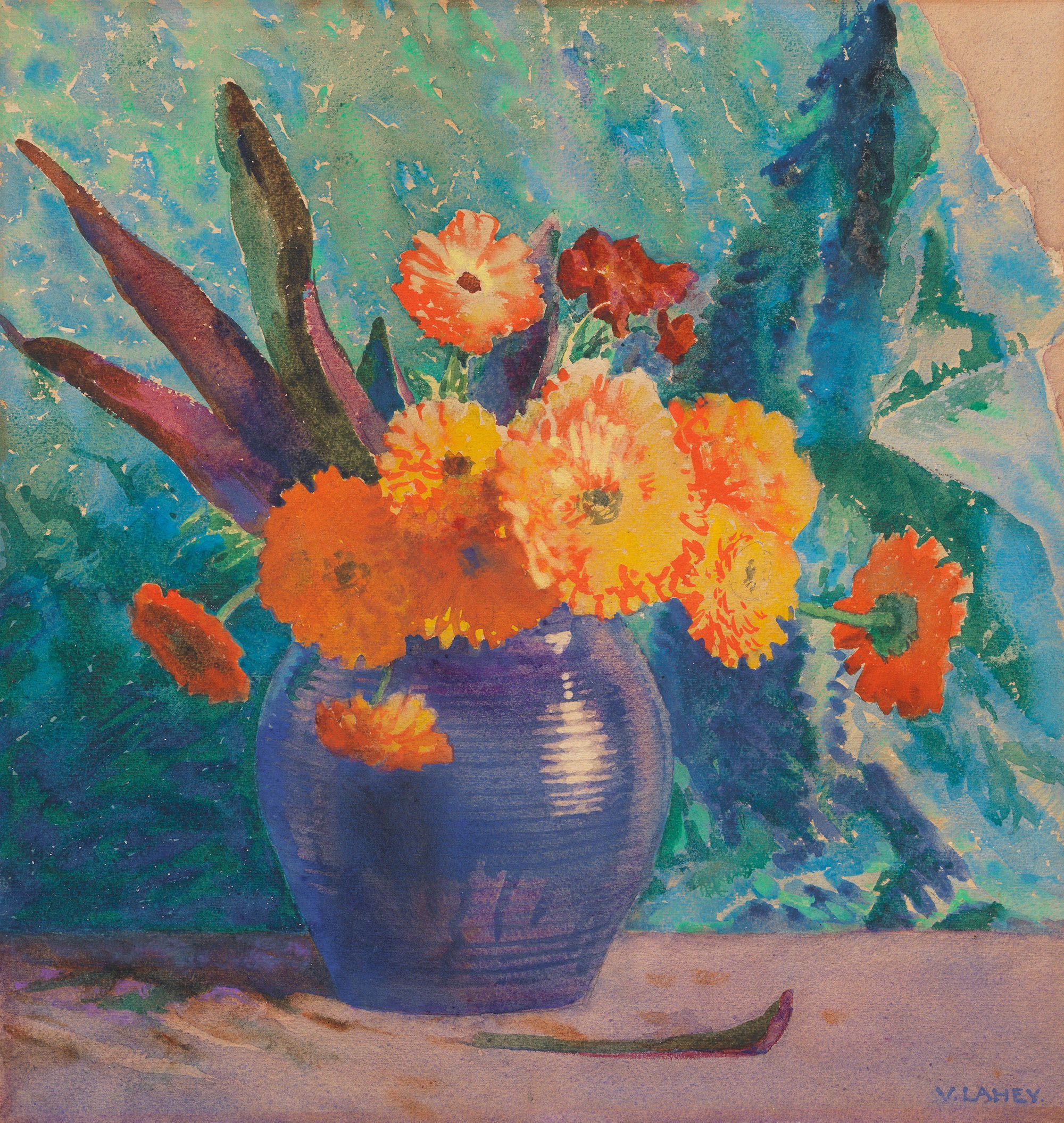
Lahey recommended H Barret Carpenter's text Suggestions for the Study of Colour (1915) to her students. Carpenter's exercises established harmony by a judicious blending of colours, whereas Lahey's own works were brilliant in their intensity. However, there is a clear connection between Lahey's works and Carpenter's recommendations for achieving the effect of shadows by using colours 'in their natural order': meaning their increasing intensity. In Calendulas c.1936-37 (illustrated), for example, Lahey uses intense shades of orange to create the effect of a shadow.
Calendulas c.1936-37

Vida Lahey, Queensland Australia 1882–1968 / Calendulas c.1936-37 / Watercolour and gouache over pencil on wove paper on cardboard / 48 x 45.8cm / Gift of Miss Maria Theresa Treweeke 1937 / Collection: Queensland Art Gallery | Gallery of Modern Art / © QAGOMA / View full image
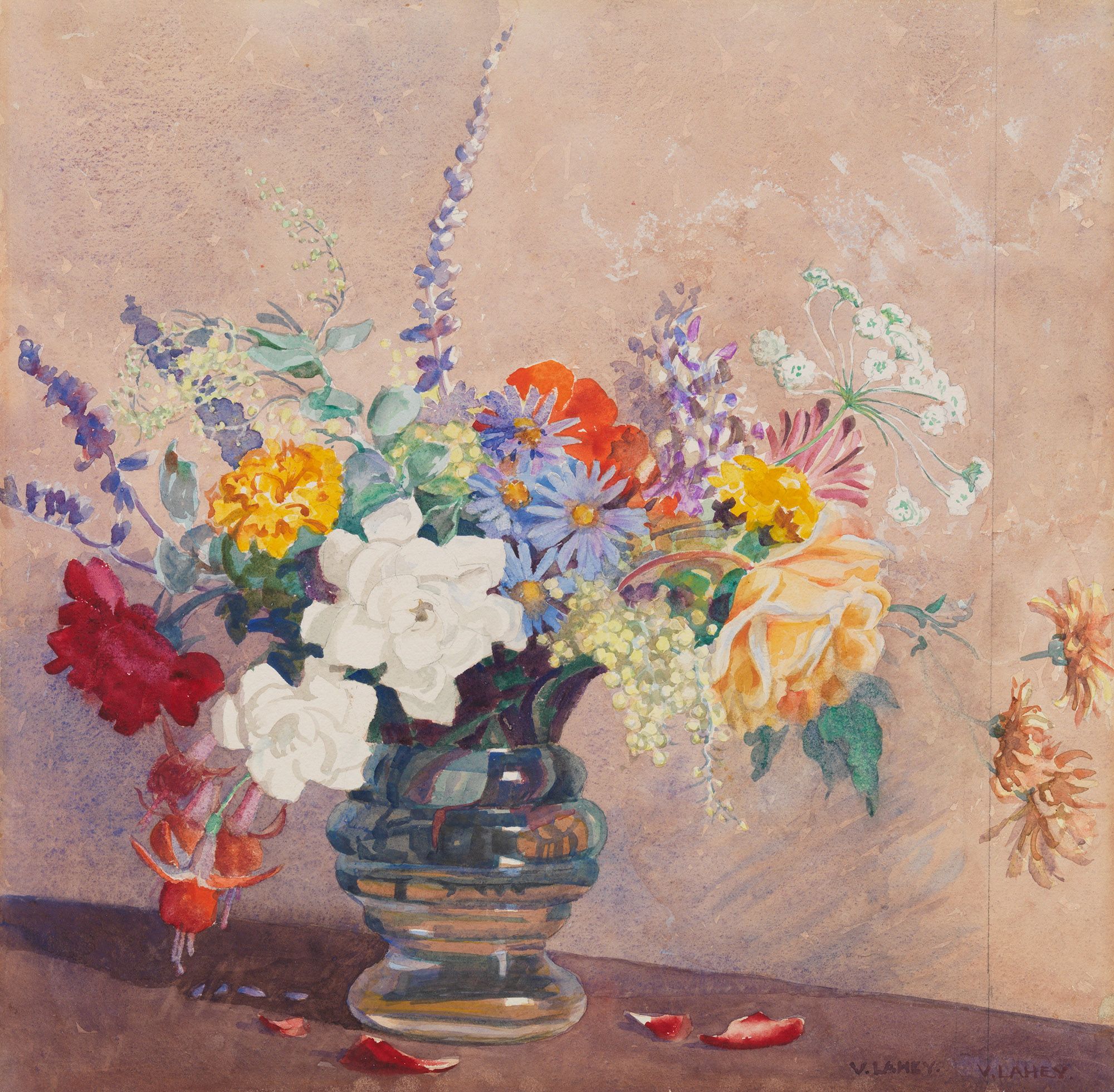
Lahey was an avid gardener and would have picked the flowers in this 'mixed bunch' herself. She was particularly fond of fuchsias and made a special effort to shelter the delicate blooms from Queensland’s harsh climate.
A mixed bunch c.1936-37

Vida Lahey, Queensland Australia 1882–1968 / A mixed bunch c.1936-37 / Watercolour on cream wove paper / 40 x 40.2cm / Gift of Miss Maria Theresa Treweeke 1937 / Collection: Queensland Art Gallery | Gallery of Modern Art / © QAGOMA / View full image
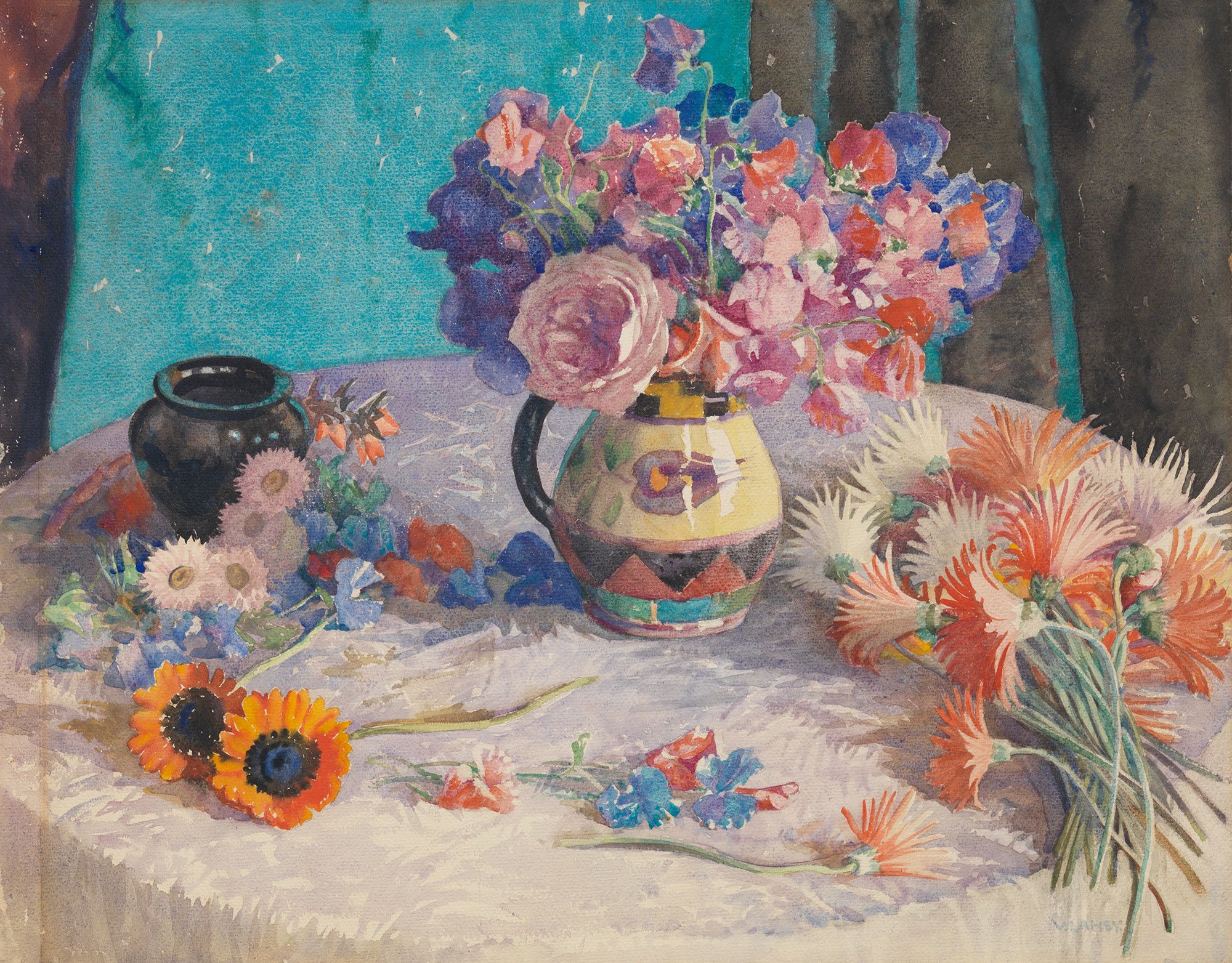
Sweet peas and gerberas c.1942

Vida Lahey, Queensland Australia 1882–1968 / Sweet peas and gerberas c.1942 / Watercolour over pencil on wove paper / 54.5 x 66.3cm / Purchased 1943 / Collection: Queensland Art Gallery | Gallery of Modern Art / © QAGOMA / View full image
Like Crocus and sunflowers 1955, Noonday shadows 1946 (illustrated) is one of many flower studies incorporating a window, here, the veil of the curtain is almost transparent, the folds directing the viewer across the composition.
Noonday shadows 1946

Vida Lahey, Queensland Australia 1882–1968 / Noonday shadows 1946 / Watercolour and gouache over pencil on wove paper on cardboard / 45.8 x 47.5cm / Purchased 1946 / Collection: Queensland Art Gallery | Gallery of Modern Art / © QAGOMA / View full image
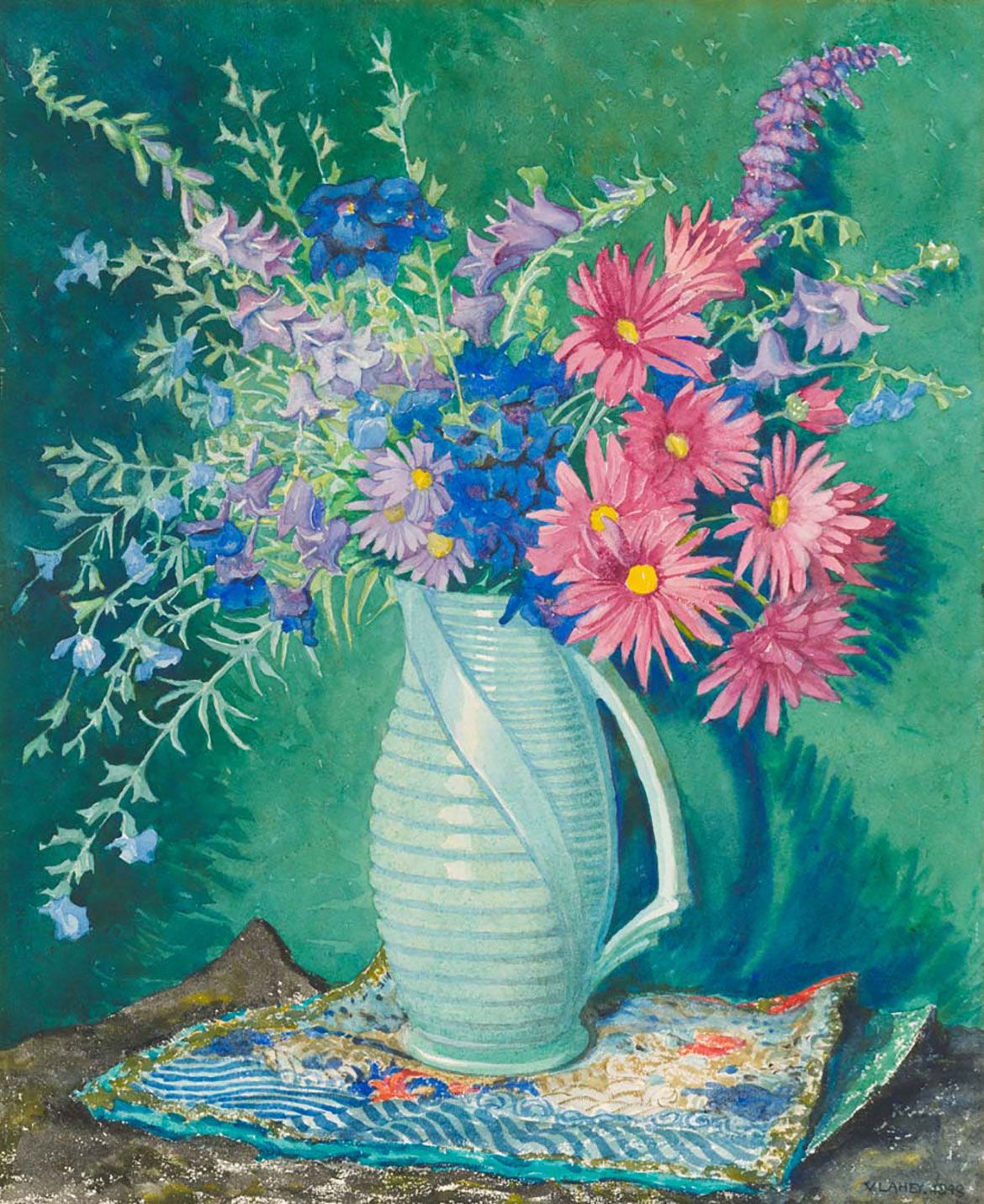
Green vase with gerberas 1948 (illustrated) exhibits the intense vibrant colours she experimented with during the 1930s and 1940s. The works after the 1940s are more subdued, however the play of pattern can be just as vibrant and experimental as seen in her use of distinctive table cloths and vases in her still life paintings.
In 1947, the Lahey family home 'Wonga-Wallen' was relocated from Canungra in the Gold Coast hinterland — some 75 kilometres south of Brisbane — to Sir Fred Schonell Drive at St Lucia.
'Wonga-Wallen, the home of the late Mr. David Lahey, commenced its journey to Brisbane on the special house carrying lorry, it was quite an interesting sight to see this big house being moved in one piece. In some parts of the road difficulty was experienced in clearing cutting and branches of trees. The house goes to St Lucia and will be the home of Misses J. [Jayne] and V. [Vida] Lahey.' The Beaudesert Times, 18 July 1947.
In the year following Vida Lahey's death in 1968, Daphne Mayo, remarked:
'This home, with its bright beds of flowers and close clipped lawns, with a background of huge trees in the gully behind and below the house, gave Vida the double happiness of growing the flowers and fruits for her still life studies before painting them.'
Green vase with gerberas 1948

Vida Lahey, Queensland Australia 1882–1968 / Green vase with gerberas 1948 / Watercolour on paper / 47.3 x 38.3cm / Gift of Rosemary Goodchild through the QAGOMA Foundation 2015. Donated through the Australian Government’s Cultural Gifts Program/ Collection: Queensland Art Gallery | Gallery of Modern Art / © QAGOMA / View full image
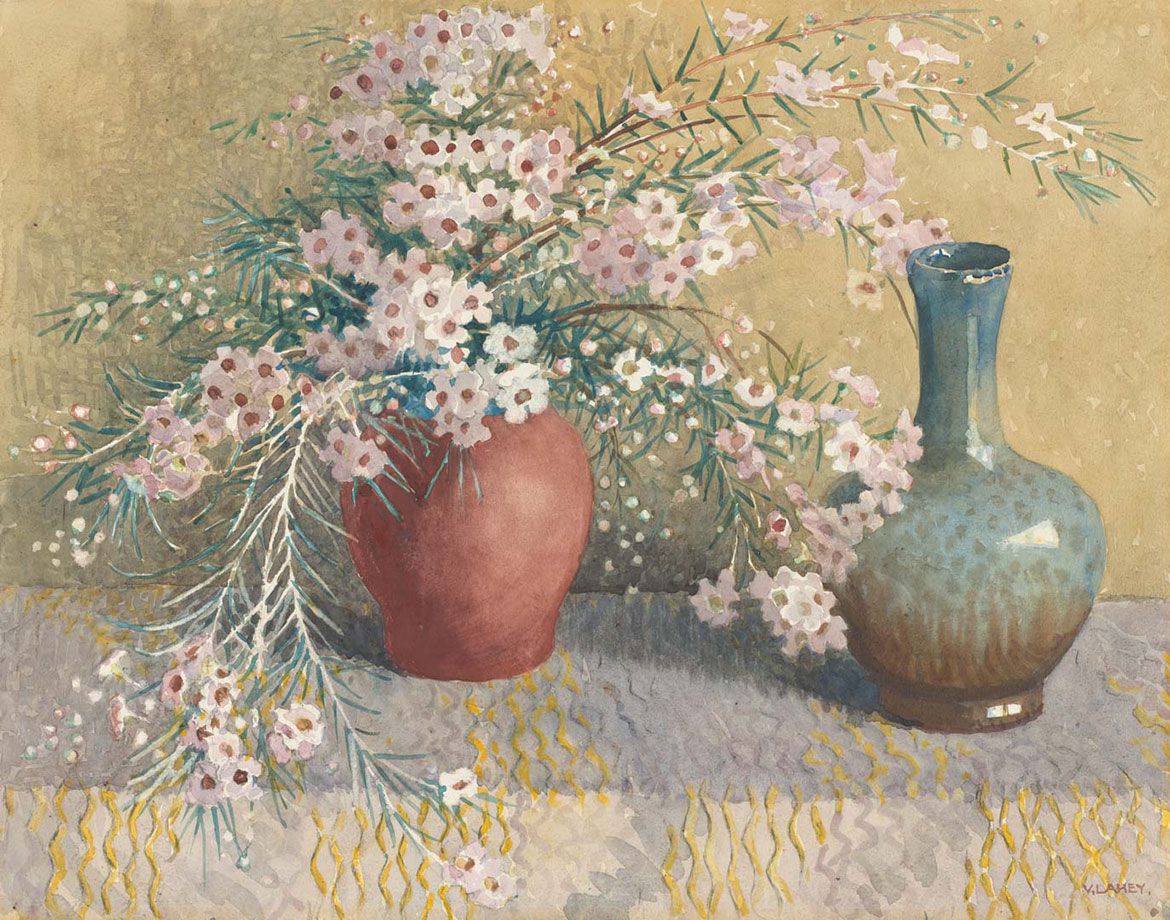
Geraldton wax in vase c.1950s (illustrated) is of particular interest as a native Australian flower study as the Gallery holds only one other Australian floral subject by Lahey, Wattle in a yellow vase c.1912-15 which is one of Lahey’s earliest flower studies.
Geraldton wax in vase 1950s

Vida Lahey, Queensland Australia 1882–1968 / Geraldton wax in vase c.1950s / Watercolour on paper / 34.5 x 44.5cm / Gift of Rosemary Goodchild through the QAGOMA Foundation 2015. Donated through the Australian Government’s Cultural Gifts Program / Collection: Queensland Art Gallery | Gallery of Modern Art / © QAGOMA / View full image
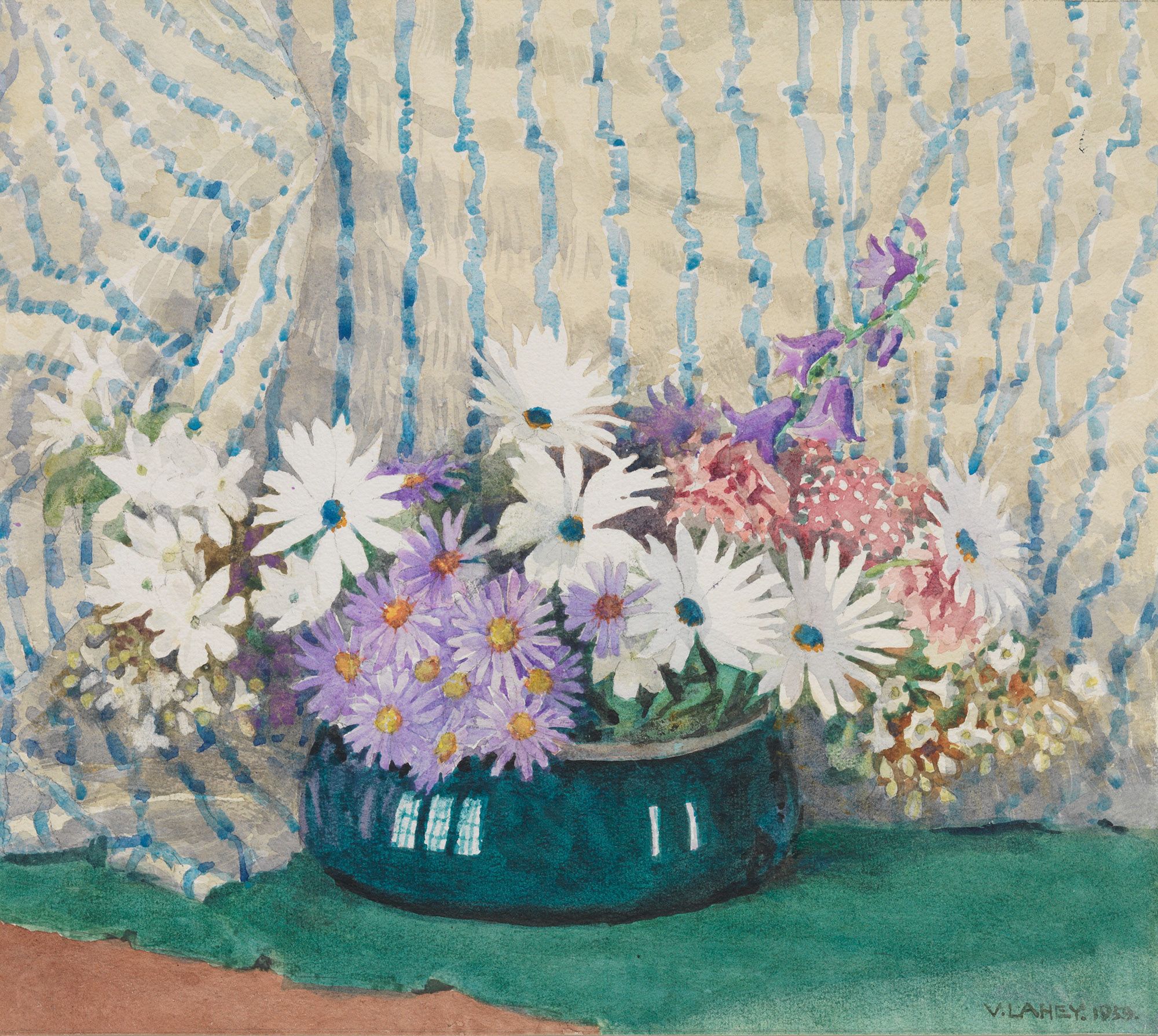
Blue-eyed daisies 1959

Vida Lahey, Queensland Australia 1882–1968 / Blue-eyed daisies 1959 / Watercolour over pencil on wove paper / 30.5 x 34.1cm / Bequest of George Brown 1977 / Collection: Queensland Art Gallery | Gallery of Modern Art / © QAGOMA / View full image
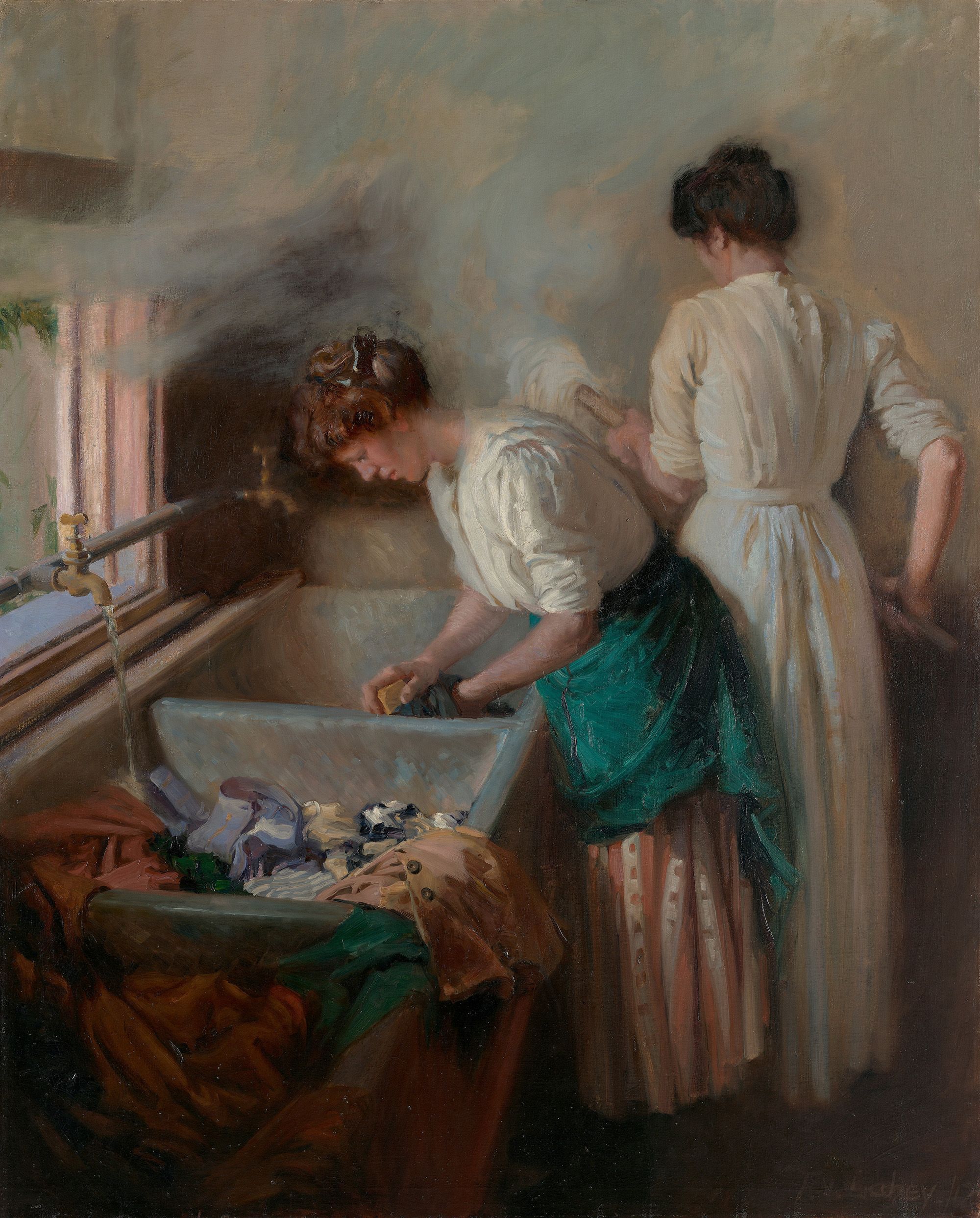
Of all the works by Lahey, she is best known for her depiction of the weekly wash-day, Monday morning 1912 (illustrated).
Monday morning 1912, which shows two women at the copper, concrete wash tubs, with bar soap in hand, was once a common sight in Australian households. With the advent of mechanical aids and electricity this sight has now vanished, recording as it does a bygone era in vivid detail.
In depicting the weekly washday at Lahey’s home 'Greylands', one of Brisbane’s earliest grand homes, Monday morning records the life of most Queensland women in the early twentieth century. Esme, a younger sister, was the model for the woman at the washtub. Go back in time to a Monday morning family wash day.
Monday morning 1912

Vida Lahey, Australia 1882–1968 / Monday morning 1912 / Oil on canvas / 153 x 122.7cm / Gift of Madame Emily Coungeau through the Queensland Art Society 1912 / Collection: Queensland Art Gallery | Gallery of Modern Art / © QAGOMA / View full image
Edited extracts by Glenn R Cooke, former Curator (Queensland Heritage), QAGOMA.
Additional research and supplementary material sourced and compiled by Elliott Murray, Senior Digital Marketing Officer, QAGOMA
Go back in time to discover Brisbane’s forgotten landmarks, delve into our historical past, and uncover unique stories through the work of Australian artists in QAGOMA’s Collection.
Monday morning 1912 is on display in the Australian Art Collection
Queensland Art Gallery
Galleries 10, 11, 12 & 13 (Josephine Ulrick and Win Schubert Galleries)
Queensland Art Gallery | Gallery of Modern Art (QAGOMA)
Brisbane, Australia