

Visual Music
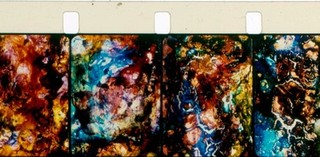
Production still from The Dante Quartet 1987 | Director: Stan Brakhage / View full image

When
28 Mar – 1 Jun 2008
Where
Gallery of Modern Art, Cinema A
About
The cinematic genre of Visual Music draws on elements of form, colour and rhythm in music and images to create visual symphonies. Working with abstraction and figuration, gesture, pitch, beat and palette, filmmakers have explored the dynamism of sight and sound synaesthesia - hearing colour and line, seeing rhythm and tone - through innovative techniques and aesthetics. The Australian Cinémathèque's Visual Music program includes an extraordinary range of approaches to this genre, from the Silly Symphonies, early Walt Disney musical animations, to retrospective programs of visual music pioneers, selections of rarely screened classics and contemporary works. This enduring and influential field of filmmaking counts among its leading practitioners such unique voices as Oskar Fischinger, Hans Richter, Len Lye, Norman McLaren, Stan Brakhage, James and John Whitney, Jordan Belson, Bärbel Neubauer and Mary Ellen Bute. The Silly Symphonies program is the most extensive to date internationally of these often hilarious and irresistibly charming visual choreographies. It showcases the technical and aesthetic innovations of Disney's musical animations. Other highlights include the in-depth retrospectives of work in this genre by Stan Brakhage and Norman McLaren.
List of Works
- Alexandre Alexeïeff and Claire Parker
- Pioneer experimental animator Claire Parker studied to be a painter before starting a lifetime career in film. She worked with her husband-to-be Alexandre Alexeieff for nearly a decade before being married in 1941. Parker was the technical specialist and artistic assistant to Alexeieff. Their films are milestones in the history of 20th-century fine-art animation in the United States and throughout the world. Cecile Starr
- Alexeïeff at the Pinboard 1960
- Une nuit sur le mont chauve (Night on Bald Mountain) 1933
- La belle au bois dormant (Sleeping Beauty) 1935
- En Passant 1943
- Colour Commercials 1952-61
- Le nez (The Nose) 1963
- Tableaux d'une exposition (Pictures at an Exhibition) 1972
- Trois thèmes (Three Moods) 1980
- Program provided by Center for Visual Music in association with Cecile Starr and The Women's Independent Film Exchange.
- Saul Bass
- Saul Bass created new parameters for the field of feature film title design through his striking use of geometric graphics animated to music. He famously collaborated with experimental filmmaker John Whitney (see program 'James and John Whitney') on the opening title sequence of Alfred Hitchcock's Vertigo, his title sequences for three of Hitchcock films are his best known work.
- Bass on Titles 1977 | Director: Saul Bass
- Vertigo 1958 | Director: Alfred Hitchcock
- North by Northwest 1959 | Director: Alfred Hitchcock
- Psycho 1960 | Director: Alfred Hitchcock
- Jordan Belson
- 'The essence of cinema is precisely "dynamic movement of form and colour," and their relation to sound. In this respect Belson is the purest of all filmmakers . . . the films remain concrete, objective experiences of kinaesthetic and optical dynamism. They are at once the ultimate use of visual imagery to communicate abstract concepts, and the purest of experiential confrontations between subject and object.' Gene Youngblood
- 'Jordan Belson is one of the greatest artists of visual music. Belson creates lush vibrant experiences of exquisite colour and dynamic abstract phenomena evoking sacred celestial experiences.' William Moritz
- Allures 1961
- Samadhi 1967
- Chakra 1972
- Light 1973
- Music of the Spheres 1977
- Northern Lights 1985
- Epilogue 2005
- Stan Brakhage
- Creating nearly 400 films in his lifetime, Stan Brakhage was one of the most prolific and influential American experimental filmmakers. Brakhage's beautiful and intimate films use colour and abstract form to explore love, mortality and spirituality. Brakhage endeavoured to remake filmmaking in order to create new viewing experiences, which he termed 'moving-visual-thinking'. His experiments with directly scratching and painting on the film's surface and layering recorded images, reflect his strong desire to remove film from the confines of narrative cinema and break audiences habitual patterns of viewing.
- Cat's Cradle 1959
- The Garden of Earthly Delights 1981
- The Dante Quartet 1987
- Delicacies of Molten Horror Synapse 1991
- Sirius Remembered 1959
- Untitled (For Marilyn) 1992
- The Cat of the Worm's Green Realm 1997
- Commingled Containers 1997
- Dog Star Man 1961–64
- Mothlight 1963
- Window Water Baby Moving 1959
- Stellar 1993
- I . . . Dreaming 1988
- Christ Mass Sex Dance 1991
- Black Ice 1994
- Crack Glass Eulogy 1992
- The Dead 1960
- The Dark Tower 1999
- Lovesong 2001
- Stately Mansions Did Decree 1999
- Fred Camper, The Chicago Reader The Wonder Ring 1955
- Blue Moses 1962
- Anticipation of the Night 1958
- A Child's Garden and the Serious Sea 1991
- Mary Ellen Bute
- 'A pioneer of visual music and electronic art, Mary Ellen Bute produced over a dozen short abstract animations between the 1930s to the 1950s. Set to classical music by the likes of Bach, Saint-Saens or Shostakovich, and filled with colourful forms, elegant design and sprightly, dance-like-rhythms, Bute's filmmaking is at once formally rigorous and energetically high-spirited, like a marriage of high modernism and Merrie Melodies.' Ed Halter
- Rhythm in Light 1934 | Directors: Mary Ellen Bute, Melville Webber, Ted Nemeth
- Synchromy No. 2 1935 | Directors: Mary Ellen Bute, Ted Nemeth
- Dada 1936
- Parabola 1937 | Directors: Mary Ellen Bute, Ted Nemeth, Rutherford Boyd, Bill Nemeth
- Escape 1937
- Spook Sport 1939
- Tarantella 1940
- Polka Graph (Fun with Music) 1947
- Colour Rhapsody 1948
- Imagination 1948
- Pastorale 1950
- Abstronic 1952
- Mood Contrasts 1953
- Oskar Fischinger
- 'As a pre-eminent progenitor of experimental film, Oskar Fischinger became one of the most influential filmmakers and visual music practitioners of the twentieth century. During the 1930s, Fischinger increasingly focused on the synchronisation of music and image, leading to experimental drawings on the soundtrack section of filmstrips (producing synthetic sound) and to multiple Studien (c.1929–34), black and white films accompanied by phonograph recordings. For Study No. 7 1931, Fischinger animated 5000 drawings to compose forms metamorphosing with Johannes Brahms's Hungarian Dance No. 51869. His first colour films, including the vibrantly hued Composition in Blue 1935, earned an international acclaim that lured Fischinger to Hollywood in 1936, where he worked for Paramount, MGM, Disney, and Orson Welles. He departed from image-sound synthesis with Radio Dynamics 1942, in which visual; imagery asserts its primacy by functioning as soundless music.'
- Lauren Hebert and Heather McGuire
- Spirals c.1926
- Walking from Munich to Berlin 1927
- Spiritual Constructions c.1927
- Study No. 1 c.1929
- Study No. 2 c.1930
- Study No. 5 1930
- Study No. 6 1930
- Study No. 7 1931
- Liebesspiel (Love Games) c.1934
- Coloratura 1932
- Kreise (Circles), (Tolirag Ad Version) 1933
- Kreise (Circles), (Abstract Version) 1933
- Muratti Greift Ein 1934
- Muratti Privat c.1935
- Komposition in Blau (Composition in Blue) 1935
- Allegretto (Early Version) 1936
- Allegretto (Late Version) 1936–43
- An American March 1941
- Radio Dynamics 1942
- Motion Painting No. 1 1947
- Len Lye
- A pioneer of direct-animation, Len Lye (1901–1980) was also a highly innovative painter, photographer and poet, as well as an important figure in kinetic sculpture. Born in New Zealand, Lye left home as a young man in search of film activity and the stimulation that would satisfy what he called his preoccu