
Vale: Shigeo Toya

Shigeo Toya installing Woods III 1991-92 (The Kenneth and Yasuko Myer Collection of Contemporary Asian Art. Purchased 1994 with funds from The Myer Foundation and Michael Sidney Myer through the Queensland Art Gallery Foundation and with the assistance of the International Exhibitions Program) for ‘The First Asia-Pacific Triennial of Contemporary Art’, 1993 / Photograph: © QAGOMA / View full image
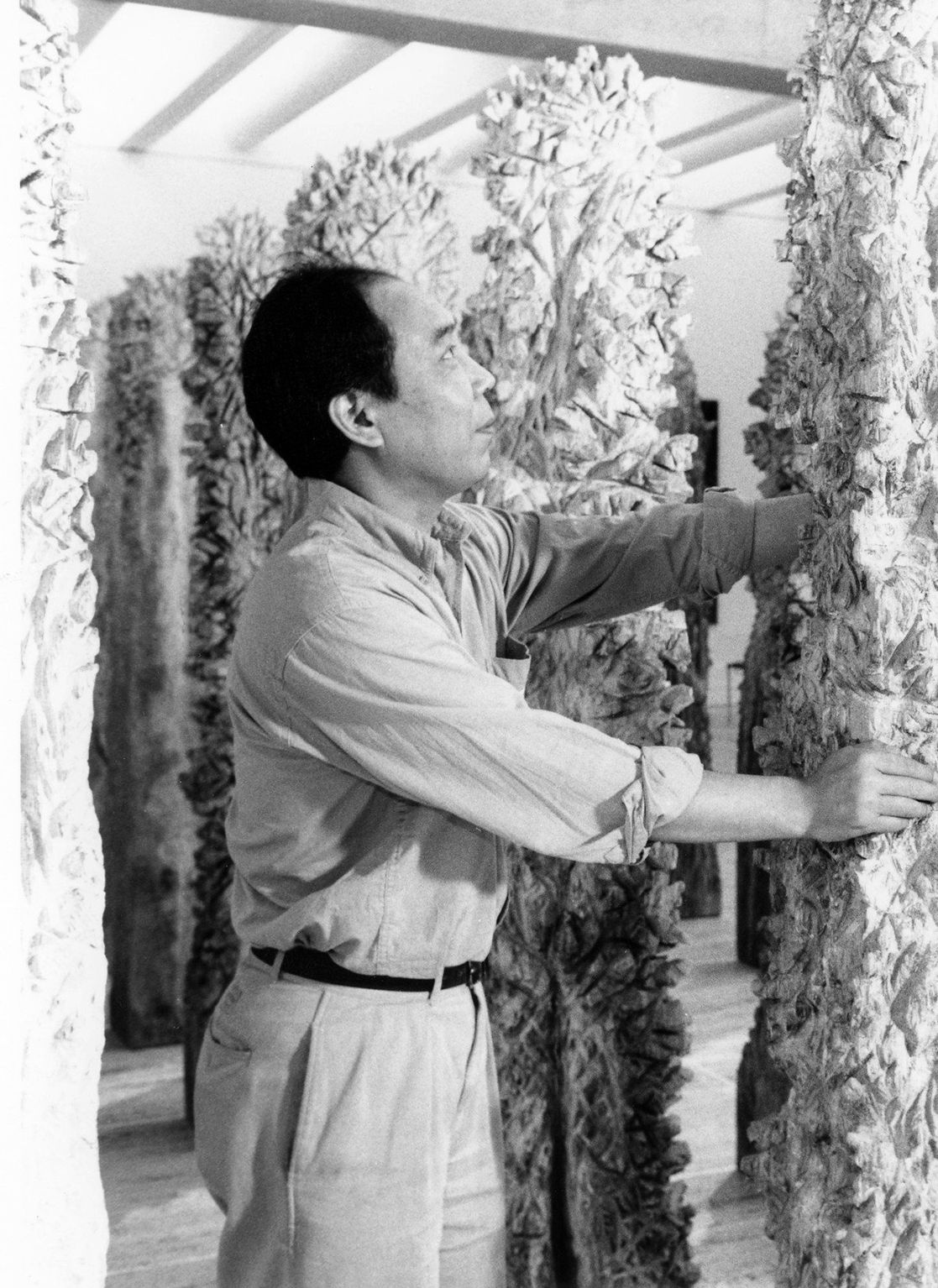
QAGOMA mourns a major figure in Asian art with the passing of sculptor Shigeo Toya in April. Born in Nagano Prefecture, Japan, in 1947, Toya grew up in a tiny village in the shadow of the Hida Mountains, also known as the Northern Japanese Alps. As a child, he played with friends in nearby woods and later recalled the joy of making secret cedar bark forts during the day — but that the forest became frightening and foreboding at night[1]. That duality of nature stayed with him, planting the seed for a deeply philosophical sculpting practice.
Toya’s work emerges from Mono-ha (‘School of Things’), an avant-garde Japanese movement pioneered by artist Lee Ufan in the late 1960s and early 1970s. With a focus on art’s raw material components, Mono-ha sought equilibrium between artist and material, explicitly rejecting Western Modernism. Artists like Toya extended the philosophy of their Mono-ha predecessors, including in the use of natural materials, but also challenged it by re-engaging with craft and labour. Expressed almost exclusively in the medium of wood, Toya’s approach drew from European and North American traditions of Minimalism and Modernism while simultaneously detaching his work from them. He aimed to reveal the ‘many complex spaces and viewpoints’ of the interior of his chosen medium; his main tool to this end was the chainsaw.[2]
Installation view of ‘Japanese Ways, Western Means’, 1989 featuring Shigeo Toya’s Forest 1986 in foreground

Installation view of ‘Japanese Ways, Western Means’, Queensland Art Gallery, 1989 with Shigeo Toya’s Forest 1986 in foreground / © Shigeo Toya Estate / Photograph: © QAGOMA / View full image
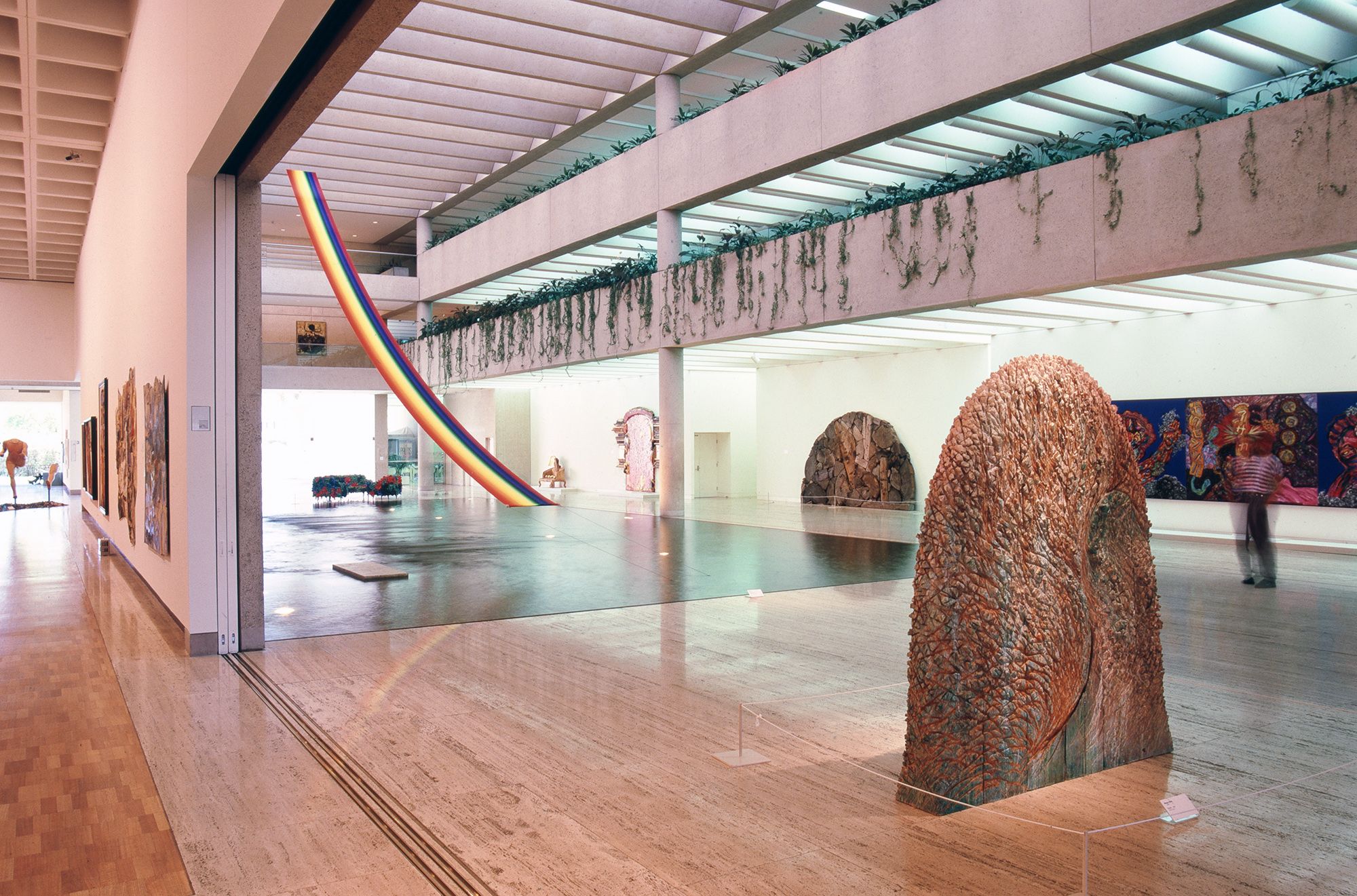
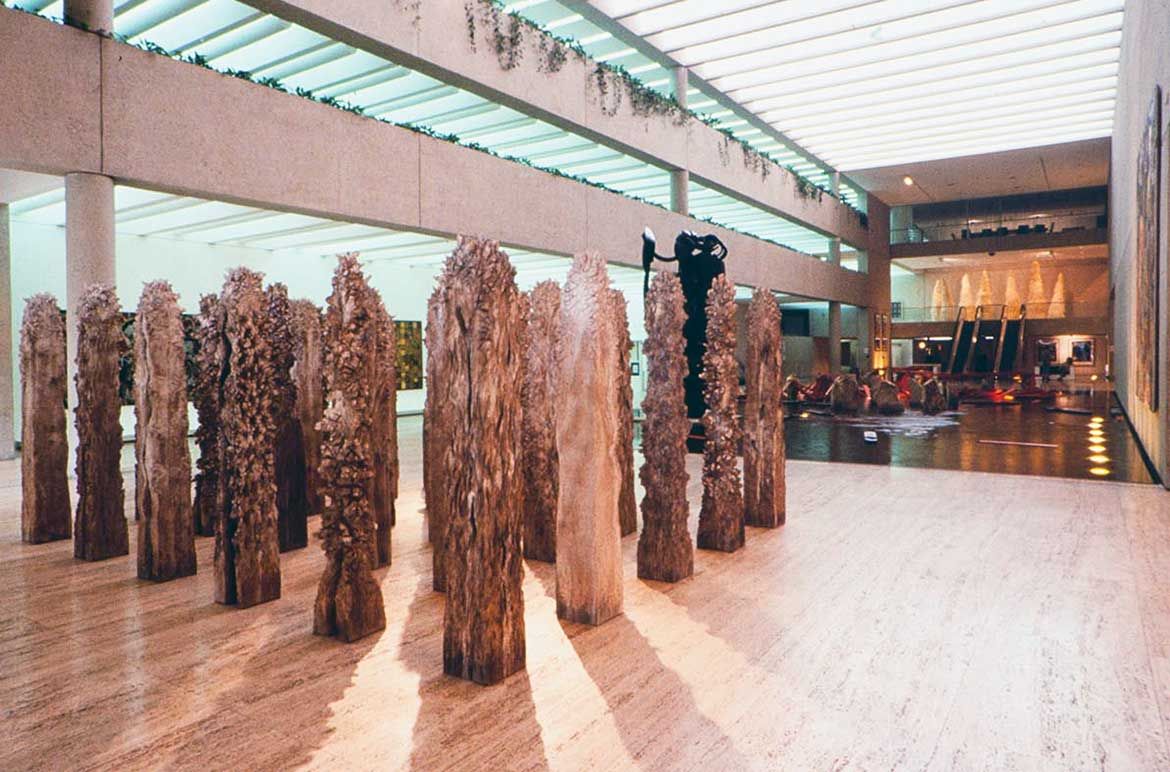
Graduating from the Aichi Prefecture University of Fine Arts in 1975, Toya was exhibiting frequently in Japan by the 1980s. His international breakthrough came in 1988 as one of three artists selected for the Japanese Pavilion at the 43rd Venice Biennale. There, he exhibited Woods 1987 — a grove of tall, squared-off wooden blocks, each carved with a unique pattern of creases and folds that he ‘released’ with his chainsaw. The following year, his work was included in the landmark exhibition ‘Japanese Ways, Western Means’ at the Queensland Art Gallery (QAG) (part of a Sister State exchange between the Gallery and the Museum of Modern Art in Saitama), the sweeping curves of his densely engraved sculpture Forest 1986 capturing his experience of stopping his car on a lonely, windswept country road. Following this, Toya presented Woods III —an iteration of the Venice project that would become a lifelong pursuit — at the Gallery’s inaugural Asia Pacific Triennial of Contemporary Art in 1993. One of the first monumental installations ever acquired by the Gallery for what is now a world-leading collection of contemporary Asian art, Woods III exemplified Toya’s mission to find simplicity in the Baroque and complexity in Minimalism — a paradox he termed ‘Minimalbaroque’.
Shigeo Toya Woods III 1991-92 installed in ‘The First Asia-Pacific Triennial of Contemporary Art’, 1993

Shigeo Toya Woods III 1991-92 (The Kenneth and Yasuko Myer Collection of Contemporary Asian Art. Purchased 1994 with funds from The Myer Foundation and Michael Sidney Myer through the QAG Foundation and with the assistance of the International Exhibitions Program) installed in ‘The First Asia-Pacific Triennial of Contemporary Art’, 1993 / © Shigeo Toya Estate / Photograph: © QAGOMA / View full image

Shigeo Toya Woods III 1991-92 (The Kenneth and Yasuko Myer Collection of Contemporary Asian Art. Purchased 1994 with funds from The Myer Foundation and Michael Sidney Myer through the QAG Foundation and with the assistance of the International Exhibitions Program) installed in ‘The First Asia-Pacific Triennial of Contemporary Art’, 1993 / © Shigeo Toya Estate / Photograph: © QAGOMA / View full image
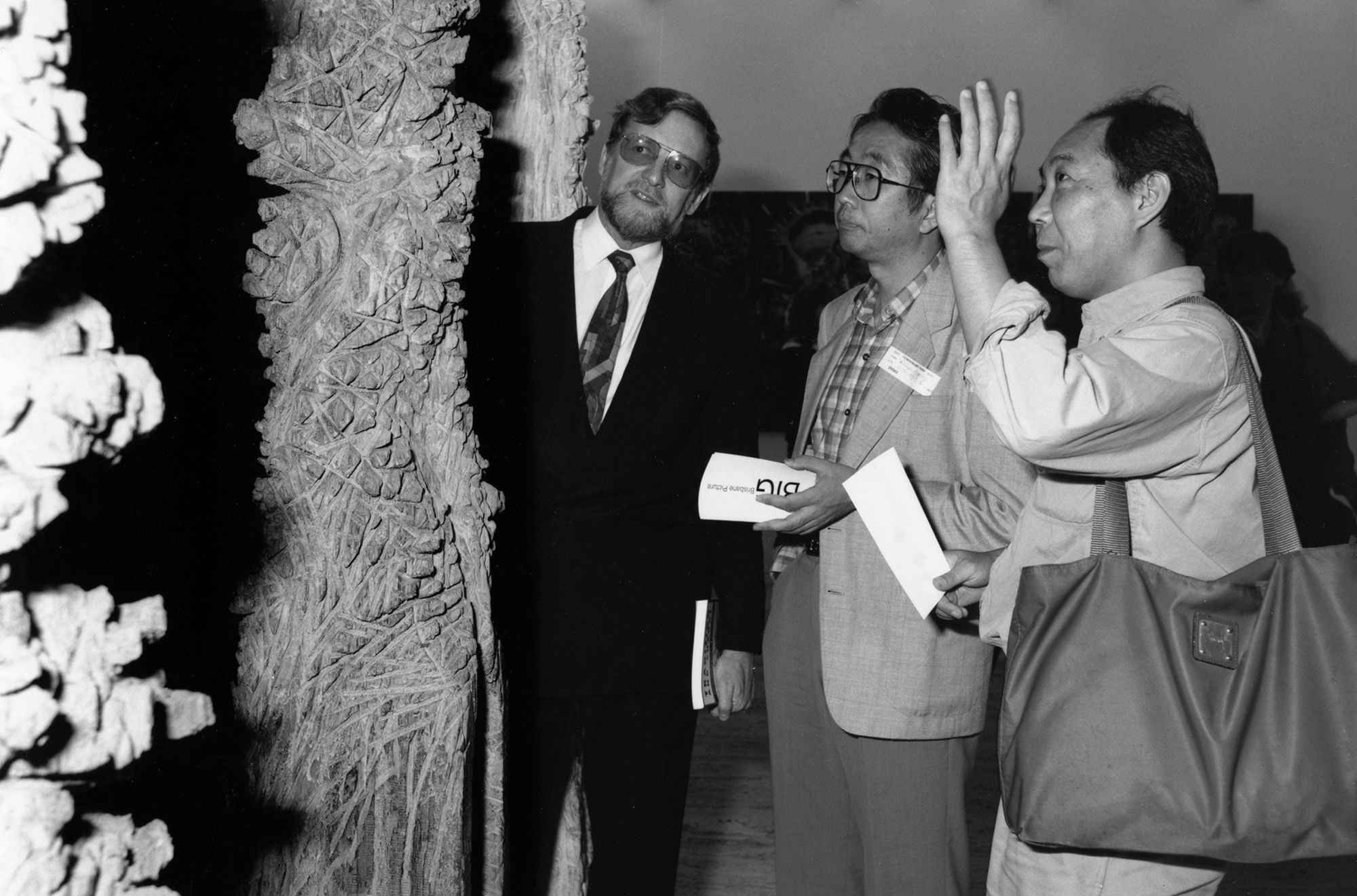
Shigeo Toya (right) at ‘The First Asia-Pacific Triennial of Contemporary Art’, 1993

Shigeo Toya (right) with Gareth Evans, Australian Minister for Foreign Affairs (left) and Hidekazu Izui, Curator and Chief of Planning Section, the Museum of Modern Art, Saitama with Woods III 1991-92 at ‘The First Asia-Pacific Triennial of Contemporary Art’, 1993 / Photograph: © QAGOMA / View full image
Toya continued to iterate and exhibit versions of Woods throughout his life, excavating the interiors of more than 350 totemic trees, alongside several other series. In 2019, he initiated a new group of works titled ‘Body of the Gaze’, in which he gave form to the idea that the world is constructed and carved by the gaze, and that an invisible realm can be implied through what he termed ‘semi-sculpture’. In recent years, Toya’s career has been celebrated with major surveys at the Nagano Prefectural Art Museum (2022) and at the Museum of Modern Art, Saitama (2023).
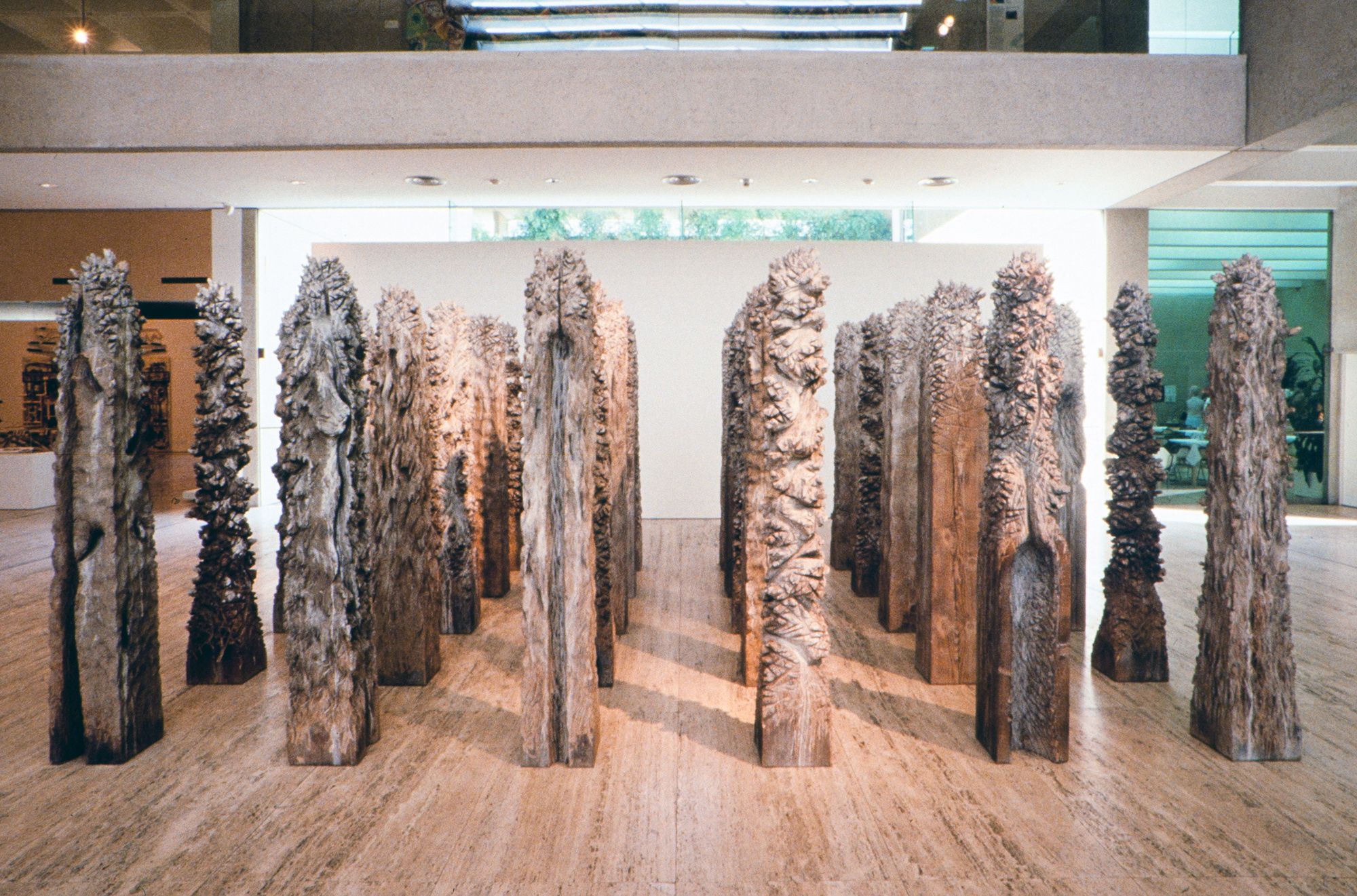
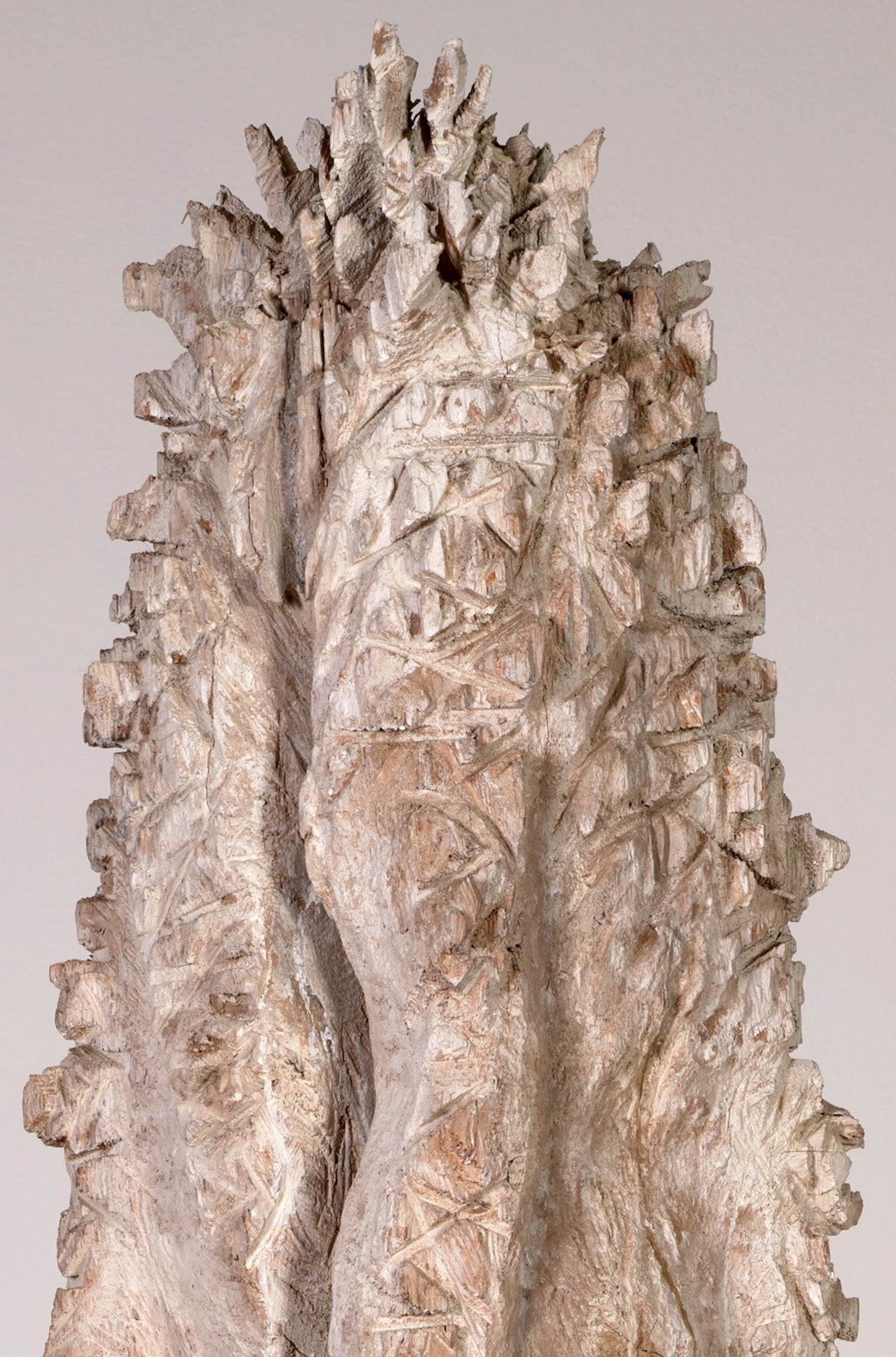
Shigeo Toya Woods III (and detail) 1991-92

A view of Shigeo Toya’s Woods III 1991-92 (The Kenneth and Yasuko Myer Collection of Contemporary Asian Art. Purchased 1994 with funds from The Myer Foundation and Michael Sidney Myer through the QAG Foundation and with the assistance of the International Exhibitions Program) with Lee Ufan’s From line (private collection), QAG, March 2024 / Photograph: Chloë Callistemon © QAGOMA / View full image

Woods III, arranged in its precise five-by-six grid of two-metre-plus pillars, makes for a ghostly, even alien, presence whenever it is installed. Since its commanding debut in the first Asia Pacific Triennial, the work has appeared in several exhibitions, including the extensive survey of Hesei-era art titled ‘We Can Make Another Future: Japanese Art after 1989’ at the Gallery of Modern Art (GOMA) (2014–15) and, most recently, as the centrepiece of ‘Inscriptions and Excavations’ at QAG (2024–25). Toya’s work will now stand as a monument to the artist, whose rigorous philosophical approach to his work nonetheless drew from his formative years in the forests of his childhood, and who succeeded ‘in bringing the invisible into a level of existence’.[3]

Shigeo Toya, Japan 1947-2026 / Woods III (detail) 1991-92 / Wood, ashes and synthetic polymer paint / 30 pieces: 220 x 30 x 30cm; 220 x 530 x 430cm (installed) / The Kenneth and Yasuko Myer Collection of Contemporary Asian Art. Purchased 1994 with funds from The Myer Foundation and Michael Sidney Myer through the QAG Foundation and with the assistance of the International Exhibitions Program / Collection: Queensland Art Gallery | Gallery of Modern Art / © Shigeo Toya Estate / Photograph: © QAGOMA / View full image
Queensland Art Gallery | Gallery of Modern Art (QAGOMA)
Brisbane, Australia
Endnotes
- ^ Jonathan Goodman. ‘Out of the woods: A conversation with Shigeo Toya’, Sculpture, vol.40, no.6, Nov–Dec 2021, pp.60–73.
- ^ Artist statement from ‘First Kiev Biennale of Contemporary Art’ (2012), quoted in Reuben Keehan, We Can Make Another Future [exhibition catalogue], Queensland Art Gallery | Gallery of Modern Art, Brisbane, 2014, p.44.
- ^ Takeshi Kanazawa, ‘Japan: Shigeo Toya’ in The First Asia-Pacific Triennial of Contemporary Art [exhibition catalogue], Queensland Art Gallery, Brisbane, 1993, p.77.