
The Heidelberg School — a new direction for Australian art

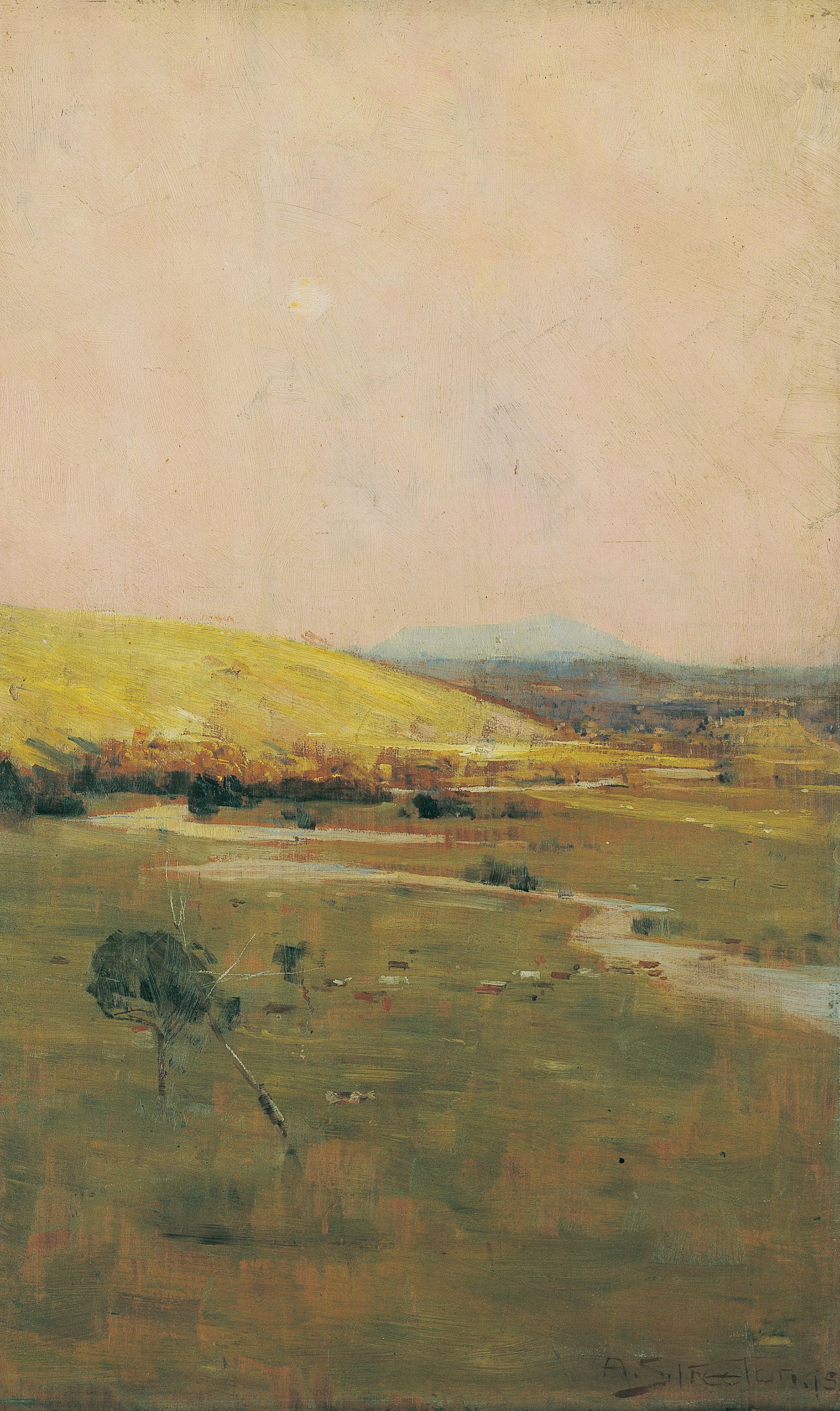
Arthur Streeton, Australia 1867–1943 / Sketch for 'Still glides the stream and shall forever glide' 1895 / Oil on cedar panel / 42 x 26.5cm / Gift of Lady Trout 1978 / Collection: Queensland Art Gallery | Gallery of Modern Art / View full image
In 1885, three young artists — Frederick McCubbin (25 February 1855–1917), Tom Roberts (8 March 1856–1931) and Louis Abrahams (1852–1903) — set up an artists’ camp at Box Hill, Victoria. The trio shared an interest in French Impressionism, advocated painting en plein air (‘out of doors’), and sought to capture fleeting atmospheric effects. Charles Conder (24 October 1868–1909), who had been exploring similar approaches in Sydney, and Arthur Streeton (8 April 1867–1943), whom McCubbin met while painting at Beaumaris on Port Phillip Bay, soon joined them.
Affecting a Bohemian attitude and communing with nature, the group made excursions to the bayside suburb Mentone, and nearby beaches, some 20 km southeast of the Melbourne CBD. Camps were also held at Eaglemont, 10 km north-east, where Streeton and Conder shared a cottage and gave lessons to students from the National Gallery School — established in 1867, at the time was Australia's premier academic art training institution — and at Heidelberg, adjacent to Eaglemont, from which the ‘Heidelberg School’ derives its name.
Arthur Streeton June evening, Box Hill 1887

Arthur Streeton, Australia 1867–1943 / June evening, Box Hill 1887 / Oil on canvas laid down on composition board / 55.9 x 76.3cm / Gift of the family of the late Hon T C Beirne MLC through the National Gallery Society of Queensland 1954 / Collection: Queensland Art Gallery | Gallery of Modern Art / View full image
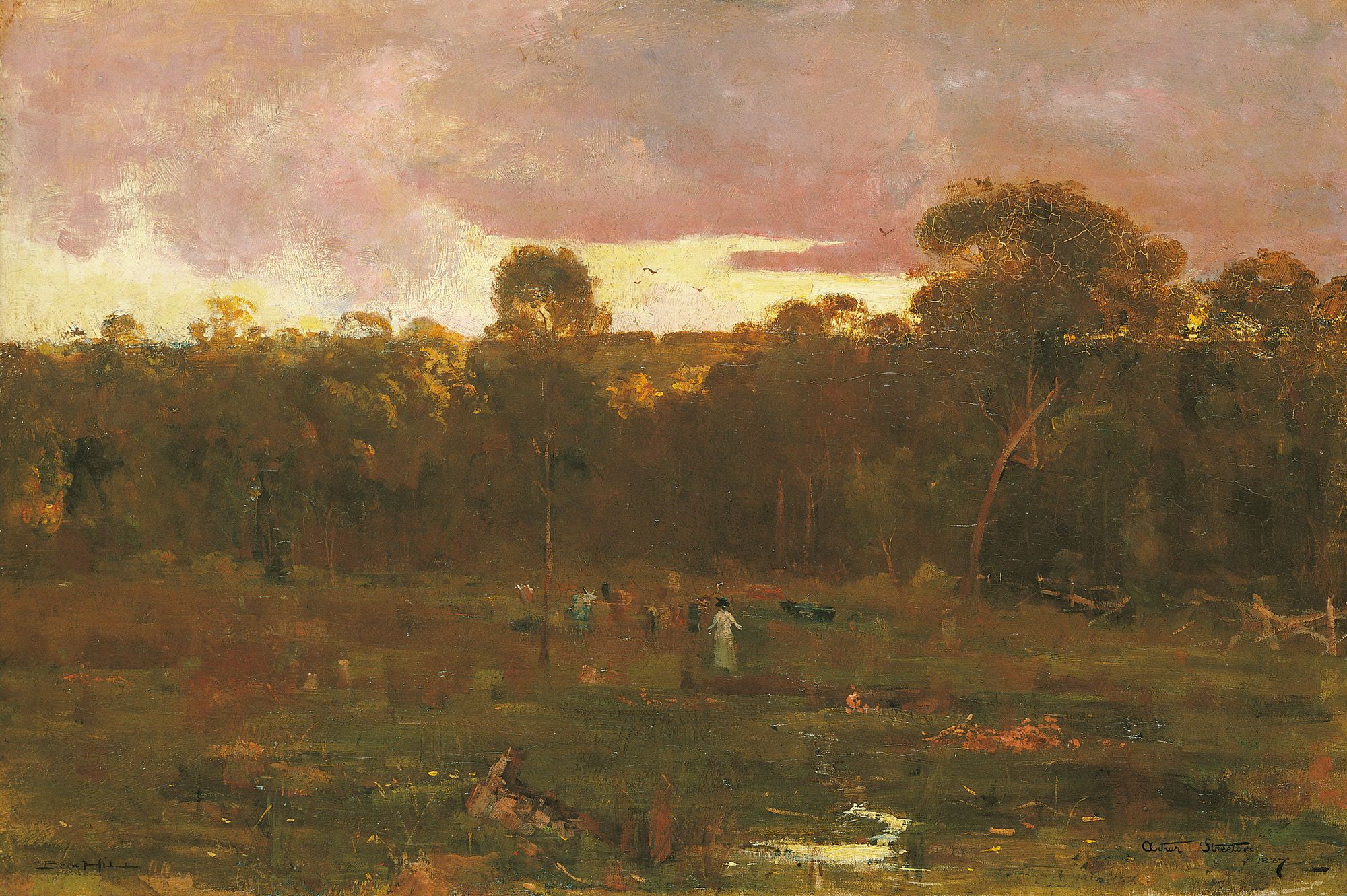
In June evening, Box Hill 1887 (illustrated), an important early work by Streeton painted shortly after he joined Roberts and McCubbin at their Box Hill weekend camps: Box Hill and Heidelberg are relatively close to each other, located about 8 km apart. Streeton took the eastern sky at sunset and the rosy flush of the afterglow as his subject, rather than the conventional view of the western sky — an idea the artist credited to Roberts. The reviewer in the Argus (7 October 1887) wrote:
'Mr Arthur Streeton's June Evening at Box-hill is an impression of nature of which most artists will recognise the force and value. A slant ray of light from the setting sun glances on the tops of the trees in the second plane of the picture, and the landscape in the foreground is already enveloped in misty shadow, save where a small pool of water reflects the amber light in the west, while the cloudy sky above, with a lower stratum of vapour, tinged by the sunset, is handled with characteristic ability’.
The Heidelberg painters defined a new direction for Australian art, drawing on domestic, semi-rural landscapes and urban life as impetus for a national ‘school’ of painting. The group frequently painted on cigar-box lids (measuring approximately nine by five inches) and other small panels, which enabled them to record impressions in the field quickly.
In 1889, they showed a total of 182 works in the ‘9 x 5 Impression Exhibition’, the first self-consciously avant-garde exhibition in Australia. The scale and sketchiness of these artworks attracted some criticism. In their defence, the artists stated:
'Any effect of nature which moves us strongly by its beauty, whether strong or vague in its drawing, defined or indefinite in its light, rare or ordinary in colour, is worthy of our best efforts'.
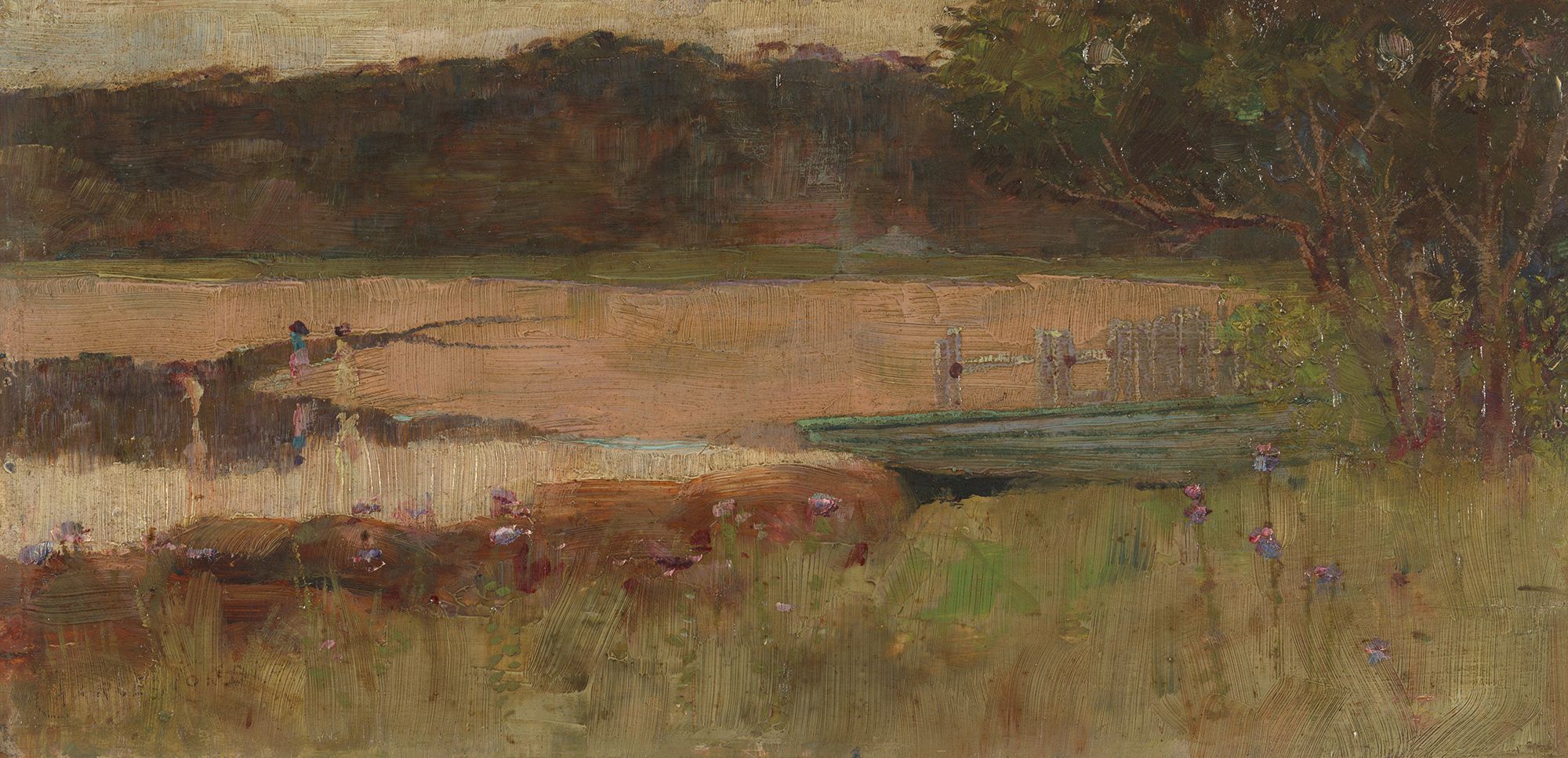
Charles Conder Quiet beach 1887–88

Charles Conder, England/Australia 1868–1909 / Quiet beach 1887–88 / Oil on wood panel / 16.2 x 31.1 cm / Purchased 1952. Maria Theresa Treweeke Bequest / Collection: Queensland Art Gallery | Gallery of Modern Art / View full image
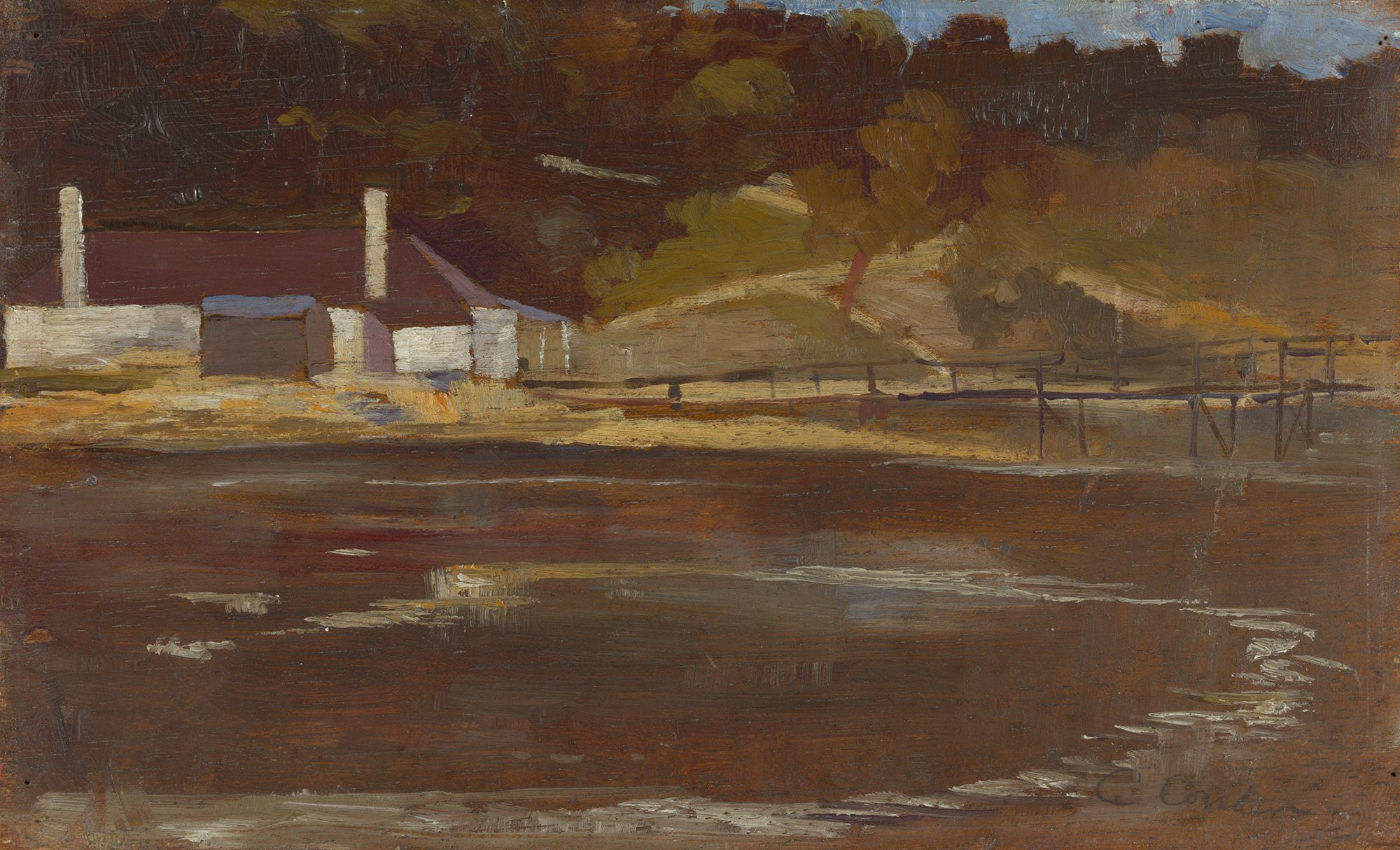
Charles Conder The little jetty c.1888

Charles Conder, England/Australia 1868–1909 / The little jetty c.1888 / Oil on wood panel / 10.8 x 19cm / Purchased 1953 / Collection: Queensland Art Gallery | Gallery of Modern Art / View full image
Conder contributed 46 paintings to the exhibition and designed the cover for the catalogue. In his work Quiet beach 1888 (illustrated), the tranquil mood carries overtones of a lost paradise, unspoilt and sparsely populated. Conder exploits the horizontal focus of the composition to establish decorative contrasts. The verticals of the bridge and the three figures with their reflections balance each other, while the foreground flowers unify and direct attention to the curve of the sandy beach, which leads the eye upwards to Conder's characteristic high horizon line.
Arthur Streeton The road up the hill c.1889

Arthur Streeton, Australia 1867–1943 / The road up the hill c.1889 / Oil on cardboard / 22.8 x 13.2 cm / Purchased 1956 / Collection: Queensland Art Gallery | Gallery of Modern Art / View full image
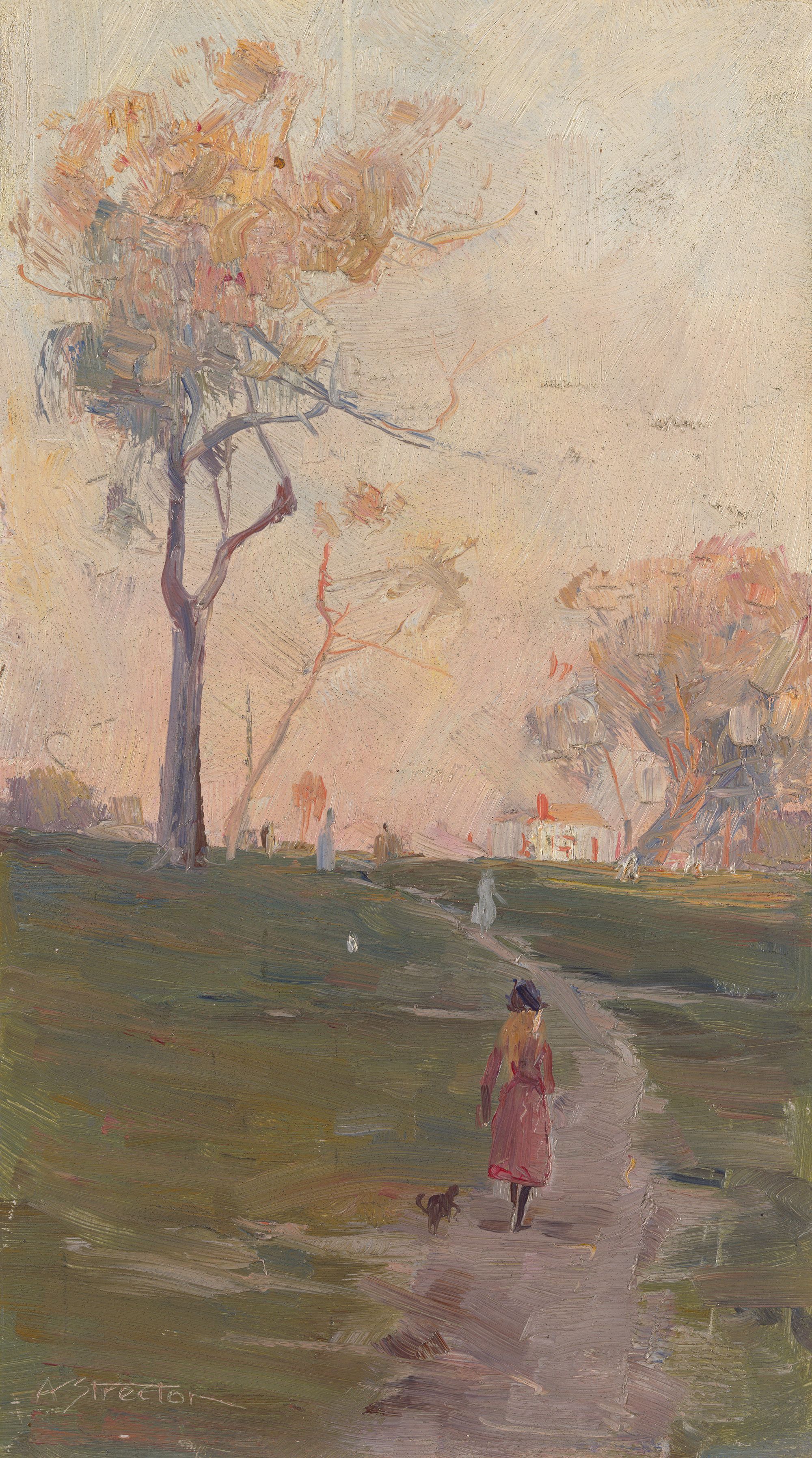
In the summer of 1888–89 Streeton founded the Eaglemont camp, later in 1889 he contributed 40 works to the '9 x 5’ Exhibition and The road up the hill c.1889 (illustrated) was probably shown as it may be identical with a work exhibited under another title. The painting relates to a passage from Thomas Hardy's Far from the madding crowd, which Streeton was reading at the time.
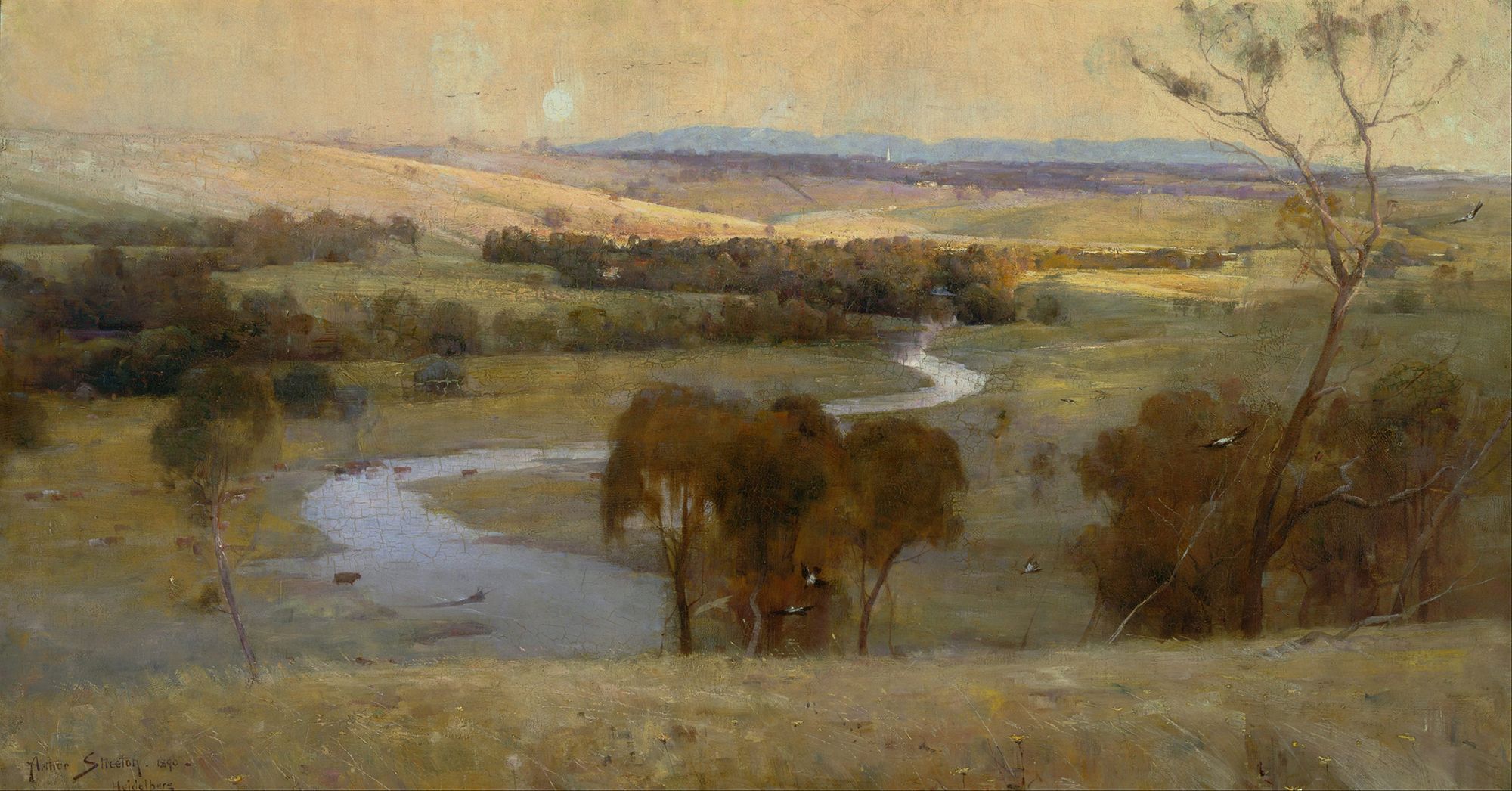
Streeton moved to Sydney in June 1890, following the sale of his painting Still glides the stream, and shall for ever glide (illustrated) to the Art Gallery of New South Wales. Sketch for 'Still glides the stream and shall forever glide' 1895 (illustrated) is a preparatory study for this major painting, the first work by Streeton to enter a public collection. Curiously, however, QAGOMA’s work is dated five years later, the artist may have brought the sketch up to a more finished quality. The scene depicts the Yarra River as it meanders through pasture land near Heidelberg.
The title of the work is drawn from the English Romantic poet William Wordsworth’s Sonnets from the River Duddon 1820, which follows the river from its source to the sea. For Streeton, the Australian landscape evoked the kinds of emotions he experienced when reading poetry.
I thought of Thee, my partner and my guide,
As being pass'd away. — Vain sympathies!
For, backward, Duddon! as I cast my eyes,
I see what was, and is, and will abide;
Still glides the Stream, and shall for ever glide;
The Form remains, the Function never dies ...
Arthur Streeton Still glides the stream, and shall for ever glide 1890

Arthur Streeton, Australia 1867–1943 / Still glides the stream, and shall for ever glide 1890 / Oil on canvas, later mounted on hardboard / 79.5 x 150.5 cm sight / Purchased 1890 / Collection: Art Gallery New South Wales / View full image
Arthur Streeton Sketch for 'Still glides the stream and shall forever glide' 1895

Arthur Streeton, Australia 1867–1943 / Sketch for 'Still glides the stream and shall forever glide' 1895 / Oil on cedar panel / 42 x 26.5cm / Gift of Lady Trout 1978 / Collection: Queensland Art Gallery | Gallery of Modern Art / View full image
On display in Australian Art Collection
Queensland Art Gallery
Galleries 10, 11, 12 & 13 (Josephine Ulrick and Win Schubert Galleries)
Queensland Art Gallery | Gallery of Modern Art (QAGOMA)
Brisbane, Australia