
Bridget Riley creates a wonderous optical illusion

Bridget Riley, England b.1931 / Big Blue 1981–82 / Oil over synthetic polymer paint on linen / 235.3 x 202cm / Purchased 1984 / Collection: Queensland Art Gallery | Gallery of Modern Art / © Bridget Riley / View full image
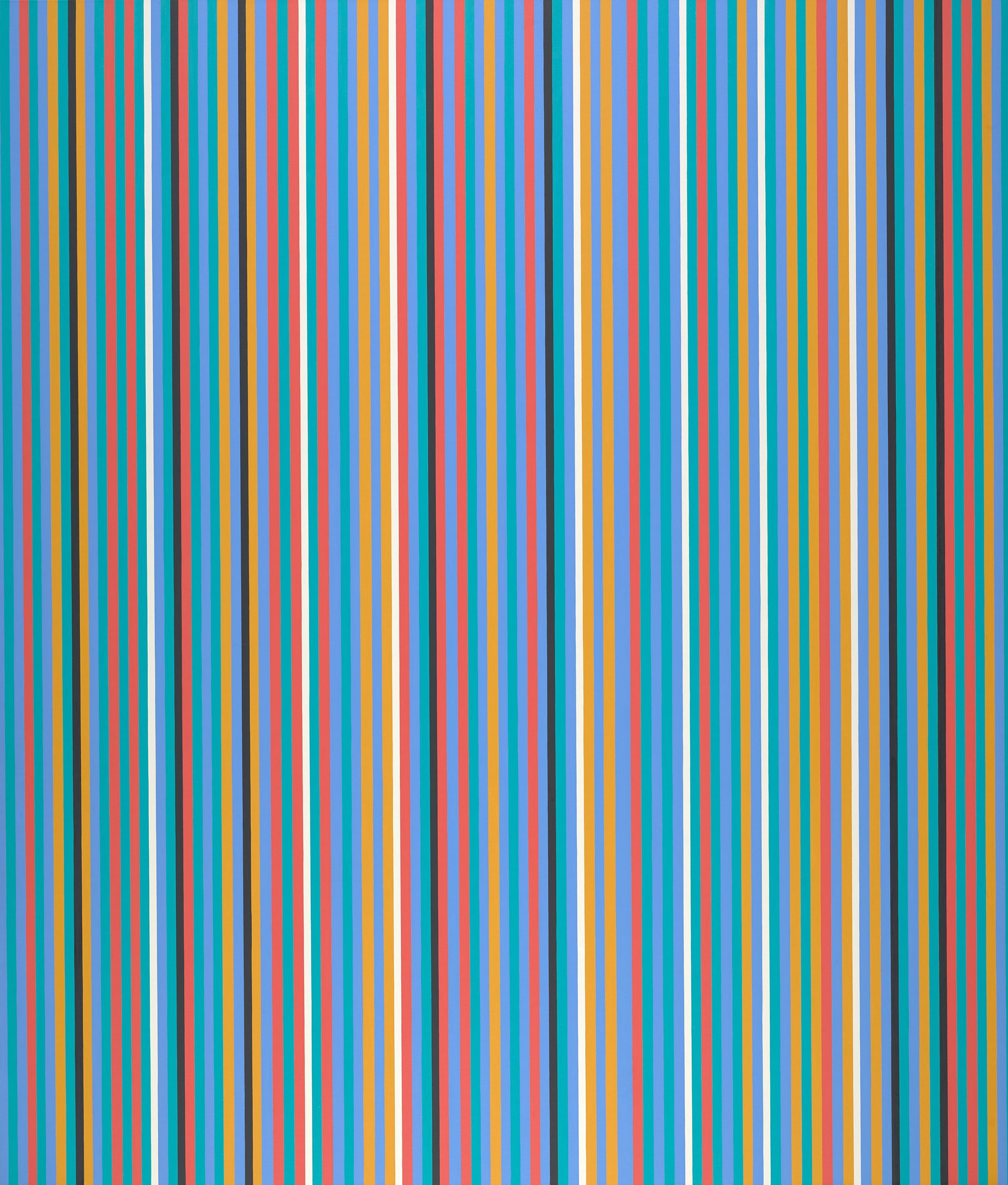
Big Blue 1981–82 creates a wonderous optical illusion, where the canvas seems to move before your eyes. Stripes of colours are arranged across the painting’s surface in a way that makes it appear to vibrate with energy. Bridget Riley is renowned for using colour and form to explore the optical limits of the human eye.
Riley's work is often connected with the Op art movement of the 1960s. Op (short for optical) art refers to abstract works that exploit the eye's physical response to different colours and shapes. Whereas Op art was short lived, Riley's work has continued to develop and explore the potential of colour and its relationships.
Big Blue was painted following Riley's visit to Egypt in 1980–81 where she was astounded by the brilliant Mediterranean light and the palette of ancient paintings in the tombs of Luxor, the encounter had a profound effect upon her choice of palette when she returned to England.
As the artist experimented with the colours needed to create the right group, she had a definite feeling of recognition, of having used some before in more subdued states. What was new was the degree of brilliance captured in these colours. Riley reported that what looked like being conceptually a restriction, was not.
The Egyptian palette gave Riley for the first time a basic range of six strong colours — brick red, ochre-yellow, blue, turquoise — which, because of their intensity, demand a return to the simpler form of stripes. Big Blue is made up of the four Egyptian colours arranged in stripes of only slightly differing widths, combined with black and white — the black acts as a strong rhythm which binds it all together and the white provides resting points.
The colour bands refuse to stay where they are. Some retreat, some jump forward; they swell and oscillate simultaneously, teasing the spaciousness and depth assured by the dominance of blue.
The work marks a shift in the artist's practice where sensuous curves were replaced by vertical bands of solid colours, creating a radiant, visually vibrating surface.
Big Blue 1981–82

Bridget Riley, England b.1931 / Big Blue 1981–82 / Oil over synthetic polymer paint on linen / 235.3 x 202cm / Purchased 1984 / Collection: Queensland Art Gallery | Gallery of Modern Art / © Bridget Riley / View full image
Queensland Art Gallery | Gallery of Modern Art (QAGOMA)
Brisbane, Australia