
Making an exhibition together with Olafur Eliasson
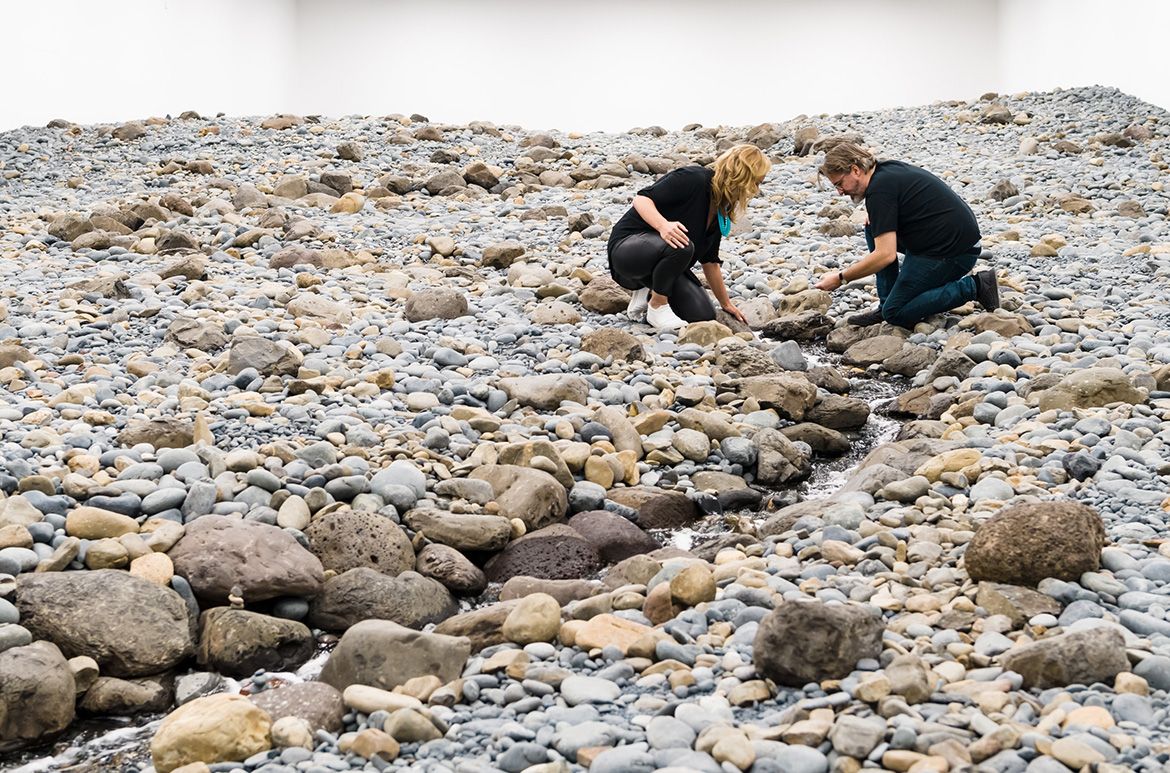
![(l-r) Geraldine Kirrihi Barlow and Olafur Eliasson viewing Riverbed 2014 (installation view, GOMA, 2019) / Water, rock (volcanic stones [blue basalt, basalt, lava], other stones, gravel, sand), wood, steel, plastic sheeting, hose, pumps / Purchased 2021. The Josephine Ulrick and Win Schubert Charitable Trust Collection: The Josephine Ulrick and Win Schubert Charitable Trust, QAGOMA / Collection: Queensland Art Gallery | Gallery of Modern Art / © 2014 Olafur Eliasson](https://cdn.sanity.io/images/m2obzhc2/production/a21fb2e709ef4a68c32555831a5e4df389d4899d-2500x1527.jpg/20191205_nharth_Water_ArtistVisit_OlafurEliasson_030.jpg?rect=760,50,1740,854&w=320&h=157&q=90&fit=crop)
(l-r) Geraldine Kirrihi Barlow and Olafur Eliasson viewing Riverbed 2014 (installation view, GOMA, 2019) / Water, rock (volcanic stones [blue basalt, basalt, lava], other stones, gravel, sand), wood, steel, plastic sheeting, hose, pumps / Purchased 2021. The Josephine Ulrick and Win Schubert Charitable Trust Collection: The Josephine Ulrick and Win Schubert Charitable Trust, QAGOMA / Collection: Queensland Art Gallery | Gallery of Modern Art / © 2014 Olafur Eliasson / View full image

Head of International Art and exhibition curator, Geraldine Kirrihi Barlow, reflects on her experience developing 'Presence' with Olafur Eliasson, opening at Brisbane's Gallery of Modern Art (GOMA) on 6 December 2025.
Tenderness and care are the two words we have returned to repeatedly when speaking of our dreams for this exhibition. They are also qualities I see in Olafur Eliasson’s early memory of a candlelit end-of-day ritual with his grandparents.
My grandparents had a small house on top of a hill, facing north, looking to Snæfellsjökull, ‘Snow Mountain’. On a clear day, you could stand in the window and look across the ocean. Sometimes the glacier would be lit from behind — of course, now it is almost gone. In 1972–73, during the oil crisis, the oil was rationed to save power. Just after dinner, a bell would sound and all the lights went out. My grandma would come with a candle. ‘Let’s all sit by the window, where there’s a bit of light,’ she said. We’d sit together as a family and read, talk, or roll around on the floor if you wanted to. That was very special, because outside the light was really blue, a very intense twilight blue. If the weather was good, the glacier would be spectacular. And then there was this one candle, this burning little piece of fire. Ice and fire, this blue colour and the warm colour on everyone’s faces and skin, like a small campfire. You knew there would be the bell and we’d run to the candle. When you’re five years old, it’s nice to know what’s about to happen. [1] Olafur Eliasson, 2024
Eliasson’s memories from his grandparents’ home holds many elements that have come to define his artistic practice. There is an alertness to different qualities of light: warm or cool; momentary, steady or cyclical; human-made or elemental; solar, electric or candle-powered; near or far; direct, refracted or dispersed. This makes sense given Iceland’s extended winter darkness and ever-light summer days.
There are features of the Icelandic landscape itself: environmental — snow, ocean and glaciers; and human — finding ways to adapt to a challenging environment and appreciating the warm shelter of his grandparents’ home. This memory, like Eliasson’s art, also balances playfulness (rolling around on the floor) with social connection (talking, gathering around a candle or campfire) and moments of personal reflection (reading or gazing out the window), as well as an awareness of the scarcity of resources (oil or sunshine) and the need to find solutions to live with these constraints (the community bell indicating ‘lights out’, and the shared candle).
Finally, Eliasson’s childhood recollection points to further themes that have driven his work, such as the importance of finding points of orientation (Which way is north? Where is the sun?) and a sense of time having special rhythms (repeating patterns, the seasons, an evening ritual, a sense of anticipation, a time to gather).
Geraldine Kirrihi Barlow & Olafur Eliasson at GOMA with Riverbed 2014
![Geraldine Kirrihi Barlow and Olafur Eliasson with Riverbed 2014 (installation view, Gallery of Modern Art, Brisbane 2019) / Water, rock (volcanic stones [blue basalt, basalt, lava], other stones, gravel, sand), wood, steel, plastic sheeting, hose, pumps / Purchased 2021. The Josephine Ulrick and Win Schubert Charitable Trust. Collection: The Josephine Ulrick and Win Schubert Charitable Trust, QAGOMA / Collection: Queensland Art Gallery | Gallery of Modern Art / © 2014 Olafur Eliasson / Photograph: N Harth © QAGOMA](https://cdn.sanity.io/images/m2obzhc2/production/5aadbbc148d00b8ce9996bb187faab49c10bee4c-1170x773.jpg/Blog_RIVERBED-1_OlafurEliasson.jpg?rect=0,2,1170,771&w=320&h=211&q=90&fit=max)
Geraldine Kirrihi Barlow and Olafur Eliasson with Riverbed 2014 (installation view, Gallery of Modern Art, Brisbane 2019) / Water, rock (volcanic stones [blue basalt, basalt, lava], other stones, gravel, sand), wood, steel, plastic sheeting, hose, pumps / Purchased 2021. The Josephine Ulrick and Win Schubert Charitable Trust. Collection: The Josephine Ulrick and Win Schubert Charitable Trust, QAGOMA / Collection: Queensland Art Gallery | Gallery of Modern Art / © 2014 Olafur Eliasson / Photograph: N Harth © QAGOMA / View full image
Visitors to 'Presence' will initially step into views of Iceland. Eliasson has photographed and taken inspiration from Iceland over the course of his career. After this first gallery, there is a sequence of large immersive installations, including Presence 2025 and other new works made especially for Brisbane; and one of the artist's most iconic early experiential works Beauty 1993, which we are thrilled to have brought into the Collection, before exiting the exhibition through Riverbed 2014. Here, we delve into these three incredible installations.
Eliasson himself was born in Copenhagen, Denmark, his parents and ancestors are from Iceland, hence his regular visits there as a child to see his grandparents. Moving between these places allowed Eliasson to think about Iceland from the differing perspectives of insider and outsider, to pay attention to features that a local might take for granted — not only to look at the landscape or effects of light and passage of the seasons, but also to think about the acts and processes of looking, perceiving and moving: the active relationship between our eyes, body and mind; between light, time and space.
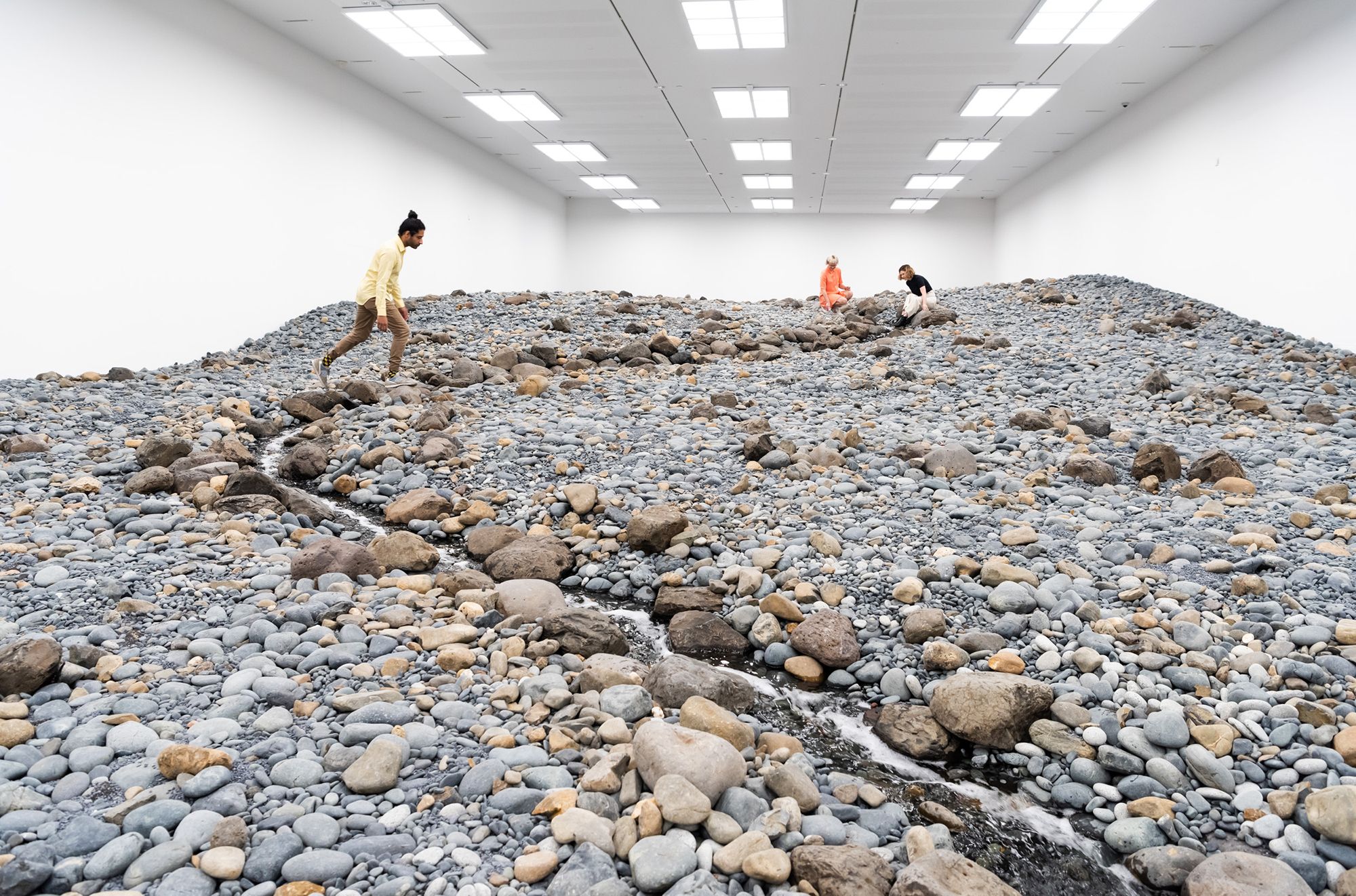
Riverbed 2014 is an expansive museum-scale, installation of rock, sand, pebbles and water — the work was first presented in Brisbane in the exhibition ‘Water’ in 2019. It evokes the wide rocky rivers and formidable landscape of Iceland yet might be many other places. In celebrating the return of this vast work to the Gallery, now a treasured part of the Collection, ‘Presence’ seeks to share something of the origins and deeper context of Riverbed within the artist’s practice.
Through the title, ‘Presence’, we hope to explore this precious quality of aliveness, availability and being, whether sensed within ourselves, as we look to each other, or more broadly, as we consider our relationship to this precious planet.
Riverbed 2014
![Olafur Eliasson, Denmark b.1967 / Riverbed 2014 / Water, rock (volcanic stones [blue basalt, basalt, lava], other stones, gravel, sand), wood, steel, plastic sheeting, hose, pumps / Purchased 2021. The Josephine Ulrick and Win Schubert Charitable Trust / Collection: The Josephine Ulrick and Win Schubert Charitable Trust, QAGOMA / © 2014 Olafur Eliasson / Photograph: N Harth © QAGOMA](https://cdn.sanity.io/images/m2obzhc2/production/2dd3ab53cb1b2968109d2d8c952e7593c3e46392-2000x1322.jpg/WEB-BLOG2000-Olafur%20Eliasson-Riverbed-GOMA_Water_installationview_20191205_nharth_115.jpg?rect=3,0,1995,1322&w=320&h=212&q=90&fit=max)
Olafur Eliasson, Denmark b.1967 / Riverbed 2014 / Water, rock (volcanic stones [blue basalt, basalt, lava], other stones, gravel, sand), wood, steel, plastic sheeting, hose, pumps / Purchased 2021. The Josephine Ulrick and Win Schubert Charitable Trust / Collection: The Josephine Ulrick and Win Schubert Charitable Trust, QAGOMA / © 2014 Olafur Eliasson / Photograph: N Harth © QAGOMA / View full image
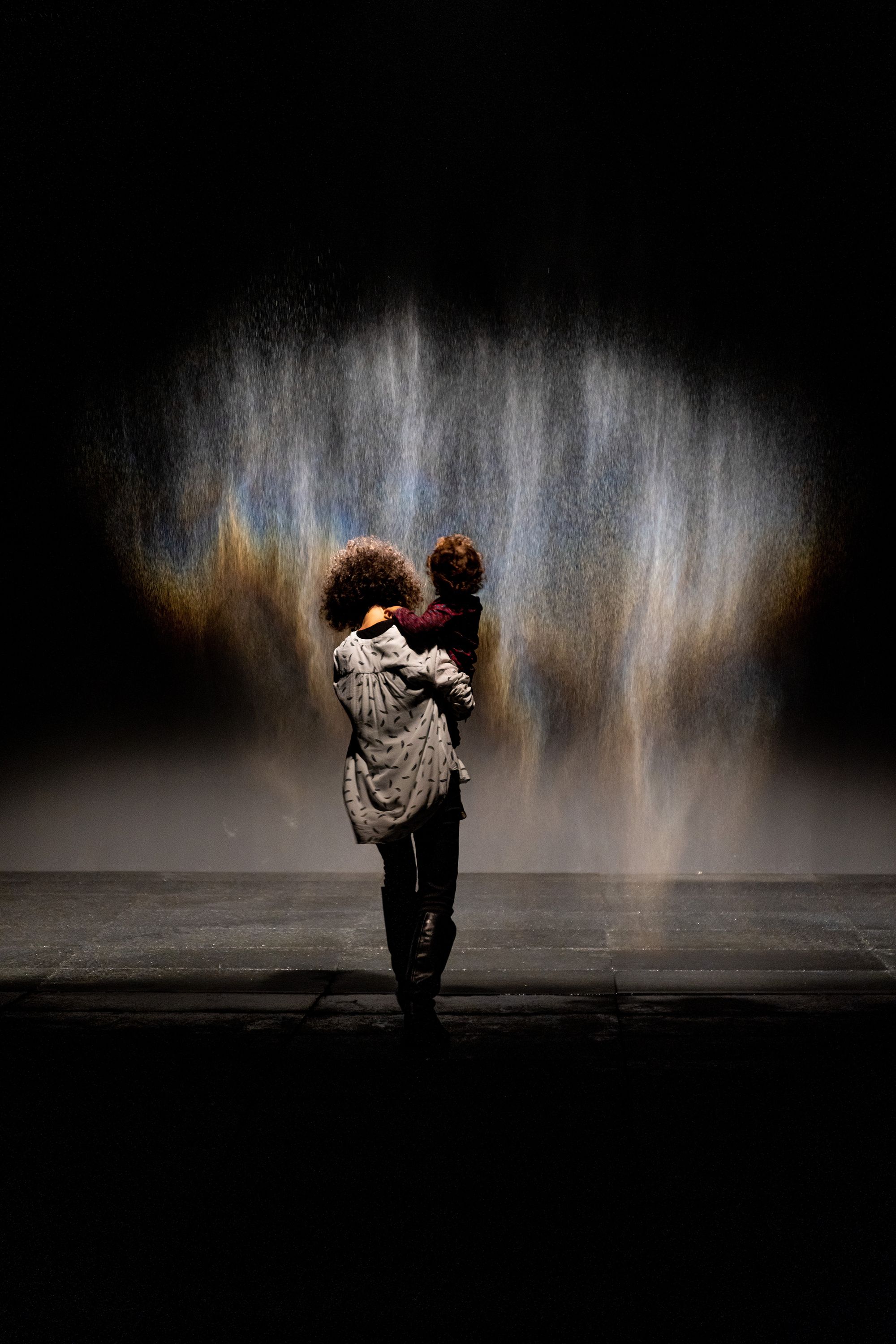
Rainbows recur throughout Eliasson’s practice. Beauty 1993 is one of his first artworks exploring atmospheric and perceptual phenomena, and the earliest work included in ‘Presence’. Here, the rainbow is no longer part of the landscape but is recreated unexpectedly within the gallery. Visitors enter a dark space and slowly let their eyes adjust to the conditions. As we walk towards the light, we realise it illuminates a fine mist of water falling gently from above. As we get closer, suddenly the colours of a rainbow appear. For each person, the rainbow appears differently according to how they journey through the space: it exists for each of us uniquely and privately, even when experienced collectively.
Creating Beauty and learning from people’s responses to the work led the artist to articulate a number of key concerns that continue to underpin his practice: the importance of seeing yourself sensing; the active role of the audience as ‘co-producer’ of the work; viewers’ awareness they are part of a shared experience; an ‘emergence of we-ness’, and collective behaviour in response; the vital place of emotion in experience, ‘feelings are facts’; and, finally, the importance of the audience having access to an understanding of the mechanism or ‘how’ behind an artwork.[2]
Beauty 1993

Olafur Eliasson, Denmark b.1967 / Beauty 1993 (installation view, Fondazione Palazzo Strozzi, Florence, Italy, 2022) / Spotlight, water, nozzles, wood, hose, pump / Purchased 2025. The Josephine Ulrick and Win Schubert Charitable Trust / Collection: The Josephine Ulrick and Win Schubert Charitable Trust, Queensland Art Gallery | Gallery of Modern Art / © 1993 Olafur Eliasson / Photograph: Ela Bialkowska, OKNOstudio / View full image
As a curator, the creative journey through ideas, knowledge, material and aesthetic experiments involved in staging this exhibition has been precious. It has also been unusual, occurring over years and closely undertaken with Eliasson and his colleagues, both from afar and during my time as a guest of Studio Olafur Eliasson in Berlin, over eight weeks in 2024 and again on a shorter return visit that year. Together, we hoped to experiment with how a major exhibition might be developed, to do so differently, and to see what benefits bringing a curatorial perspective into this creative process might achieve for the exhibition.
So, how does art-making become part of this thinking? As we planned the exhibition, Presence 2025 continued to evolve. In the earliest iteration of this work, two angled mirrors created an opportunity to ‘meet’ our reflection many times over, visually creating a ‘circle of selves’. As we planned the exhibition, this work continued to evolve, becoming a circle of wedges each containing a different landscape, before changing shape again to become a single vast 90-degree ‘wedge’ cradling an enormous yellow ‘sun’.
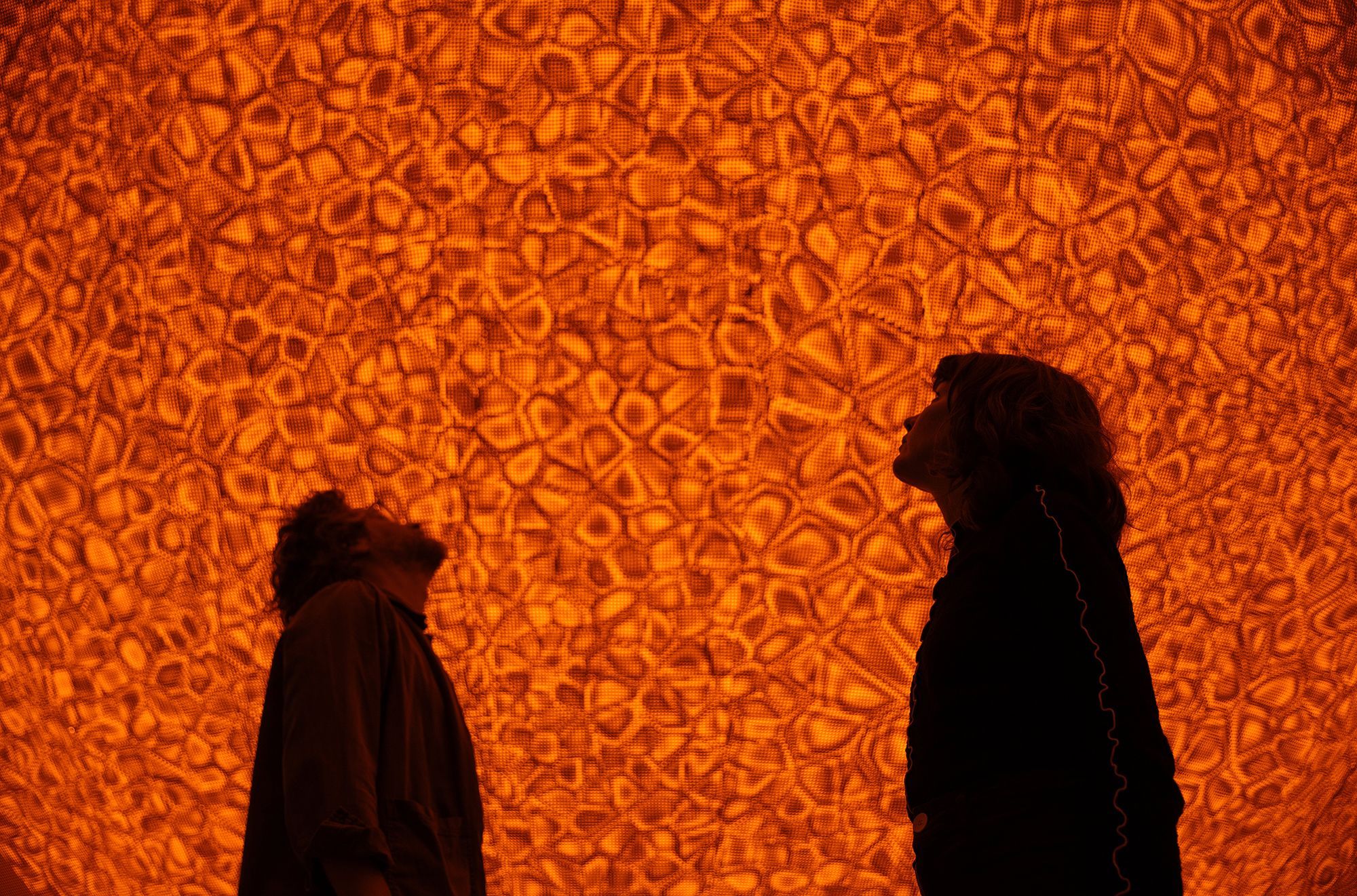
Now, stepping into the room, we will be startled by an enormous yellow sun which appears to push beyond the boundaries of the ceiling. We are in fact looking at one-eighth of a full sphere, its form completed in the mirrors to each side and above. As we move, the surface of the ‘sun’ seems to flare and shift with light and energy. To achieve this, layers of pattern and mesh are interlaced to create a moiré effect. Presence draws deeply from Eliasson’s art-making language — including the ceiling mirror and yellow monofrequency light used to such effect in The weather project, which brought a radiant orange sun into the vast post-industrial spaces of the Turbine Hall at Tate Modern, London, in 2003.
Some of the newest works in 'Olafur Eliasson: Pressence' such as Presence are so ambitious that they haven’t been fully realised or experienced before, just partially tested in the studio before being debuted in Brisbane. So the excitement will be discovering what we actually feel in the presence of these new works...
A sense of that we can surprise and know ourselves in new ways.
A sense of energy, light and hope.
Presence 2025

Olafur Eliasson, Denmark b.1967 / Presence (detail) 2025 / Stainless steel, aluminium, monofrequency lights, printed textile wedges, aluminium perforated sheets, mirror foil, glass mirror, wood / Courtesy: The artist; neugerriemschneider, Berlin; and Tanya Bonakdar Gallery, New York / © 2025 Olafur Eliasson / Photograph: Studio Olafur Eliasson / View full image
Edited extract from ‘Tenderness and care — Making an exhibition together‘ by Geraldine Kirrihi Barlow from Olafur Eliasson: Presence, QAGOMA, 2025.
‘Presence’ is accompanied by an expansive publication produced in collaboration with Eliasson and his studio with contributions from celebrated writers Ceridwen Dovey and Robert Macfarlane, a curatorial essay and extended interview with the artist.
The exhibition is complemented by QAGOMA’s interactive mobile companion, which includes an exhibition guide with curatorial insights, images, and behind-the-scenes videos, and a sense trail that invites visitors to experience selected artworks through gentle sensory prompts. When you buy your ticket to 'Presence', you’ll immediately get access to enhance your visit, so bring your headphones.
Olafur Eliasson: Presence
6 December 2025 – 12 July 2026
Gallery of Modern Art (GOMA)
Gallery 1.1 (The Fairfax Gallery), Gallery 1.2 & Gallery 1.3 (Eric and Marion Taylor Gallery)
Brisbane, Australia
Get tickets to 'Olafur Eliasson: Presence’