
Jardiniere is an example of the sumptuous work produced during Brisbane’s burgeoning pottery industry

JL (James Laurence) Watts, Queensland Australia 1849–1925 / James Campbell & Sons, Queensland Australia 1885–1948 / Jardiniere c.1890 / Earthenware white clay body. The neck modelled with ivy leaves within arches, the swelling body with four sunflowers and leafy branches and the handles modelled as two grotesque masks. Glaze splashed clear brown, green and deep cobalt / 61 x 49 x 32.2cm / Gift of Miss Alison Campbell 1986 / Collection: Queensland Art Gallery | Gallery of Modern Art / View full image
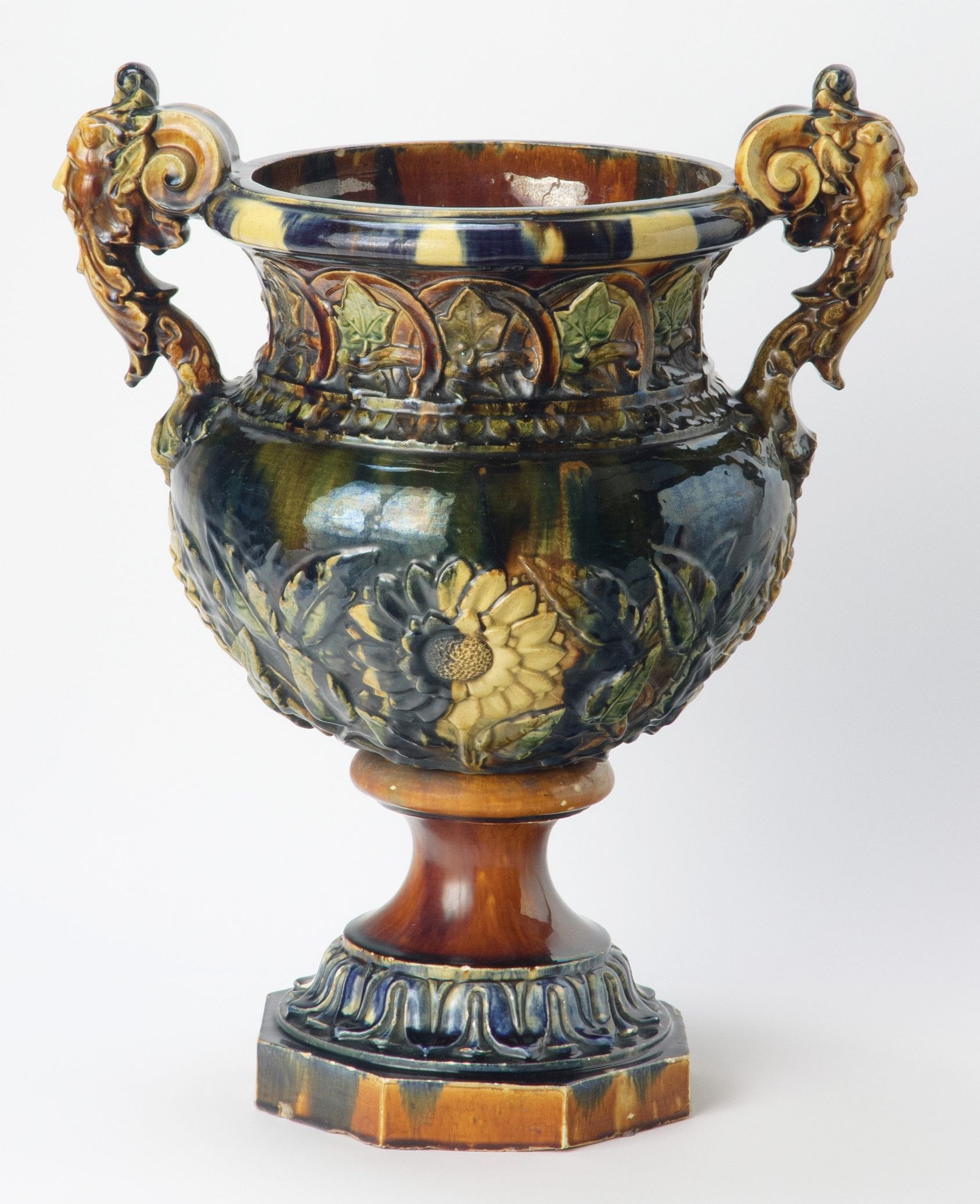
This elaborate Jardiniere c.1890 by JL (James Laurence) Watts (1849–1925) is representative of the neoclassical decorative objects that found popularity in colonial Australia in the late nineteenth century. While based in Brisbane, Watts’s iconography was inspired by a popular appetite for British designs, developed by followers of the Aesthetic Movement (c.1860–1900) who favoured ornate decorations drawn from diverse sources, including ancient Greece.
Intended as a flowerpot, the Jardiniere references a Greek vessel called a volute krater, named for the spiral flourishes that decorate its handles. Adorned with grotesque masks and a string of ivy that refers to ancient Greek decorative traditions, the pot’s prominent sunflower motifs were fashionable during the Victorian Aesthetic Movement, symbolising happiness and aesthetic appreciation due to their ability to turn towards the sun. In these respects, the Jardiniere is an example of the sumptuous work produced during Brisbane’s burgeoning pottery industry and the diverse European touchpoints that influenced decorative objects in the colony.
Jardiniere c.1890

JL (James Laurence) Watts, Queensland Australia 1849–1925 / James Campbell & Sons, Queensland Australia 1885–1948 / Jardiniere c.1890 / Earthenware white clay body. The neck modelled with ivy leaves within arches, the swelling body with four sunflowers and leafy branches and the handles modelled as two grotesque masks. Glaze splashed clear brown, green and deep cobalt / 61 x 49 x 32.2cm / Gift of Miss Alison Campbell 1986 / Collection: Queensland Art Gallery | Gallery of Modern Art / View full image
The relationship between art and industry was a topic of serious concern in nineteenth century England and notable designers worked for the major manufacturers: George Tinworth at Doultons (founded 1815), Christopher Dresser for Hukin & Heath (founded 1855).
Watts, Queensland's most significant early sculptor had an association with Brisbane’s major pottery manufacturer, James Campbell & Sons. This impressive Jardiniere would easily pass as a product of an English factory, the finely modelled grotesque mask handles, the four sunflowers indicative of the 'aesthetic' taste, the splashed brown, green, clear and cobalt majolica glaze etc. perfectly reflect English tastes.
Watts studied at the Royal College of Art, South Kensington and was employed in the building industry in London before he and his family arrived in Brisbane late 1884, then actively involved in the artistic life of Brisbane.
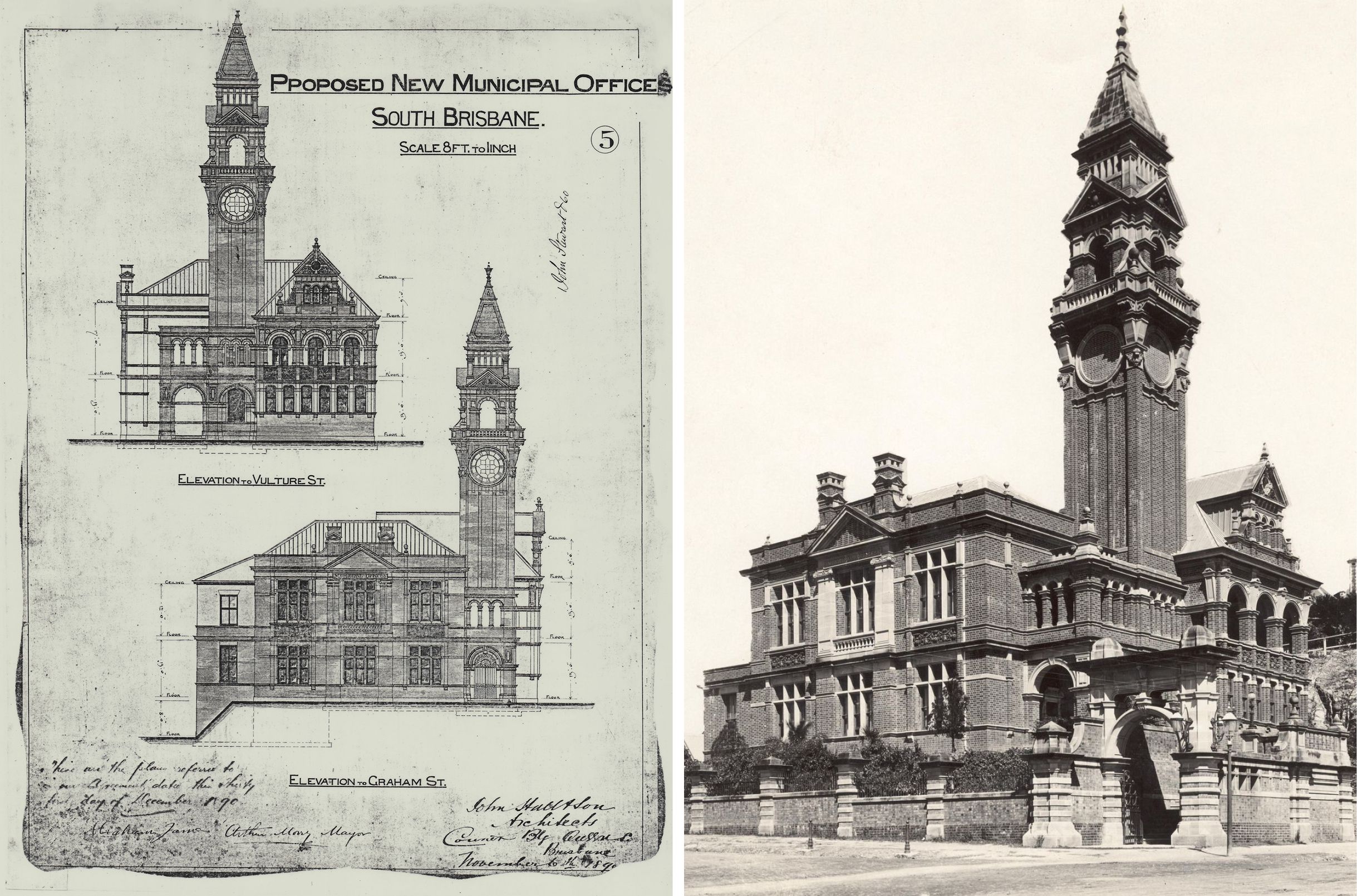
Of note, Watts also modelled the terracotta tympanium for the South Brisbane Municipal Chambers (now heritage-listed) which opened in 1892 on the corner of Vulture and Graham Streets in South Brisbane. The building’s terracotta panelling, which forms the intricate architraves and the main tympanum, was created by James Campbell & Sons.
The firm of James Campbell (Established 1854), later to become James Campbell & Sons Limited in 1882, was one of Brisbane’s earliest importers then manufacturers of building materials, operating until the mid-1900s. With a reputation to be able to supply 'Everything for Building', their comprehenisive range included lime, cement, plaster, timber products, bricks and pottery, and painting supplies for the young colony’s growing demand for construction supplies.
South Brisbane Municipal Offices

(l-r) South Brisbane Municipal Offices Proposed Elevations, 1890; Item ID ITM1684408; Courtesy: Queensland State Archives / South Brisbane Municipal Offices, c.1892; Courtesy: Mobsby Collection, Fryer Library, University of Queensland / View full image
Delve into the QAGOMA Collection
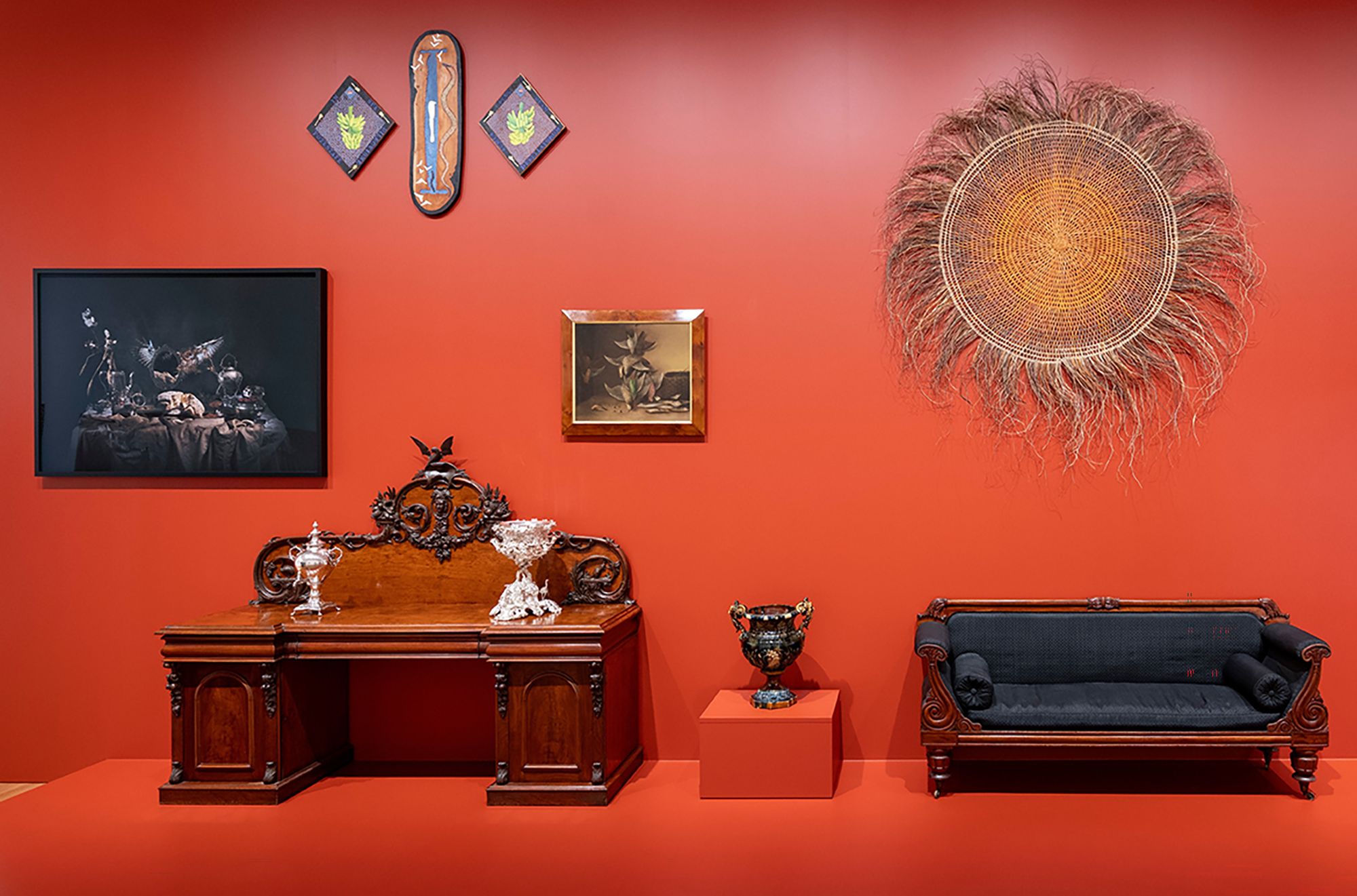
A partner to the elaborate Queensland colonial earthenware Jardiniere c.1890 is the 'Glengallan' sideboard 1868. The magnificent sideboard — the carving attributed to Matthew Fern (1831–98) — is one of Queensland's most significant examples of colonial furniture. While the backboard depicts the national symbols of an emu and a kangaroo, the inclusion of the lorikeet and pineapple give it a more local flavour.
This cedar sideboard, provenanced to 'Glengallan' outside Warwick in southeast Queensland, is commanding in scale being two metres high and almost two and a half metres wide. An 1868 press report in The Brisbane Courier records the first showing of the sideboard:
'It is satisfactory to know that our beautiful indigenous timbers are coming into favour for cabinet work. We had the pleasure yesterday of inspecting [at] Mr. Ebenston's, Queen-street, a drawing and dining-room suite of furniture, of Queensland woods and Brisbane manufacture and made to order for Mr. John Deschar [sic], Glengallan station, Darling Downs. It is no exaggeration to say that the two suites surpass in strength, beauty and substantiality, anything we have yet seen imported, and we understand the cost will not exceed the imported goods of the same class... It is satisfactory to find that our leading colonists are at last becoming alive to the advantages which our local cabinet makers and upholsterers are able to offer them.'
'Glengallan' sideboard 1868

Joshua Ebenston, Queensland Australia c.1835–77 / Matthew Fern, Queensland Australia 1831–98 / 'Glengallan' sideboard 1868 / Cedar, carved / 198 x 242 x 70cm / Purchased 1995 with funds from the Australian Decorative & Fine Arts Society (Brisbane) Inc. through and with the assistance of the QAG Foundation and the QAG Foundation Grant.Celebrating the Queensland Art Gallery's Centenary 1895–1995 / Collection: Queensland Art Gallery | Gallery of Modern Art / View full image


Australian Art Collection, Queensland Art Gallery, Gallery 10 (Josephine Ulrick and Win Schubert Galleries) / View full image
On display in the Australian Art Collection
Queensland Art Gallery
Galleries 10, 11, 12 & 13 (Josephine Ulrick and Win Schubert Galleries)
Go back in time to discover Brisbane’s forgotten landmarks, delve into our historical past, and uncover unique stories through the work of Australian artists in QAGOMA’s Collection.
Queensland Art Gallery | Gallery of Modern Art (QAGOMA)
Brisbane, Australia