
Go back in time when bridges under construction fascinated artists

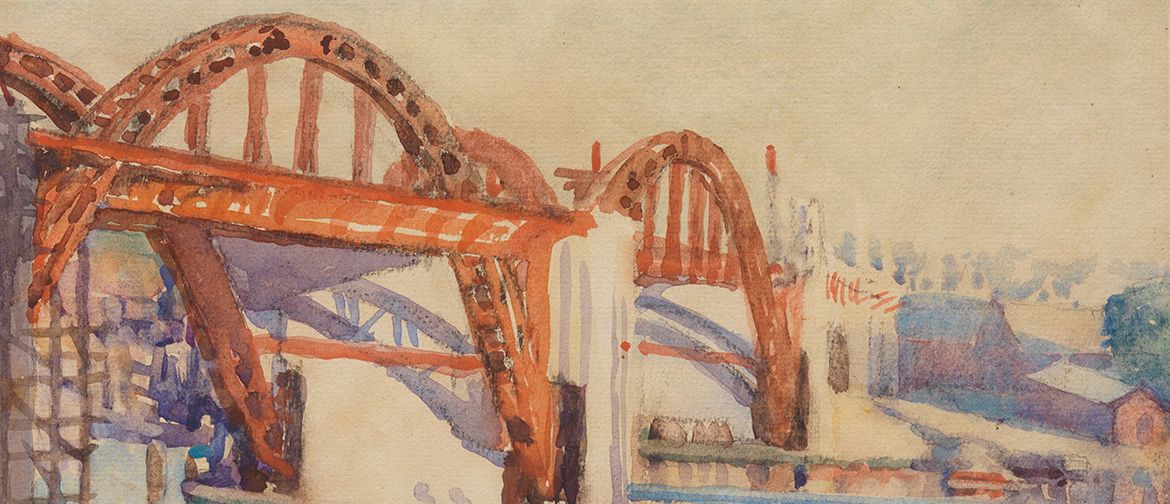
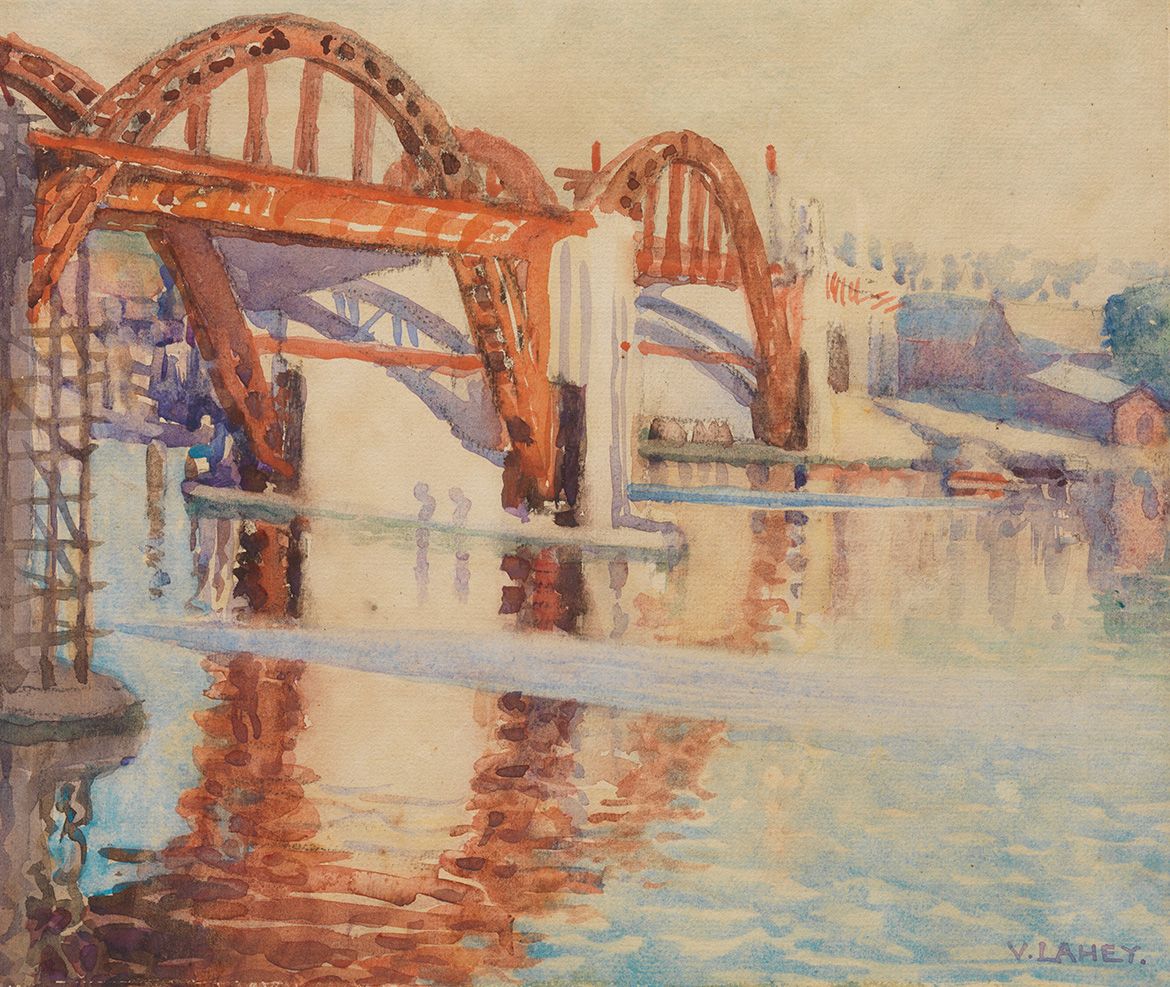
Vida Lahey, Australia 1882–1968 / Building the bridge 1931 / Watercolour and gouache over pencil on wove paper on cardboard / 24.5 x 28.5cm / Gift from the estate of Mrs Gladys Powell 1941 / Collection: Queensland Art Gallery | Gallery of Modern Art / © QAGOMA / View full image
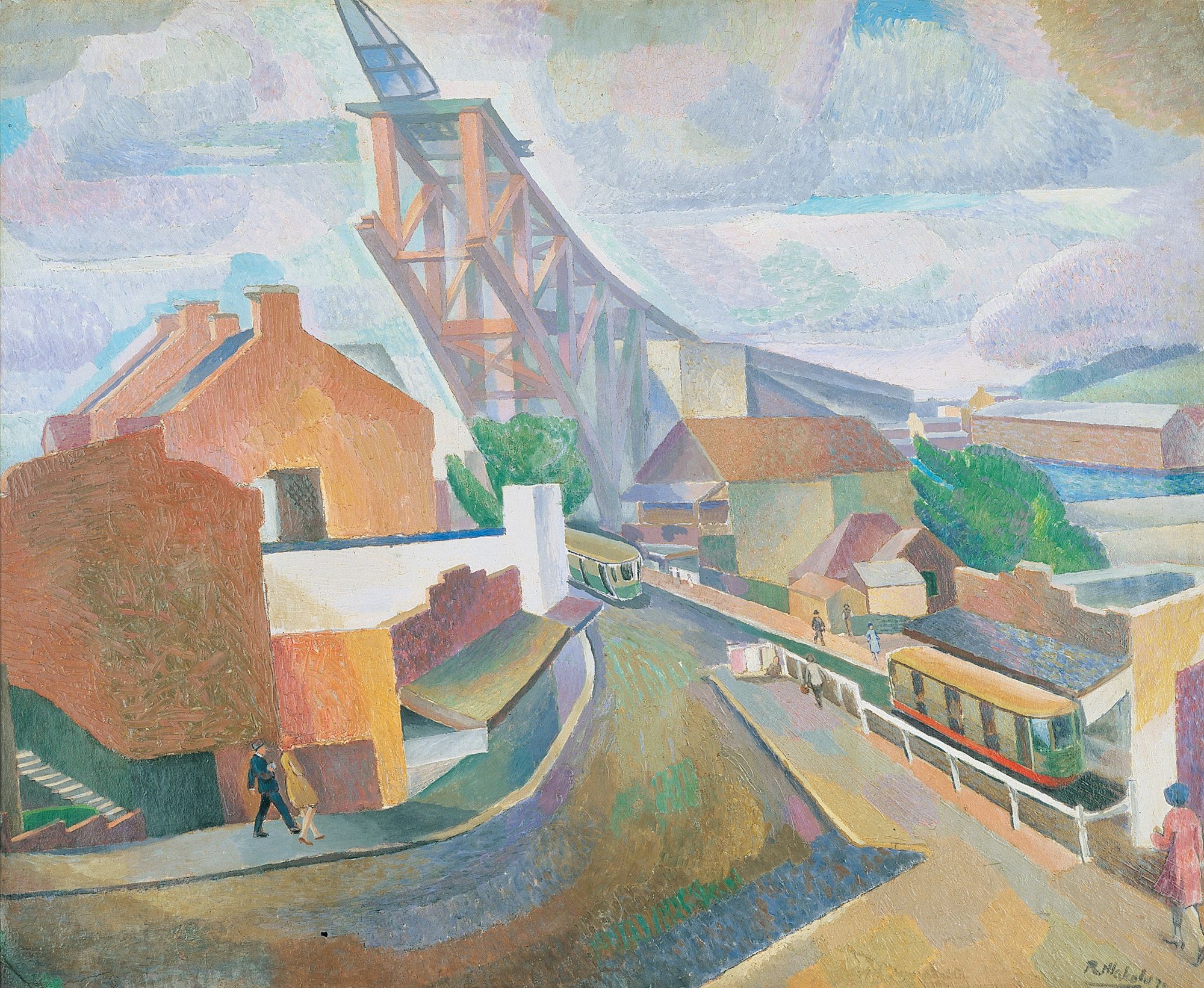
Roland Wakelin's (17 April 1887–1971) subject choice The Bridge under construction 1928 (illustrated) is an indication of the raging interest in the construction of the Sydney Harbour Bridge. During these years the growing curve of the Harbour Bridge fascinated both modern and traditional artists.
The conservative establishment celebrated it as an achievement of the 'heroic' age of engineering design; contemporary artists saw the Bridge as a sweeping arch of steel which seemed to embody all the energy of the time. For Wakelin, the Bridge represented a convergence of the various paths he had undertaken in order to arrive at a 'modernist' practice.
Roland Wakelin The Bridge under construction [Sydney] 1928

Roland Wakelin, New Zealand/Australia 1887–1971 / The Bridge under construction 1928 / Oil on composition board / 96.5 x 118cm / Purchased 1994. QAG Foundation Grant. Celebrating the Queensland Art Gallery's Centenary 1895–1995 / Collection: Queensland Art Gallery | Gallery of Modern Art / © Roland Wakelin Estate / View full image
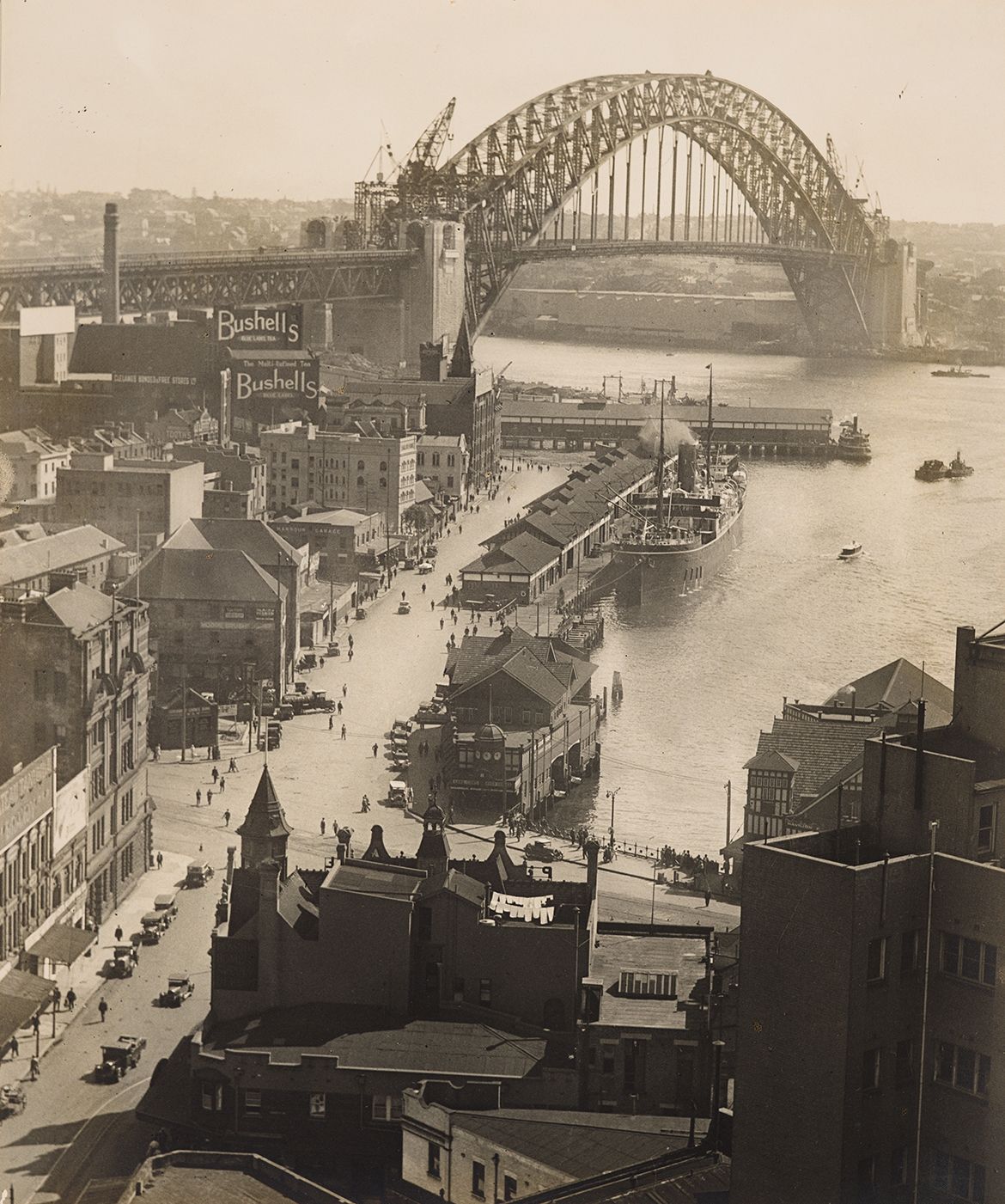
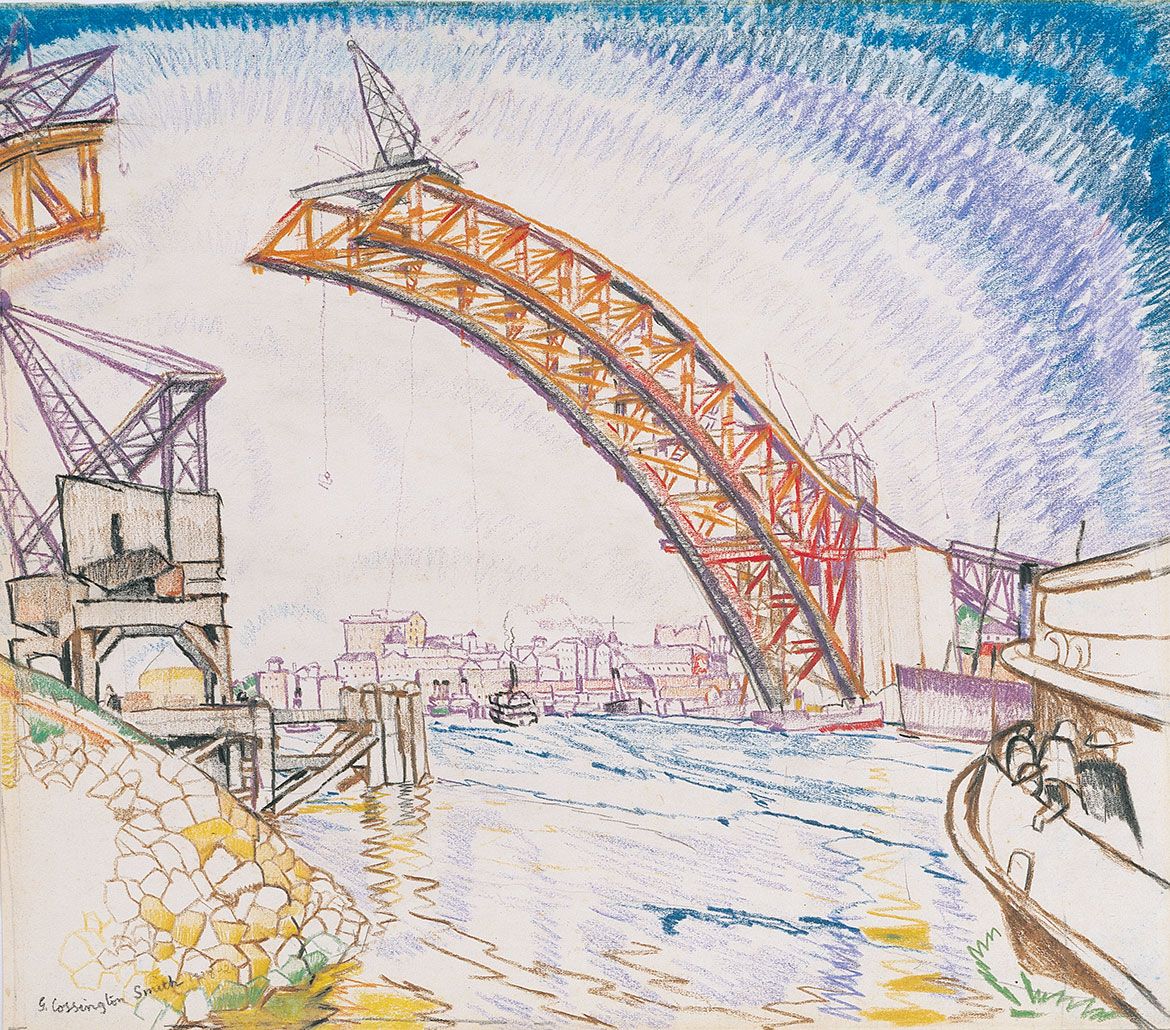
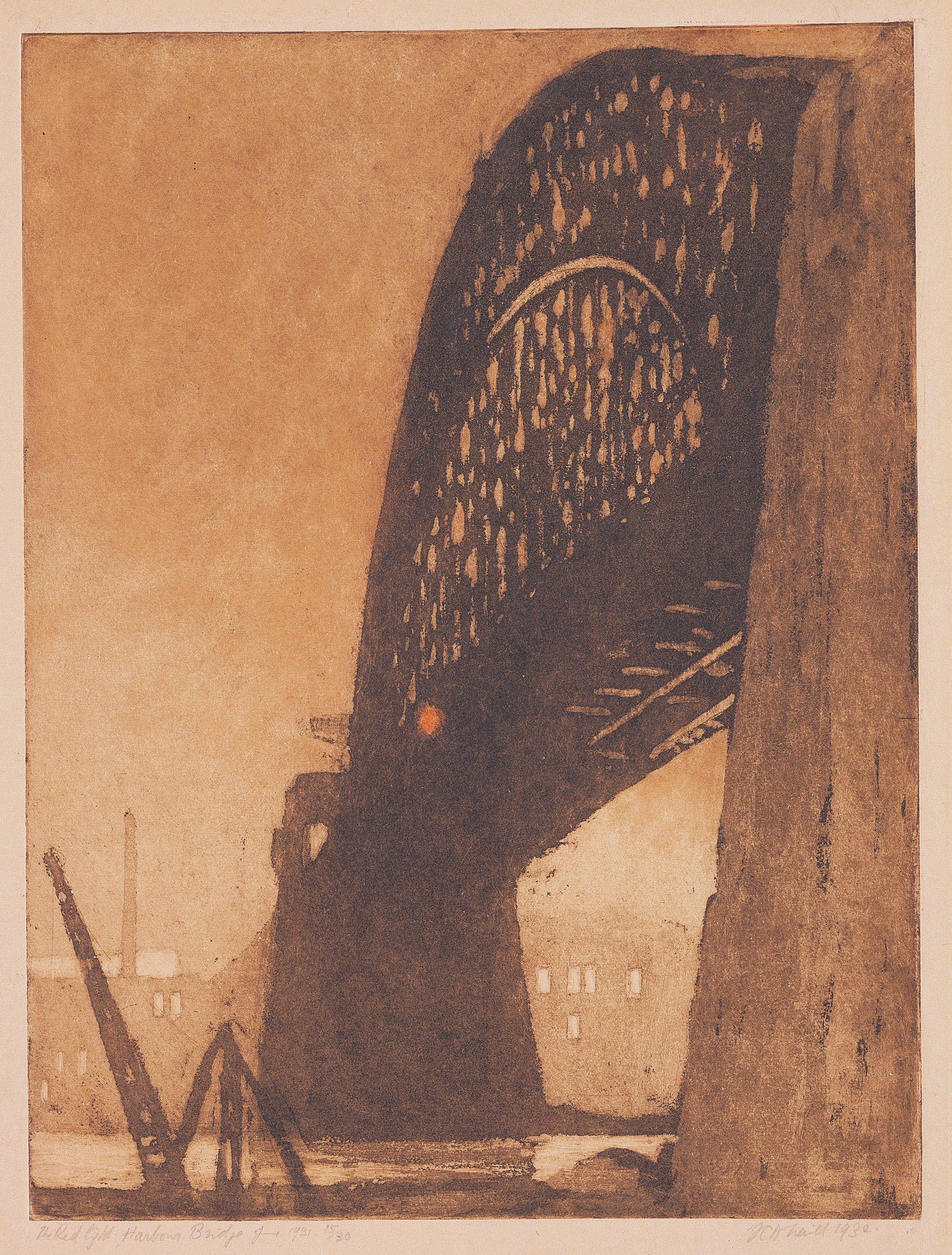
His interest in the project was shared by many other artists and observers. To name just a few, the Bridge was photographed by Harold Cazneaux (illustrated), drawn and painted by Grace Cossington Smith (illustrated), and etched by Jessie Traill, who described it as 'looking like net-work against the evening sky' (illustrated).
Construction of the Bridge began on the approaches to the span in 1923 from Dawes Point and Milsons Point, on the bridge itself in 1925, and concluded in January 1932, with the bridge officially opening on March 19 that year. The building was tracked by continual reports in the daily press which published regular photographs, bulletins and even line drawings of the real and anticipated progress of its construction.
Harold Cazneaux Bridge, West Circular Quay [Sydney] 1931

Harold Cazneaux, Australia 1878–1953 / Bridge, West Circular Quay 1931 / Gelatin silver photograph on paper 30 x 24.3cm / Purchased 2011. Andrew and Lilian Pedersen Trust / Collection: Queensland Art Gallery | Gallery of Modern Art / View full image
Grace Cossington Smith Before the arches met [Sydney] c.1930

Grace Cossington Smith, Australia 1892-1984 / Before the arches met c.1930 / Crayon and coloured pencils over pencil on cream wove paper / 37.8 x 43.4cm / Purchased 1976. Godfrey Rivers Trust / Collection: Queensland Art Gallery | Gallery of Modern Art / © QAGOMA / View full image

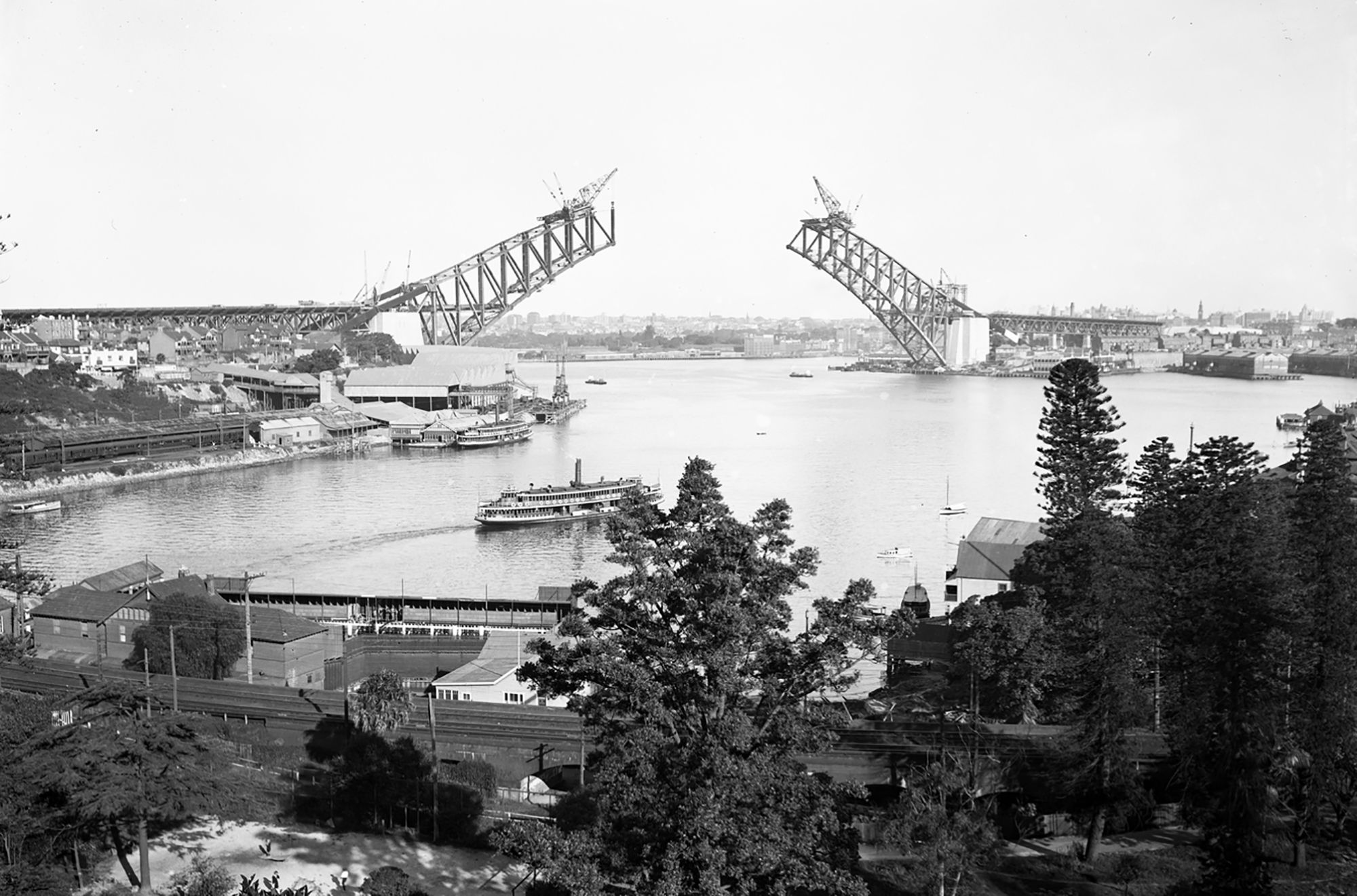
Construction of the Sydney Harbour Bridge, c.1930 / FL383247 / Courtesy: State Library New South Wales / View full image
Jessie Traill The Red Light, Harbour Bridge, June 1931 [Sydney] 1932

Jessie Traill, Australia 1881–1967 / The Red Light, Harbour Bridge, June 1931 1932 / Aquatint, hand-coloured on yellowed Oriental paper / 41.6 x 31.7cm / Purchased 1949 / Collection: Queensland Art Gallery | Gallery of Modern Art / © Jessie Traill/Copyright Agency / View full image
Wakelin utilised the spiral as a technique, the effect of which was to place the viewer in the middle of a 'whirlwind'. Acknowledging the accelerating pace of modern life with imagery that suggested the vortex was something of a commonplace in visual culture at this time.
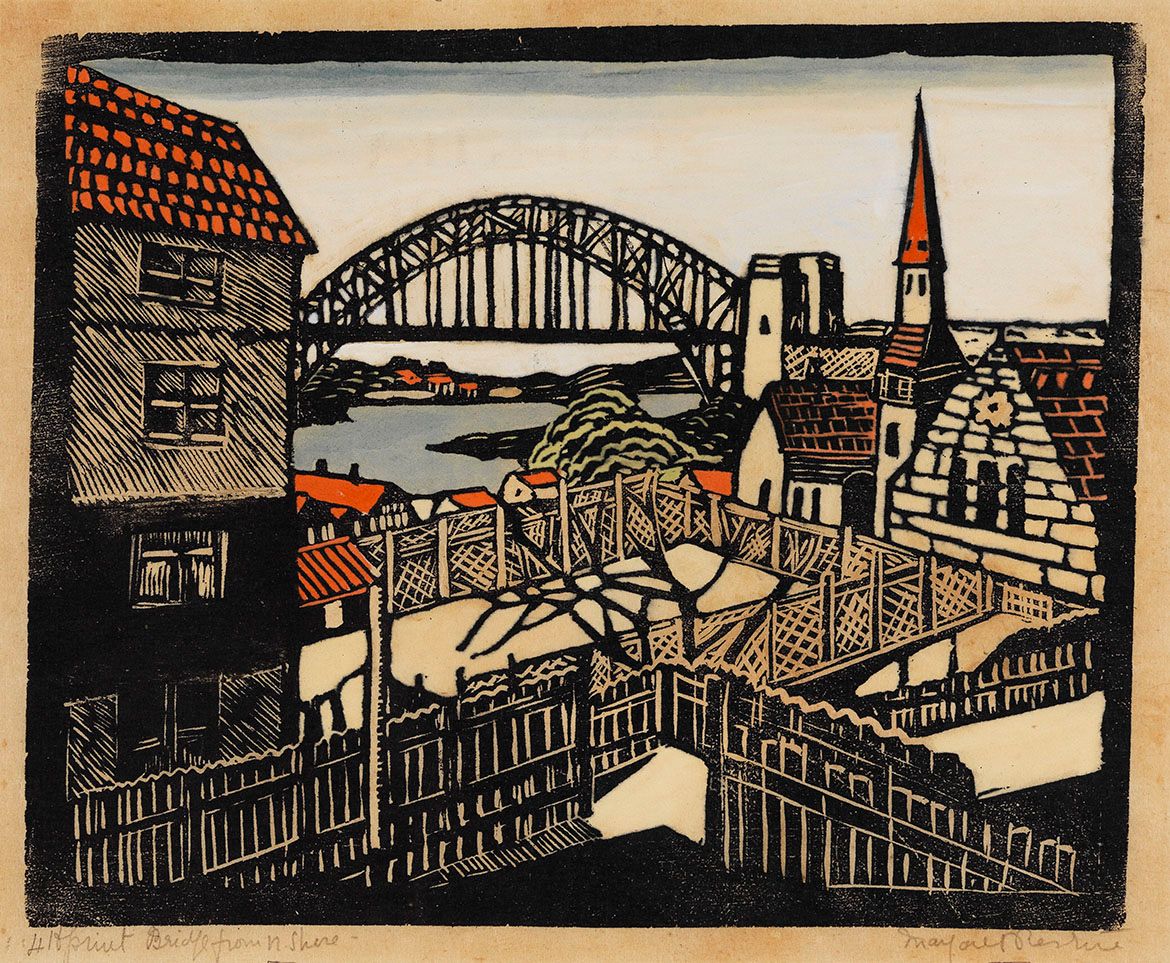
The notion of the 'modern' as something that had to be manufactured and experienced was very influential, both for those who wholeheartedly endorsed it and those who feared it. Such concerns certainly enlivened public debate about the Sydney Harbour Bridge, which was being built during the early years of the Depression. Even self-proclaimed progressives like Margaret Preston expressed reservations about the 'great towering structure that sends everything around it out of perspective' (illustrated).
Margaret Preston Bridge from North Shore [Sydney] c.1932

Margaret Preston, Australia 1875–1963 / Bridge from North Shore c.1932 / Woodcut, hand-coloured on paper / 20.3 x 24.5cm (sight) / Purchased 2003. QAG Foundation / Collection: Queensland Art Gallery | Gallery of Modern Art / © Margaret Preston/Copyright Agency / View full image
A suggestion of this tension is captured in Wakelin's The Bridge under construction, where the artist uses large blocks of colour in the foreground to emphasise the sweep of the street down the hill; the arch of the bridge itself picks this up and completes the spiral, pushing the eye to the end point on which a crane is perched. Detail is minimised — the futuristic-looking trams operate without untidy overhead wires and the architecture is monumentalised into large planes. Everything is dwarfed by the enormous span of steel. Here Wakelin has succeeded in combining colour and form with a dominant, penetrating rhythm. The painting vibrates with colour and light.
Roland Wakelin, New Zealand/Australia 1887–1971 / The Bridge under construction 1928 / Oil on composition board / 96.5 x 118cm / Purchased 1994. QAG Foundation Grant. Celebrating the Queensland Art Gallery's Centenary 1895–1995 / Collection: Queensland Art Gallery | Gallery of Modern Art / © Roland Wakelin Estate / View full image

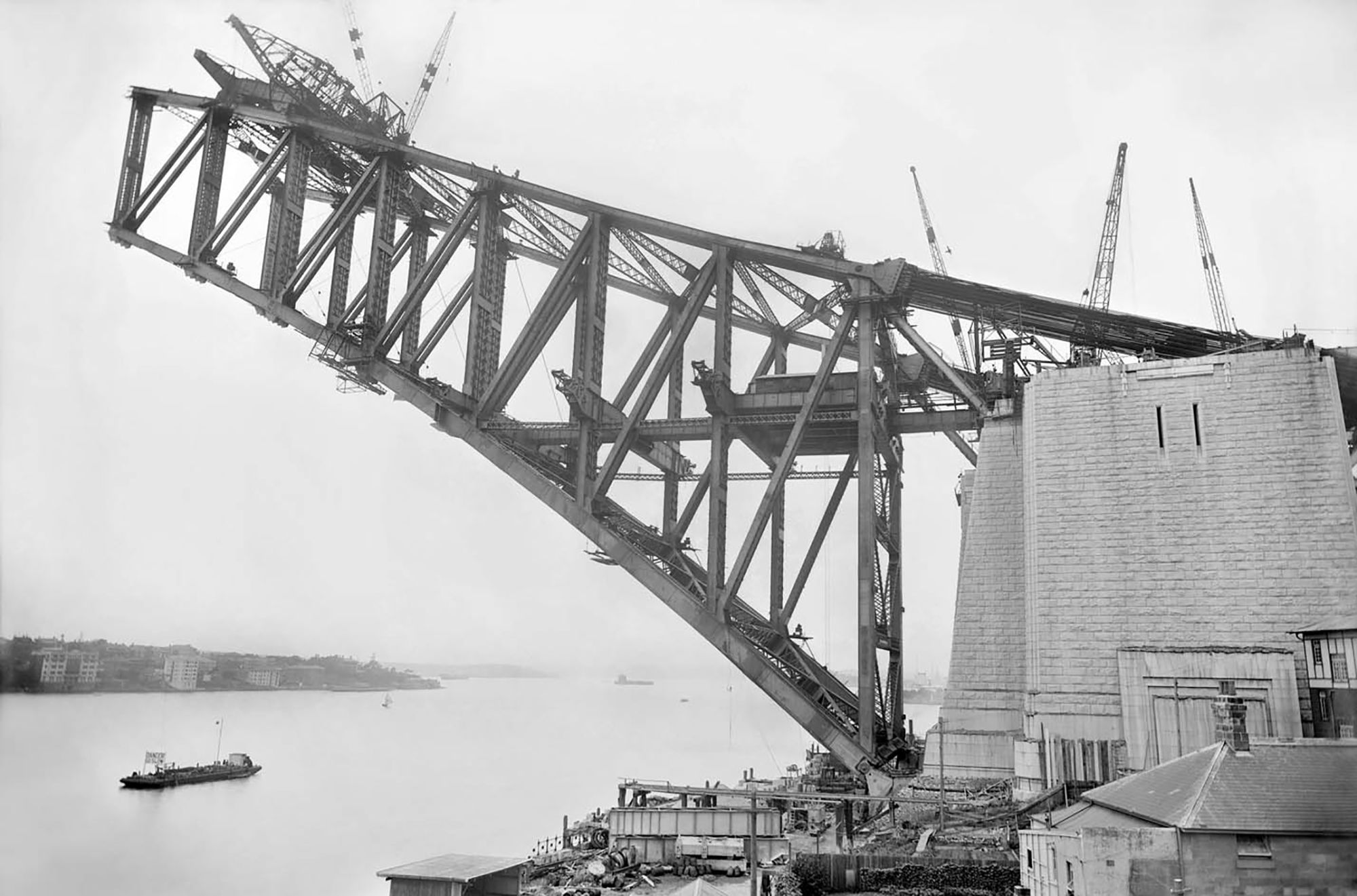
Construction of the Sydney Harbour Bridge, c.1928 / Series 07: Box 37 No. 430 / Courtesy: State Library New South Wales / View full image
Meanwhile in Brisbane
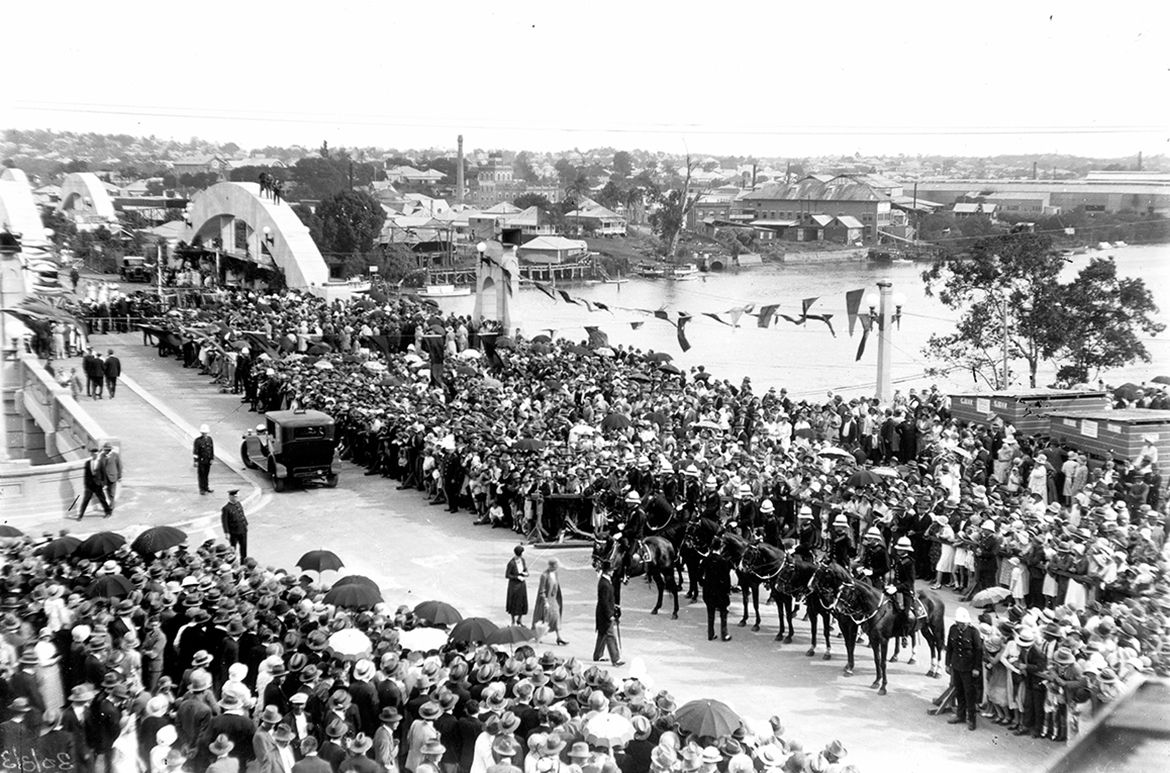
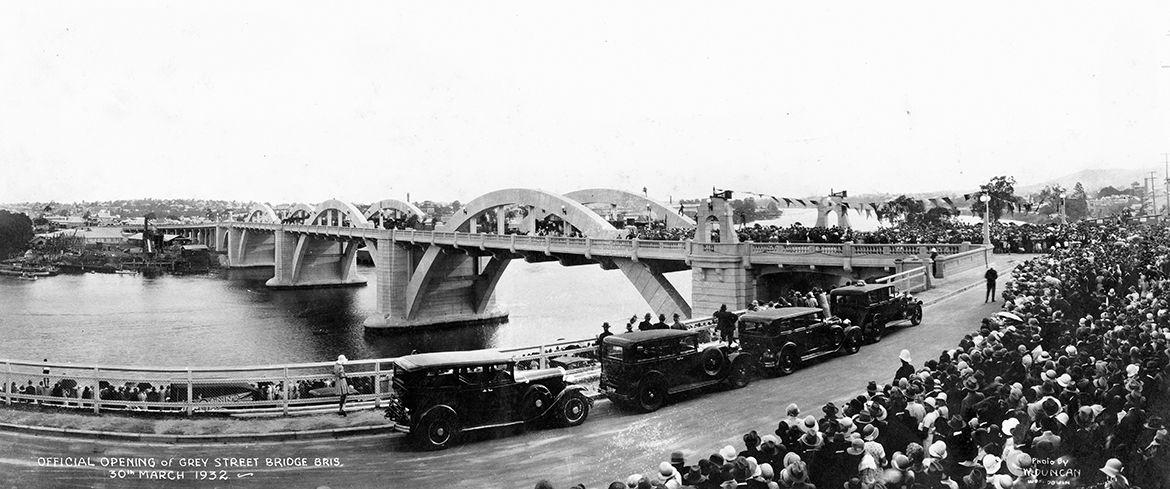
There was also major building activity in Australia’s larger cities like Brisbane during the 1920s and 30s, typified locally by the construction of the Grey Street Bridge (1928–30 March 1932) linking South Brisbane to North Quay (illustrated), officially opening eleven days after the Sydney Harbour Bridge and nearly eight years before the Story Bridge (1935–6 July 1940), linking Kangaroo Point to Petrie Bight (illustrated).
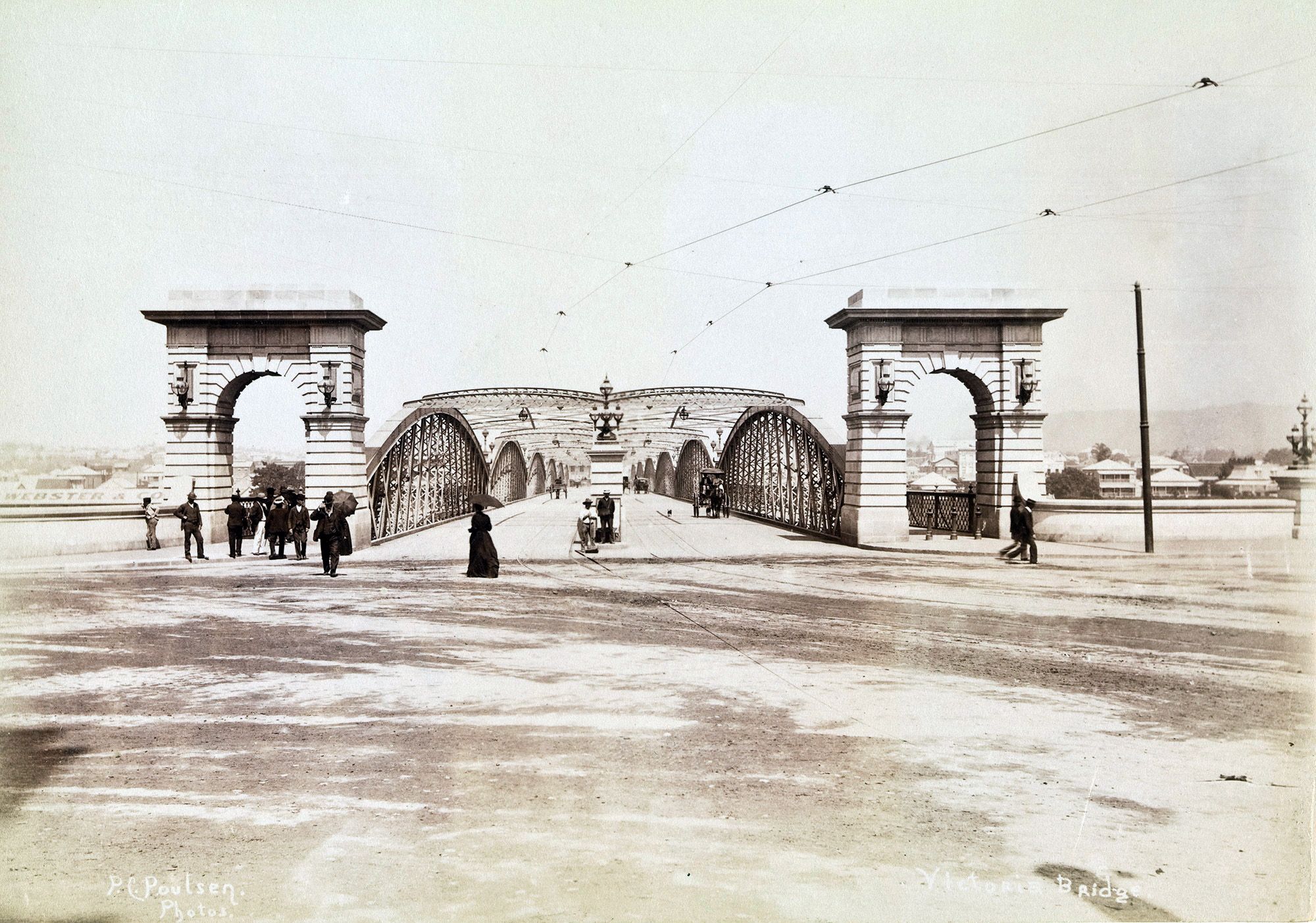
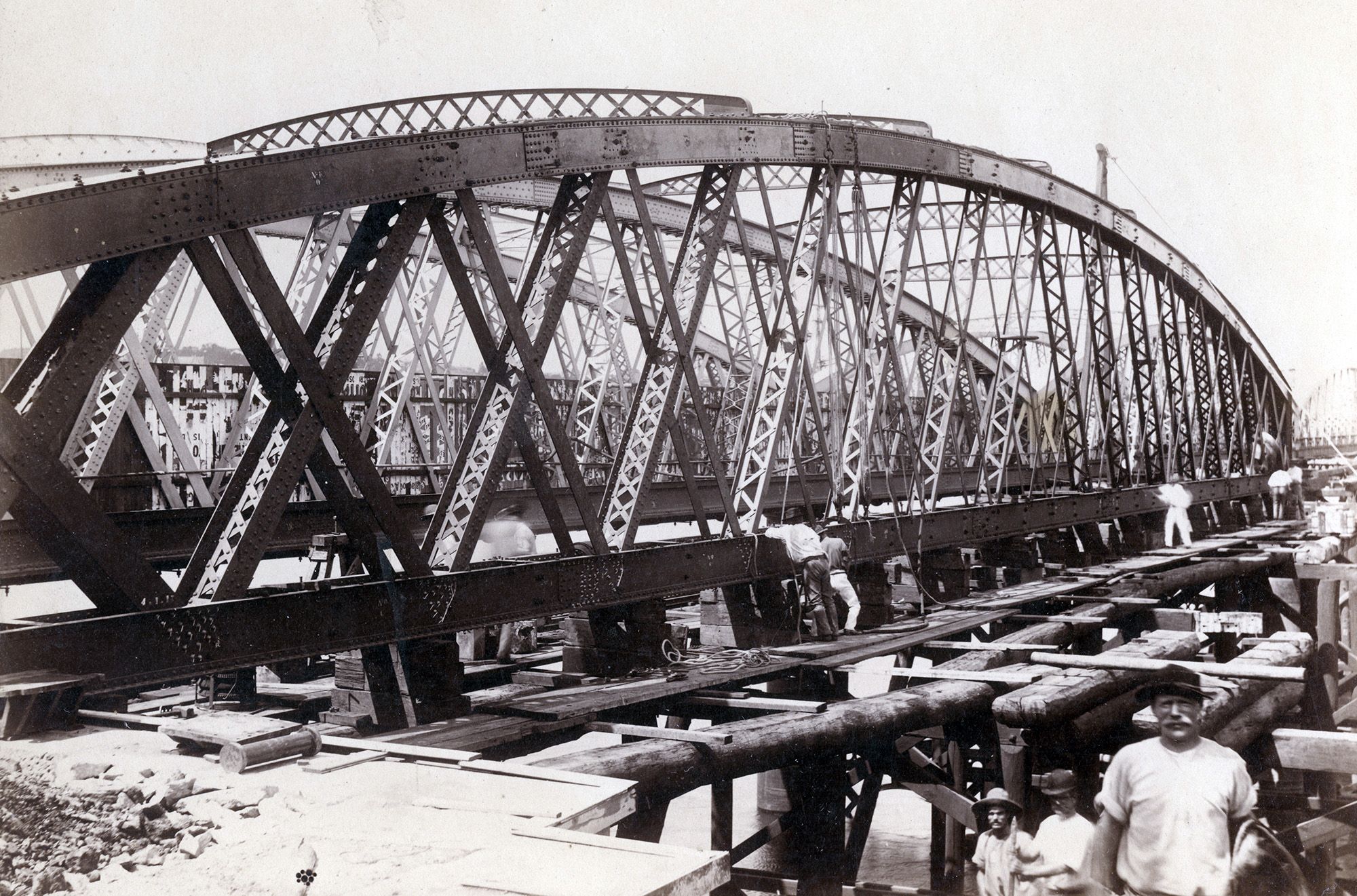
The Story Bridge, built as part of the State Government’s response to the Great Depression, remains one of Queensland’s most iconic landmarks. By the 1920s, Brisbane had outgrown the Victoria Bridge which remained the sole inner-city river crossing. This second permanent bridge (illustrated) was built in 1897 lasting until 1969, when it was demolished for the current Victoria Bridge.
Second permanent Victoria Bridge

Poul C Poulsen, Australia 1857–1925 / Victoria Bridge c.1897 / Albumen photograph on paper mounted on card / 14.5 x 20.5cm / Gift of Glenn R Cooke through the QAG Foundation 2009 / Collection: Queensland Art Gallery | Gallery of Modern Art / View full image
Victoria Bridge under construction, 1896

Construction of the second permanent Victoria Bridge, Brisbane, c.1896 / 99183505988202061 / Courtesy: John Oxley Library, State Library of Queensland, Brisbane / View full image
A 1926 report by the Cross River Commission, recommended the creation of several new bridges. The Grey Street Bridge was constructed, but a bridge at Kangaroo Point would not begin for several more years.
Rivalry between Brisbane and Sydney was intense. Brisbane was immensely proud of its new bridges, their openings were grand events, and the construction of both inspired numerous artists.
Vida Lahey
Vida Lahey (26 August 1882–1968) is recognised as one of Queensland’s most influential artists. She contributed to the development of art in the state both through her own vibrant cityscapes and still lifes and her tireless efforts as an art advocate and educator.
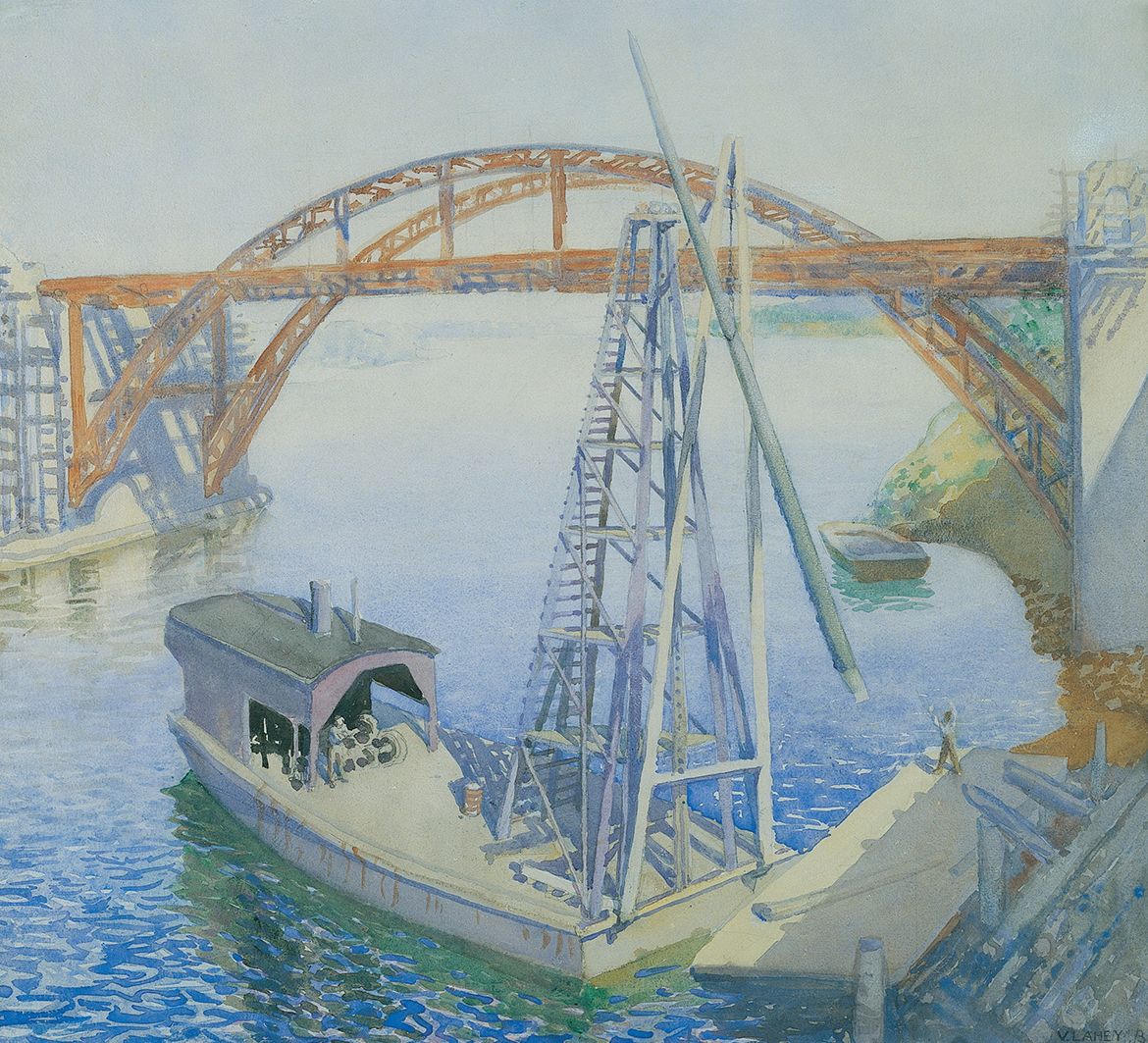
During the 1930s, Lahey and her contemporaries were increasingly drawn to paint images of modern life. She captured the scenes of industry she observed in and around Brisbane, such as the construction of the Grey Street Bridge (renamed the William Jolly Bridge in 1955, in memory of the first Lord Mayor of Greater Brisbane). Building the bridge 1931 (illustrated) is a fine example of the light-filled vistas Lahey painted at this time and focuses on the structure’s curved concrete-encased steel spans as symbols of modern engineering, and of modernity more broadly. Like Sydney artist Grace Cossington Smith, who painted the Sydney Harbour Bridge under construction in the early 1930s, Lahey has used a high-key, post-impressionist palette that reveals her understanding of developments in international art.
Vida Lahey Building the [Grey Street] bridge [Brisbane] 1931

Vida Lahey, Australia 1882–1968 / Building the bridge 1931 / Watercolour and gouache over pencil on wove paper on cardboard / 24.5 x 28.5cm / Gift from the estate of Mrs Gladys Powell 1941 / Collection: Queensland Art Gallery | Gallery of Modern Art / © QAGOMA / View full image
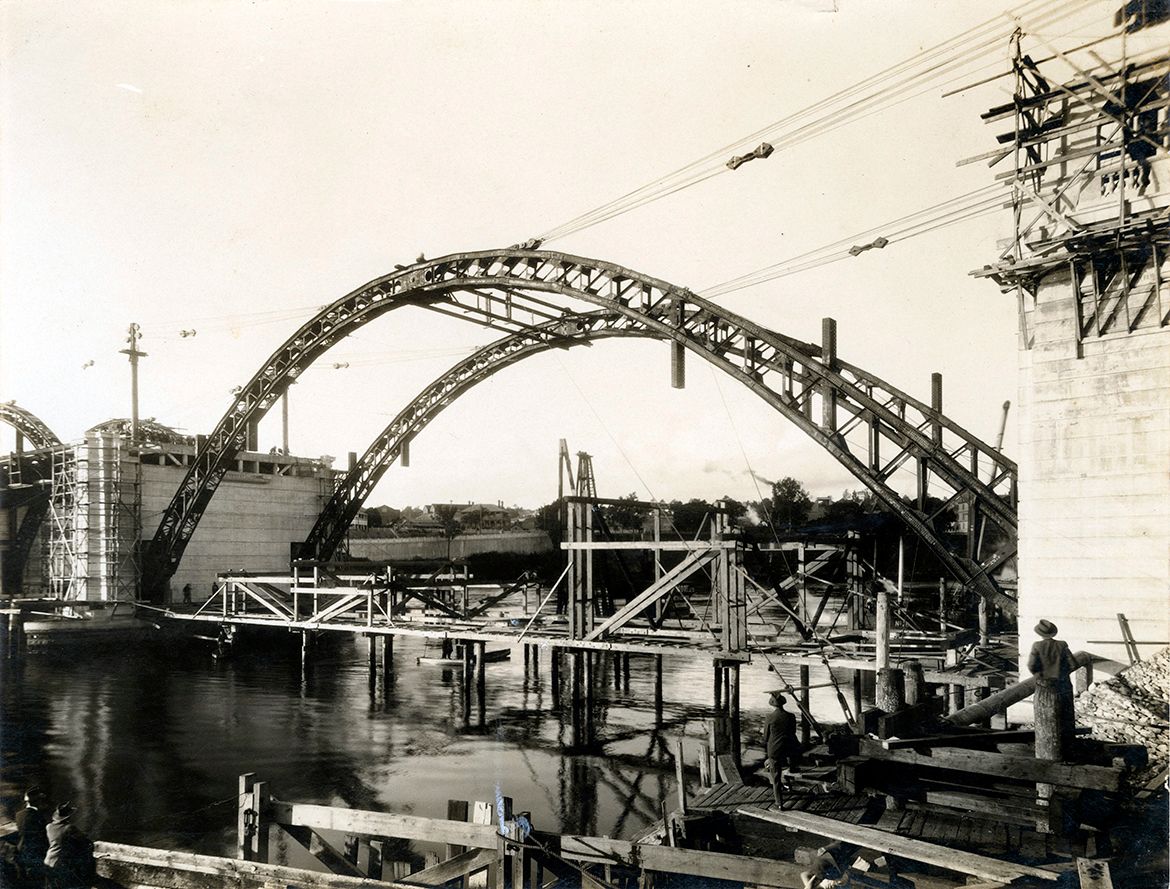
Arch & pylon being constructed on the Grey Street Bridge, c.1929

Arch and pylon being constructed on the Grey Street Bridge, c.1929 / Image number: 10189-0001-0010 99183875002802061 / Courtesy: John Oxley Library, State Library of Queensland, Brisbane / View full image
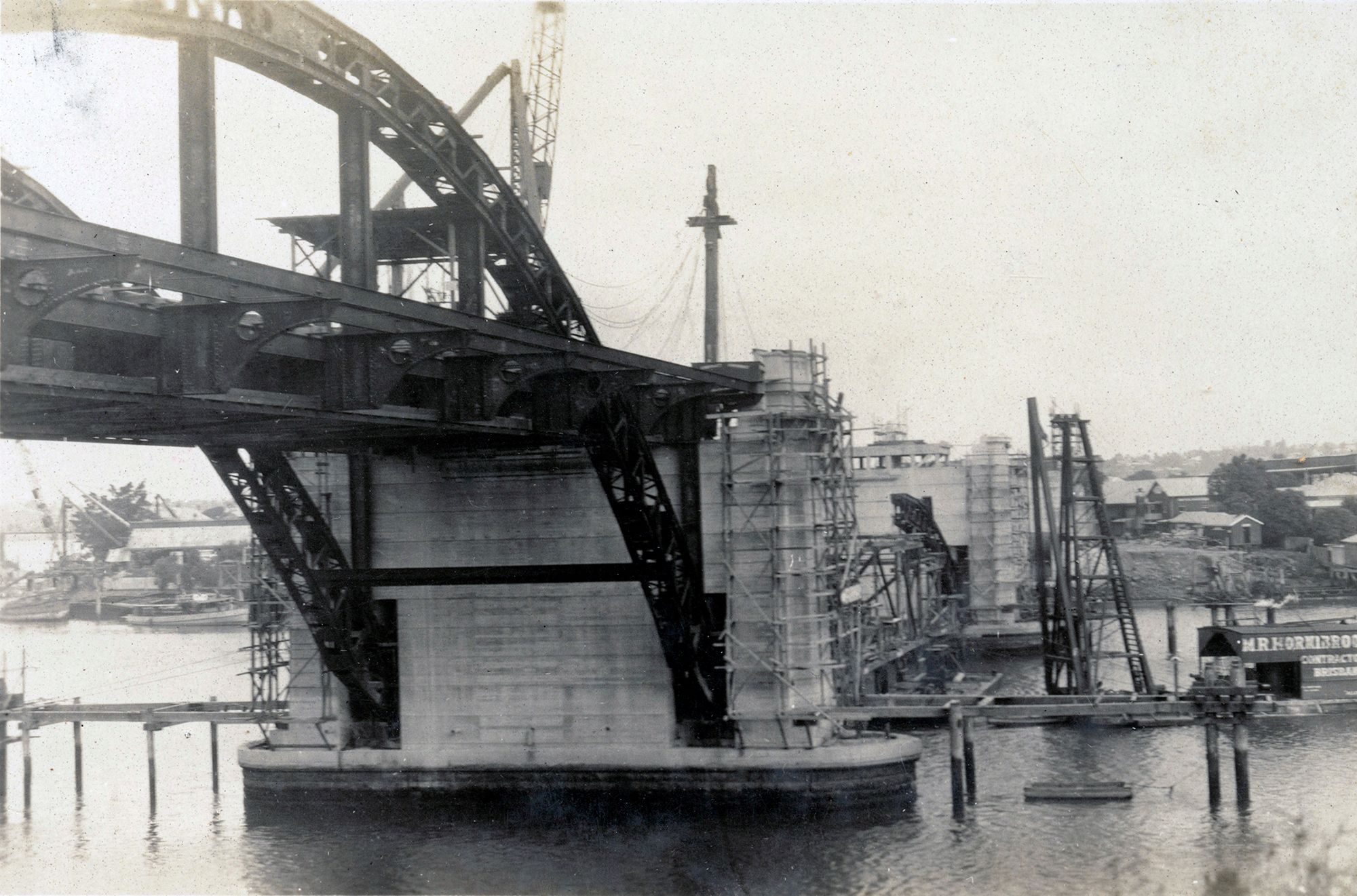

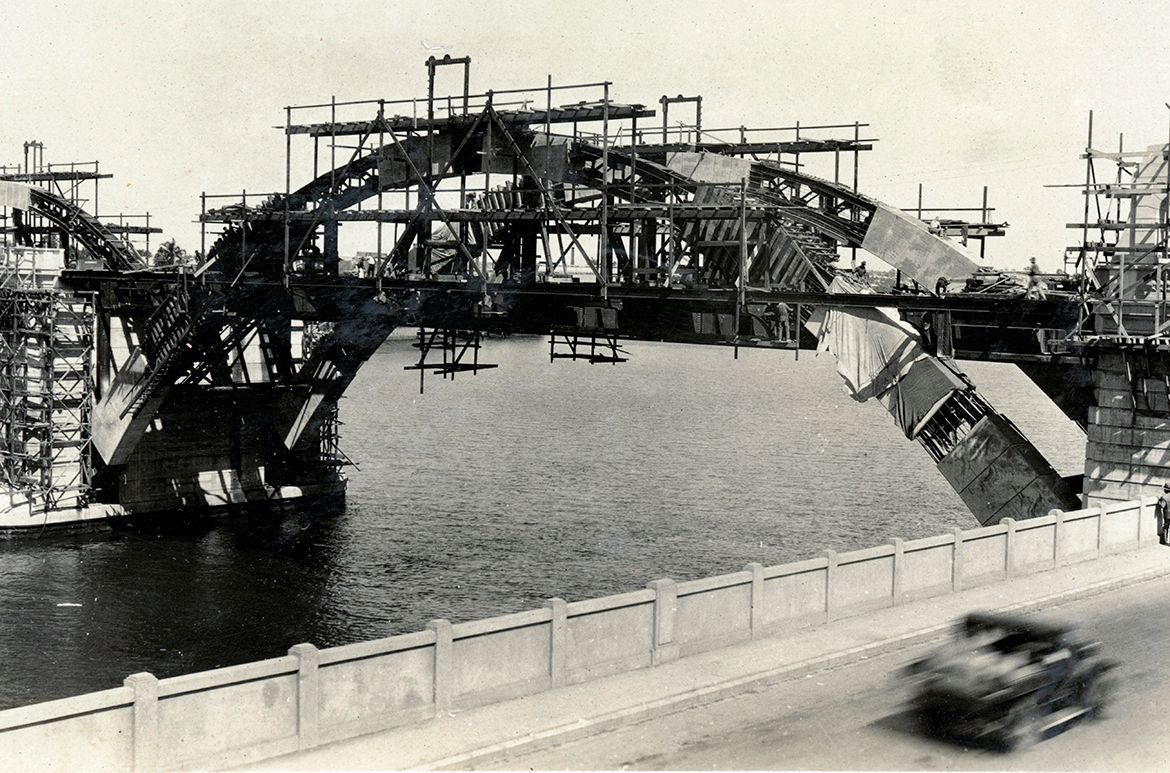
Grey Street Bridge under construction c.1929 / Album Hornibrook Business and Family Photographs / 30146-0001-0029 / Courtesy: John Oxley Library, State Library of Queensland, Brisbane / View full image
Vida Lahey The new [Grey Street] bridge [Brisbane] 1931

Vida Lahey, Australia 1882–1968 / The new bridge 1931 / Watercolour on paper / 48.7 x 53.5cm / Purchased 1997 with funds from M.I.M. Holdings Limited through the QAG Foundation / Collection: Queensland Art Gallery | Gallery of Modern Art / © QAGOMA / View full image
Arch of the Grey Street Bridge under construction c.1929

Arch of the Grey Street Bridge under construction c.1929 / 10189-0001-0051 / Courtesy: John Oxley Library, State Library of Queensland, Brisbane / View full image

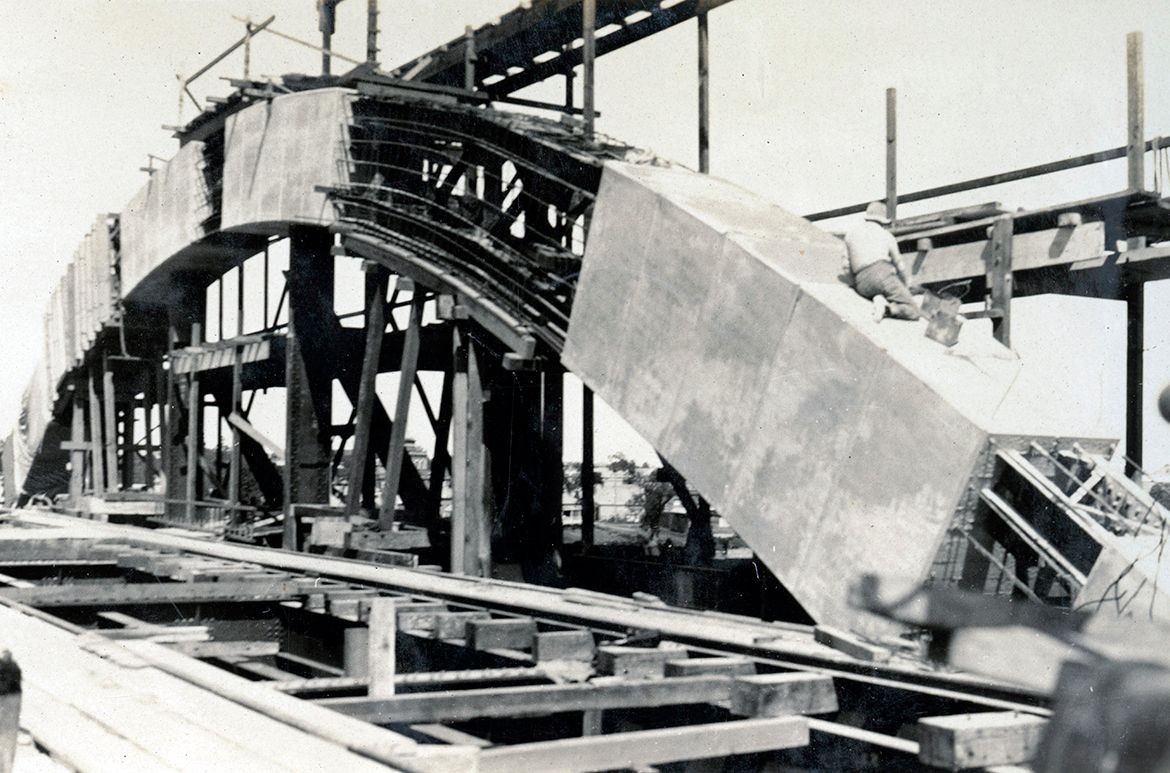
Arch of the Grey Street Bridge under construction c.1929 / 10189-0001-0050 / Courtesy: John Oxley Library, State Library of Queensland, Brisbane / View full image
Official opening of Grey Street Bridge, 1932

Crowds of people gathered for the opening of the Grey Street Bridge, 1932 / 34276 / Courtesy: John Oxley Library, State Library of Queensland, Brisbane / View full image

Official opening of the Grey Street Bridge, 1932 / 150516 / Courtesy: John Oxley Library, State Library of Queensland, Brisbane / View full image
Rose Simmonds
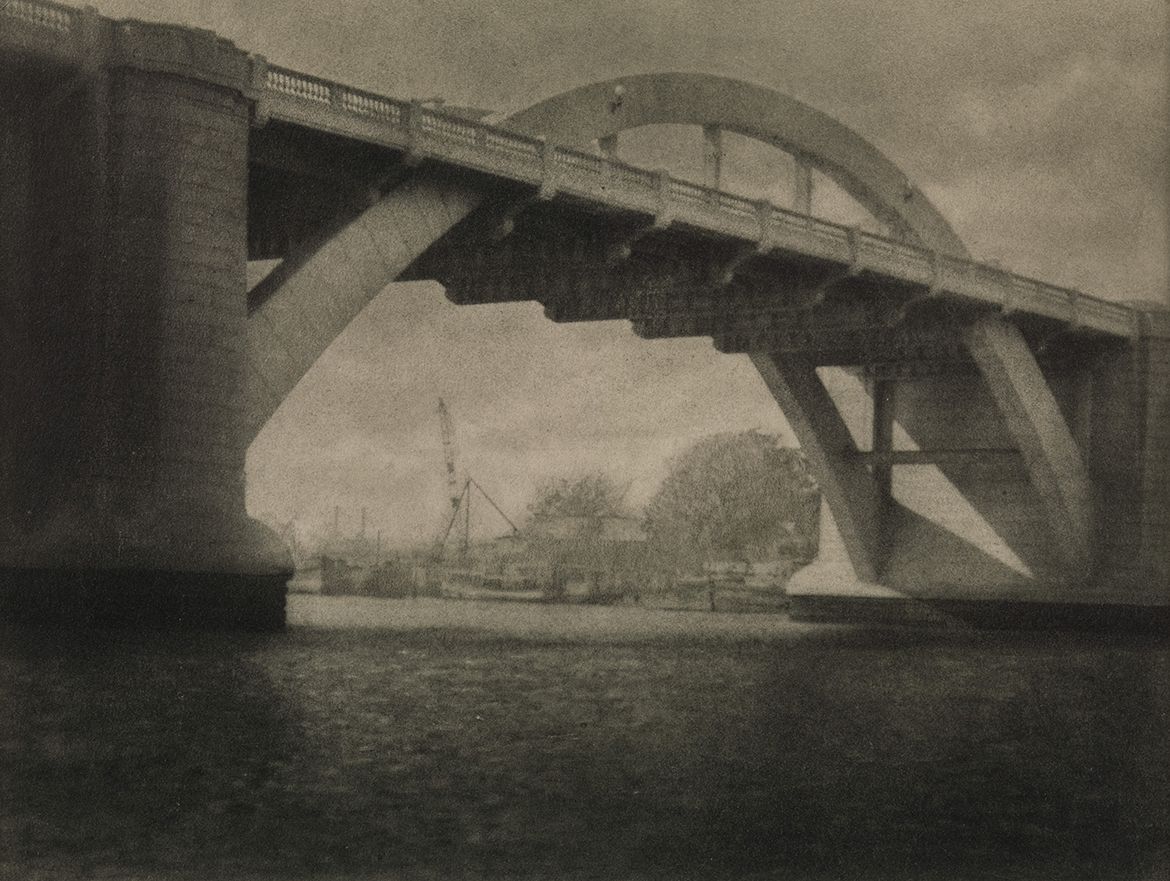
London-born, Queensland-based photographer Rose Simmonds’s (26 July 1877–1960) early photographs reveal her dedication to the tenets of Pictorialism. This movement emerged in England and France at the end of the nineteenth century and saw photographers seeking to assert their medium’s status as art by emulating the effects of painting. To this end, Pictorialists eschewed the detailed realism previously associated with the photographic image, producing softly focused prints that emphasised atmospheric effects.
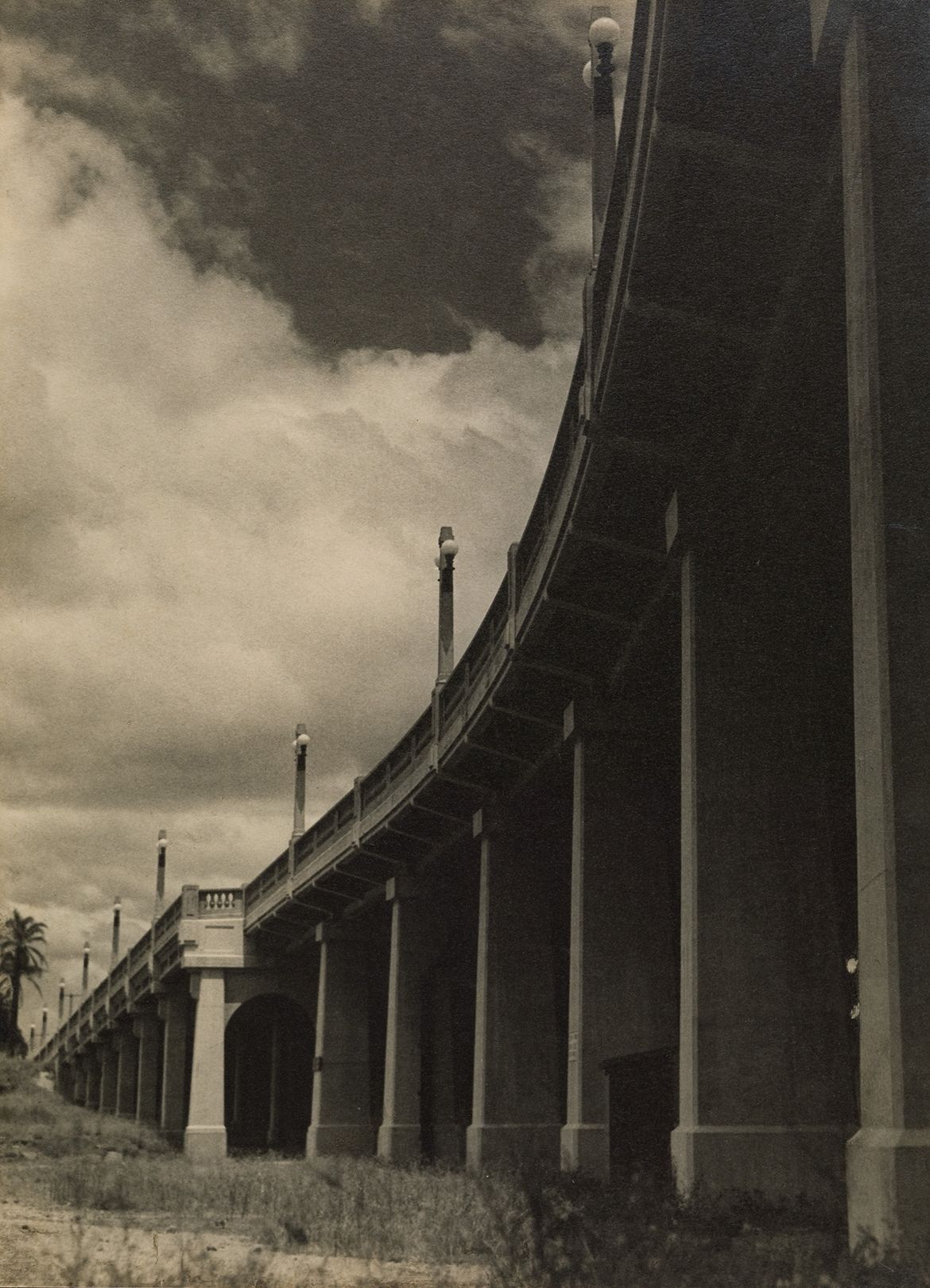
Many of Simmonds’s photographs bridge the gap between Pictorialism and modernist photography, which evolved after World War One in response to rapid industrialisation. From a low vantage point, Simmonds has foregrounded the bridge in (Grey Street Bridge, Brisbane) c.1933 (illustrated) as a feat of modern engineering. At the same time, she has chosen to blur the detail and use the bromoil process favoured by Pictorialists, whereby a photograph’s silver image is removed and replaced with ink to create tonal variations.
Rose Simmonds (Grey Street Bridge, Brisbane) c.1933

Rose Simmonds, Australia 1877–1960 / (Grey Street Bridge, Brisbane) c.1933 / Bromoil transfer photograph on paper / 18.4 x 23.9cm (comp.) / Gift of Dr J.H. Simmonds 1982 / Collection: Queensland Art Gallery | Gallery of Modern Art / View full image
Stanley W Eutrope
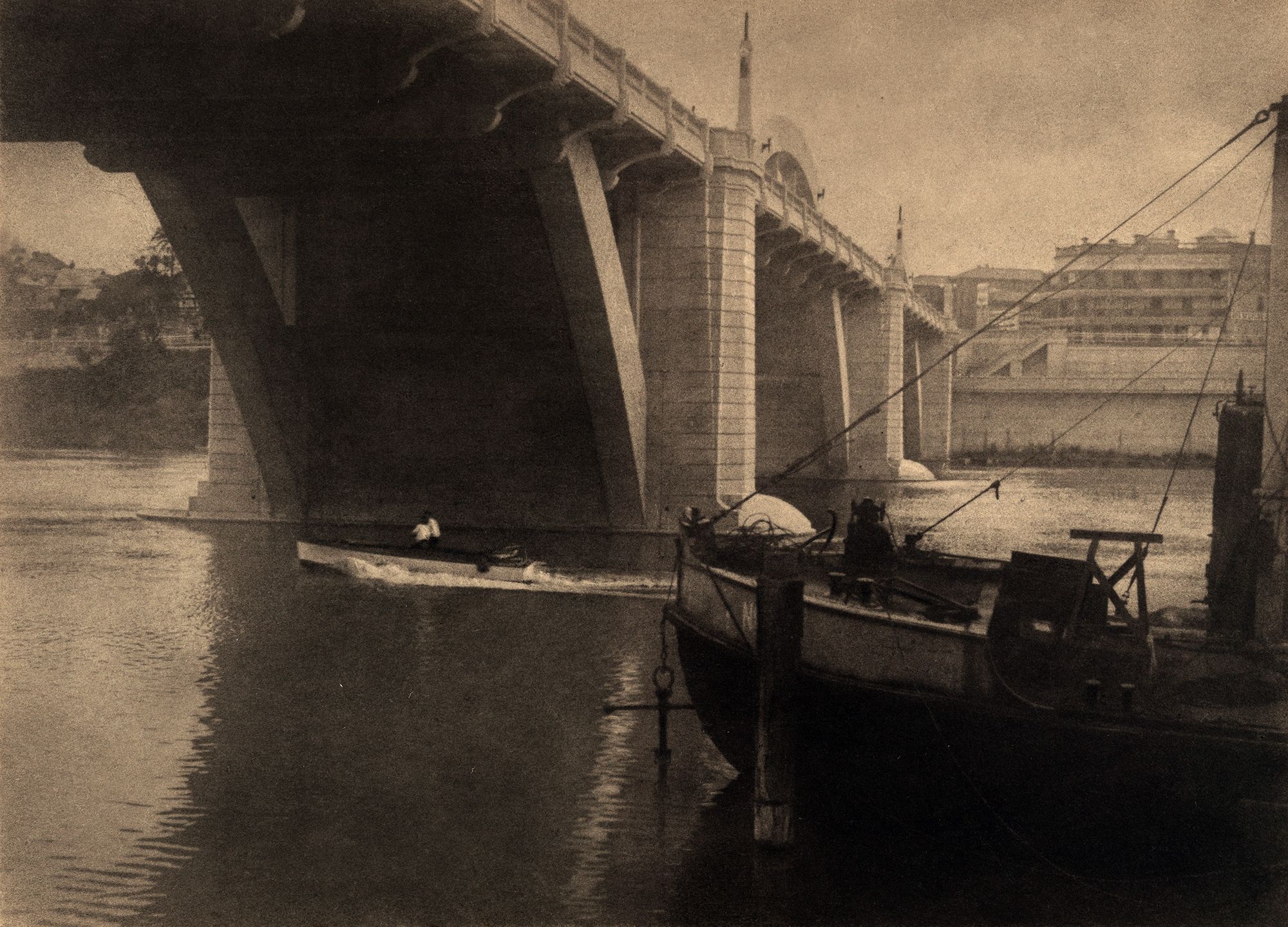
Stanley William Eutrope (1891–1983) was born in Melbourne and began exhibiting around 1917 at the height of the Pictorialism movement. He moved to Sydney in 1920, before travelling north to Brisbane in 1929 to work for Harringtons Ltd, an importer and retailer of photographic goods.
Eutrope was also inspired to document the Grey Street Bridge when completed with Under the bridge c.1933 (illustrated) and The bridge approach c.1935 (illustrated). An expert at the bromoil photographic process, Eutrope’s work was noted for its decorative and graphic effects.
Stanley W Eutrope Under the bridge (Grey Street Bridge, Brisbane) c.1933

Stanley W Eutrope, Australia 1891–1983 / Under the bridge (Grey Street Bridge, Brisbane) c.1933 / Bromoil photograph on paper / 21.5 x 29.7cm (comp) / Gift of Mrs J. Searston in memory of her mother, Mrs Florence Radford, through Miss Shirley Eutrope 1984 / Collection: Queensland Art Gallery | Gallery of Modern Art / © Stanley Eutrope Estate / View full image
Stanley W Eutrope The bridge approach (Grey Street Bridge, Brisbane) c.1935

Stanley W Eutrope, Australia 1891–1983 / The bridge approach (Grey Street Bridge, Brisbane) c.1935 / Bromoil photograph on paper / 29.7 x 21.8cm (comp) / Gift of Miss Shirley Eutrope 1984 / Collection: Queensland Art Gallery | Gallery of Modern Art / © Stanley Eutrope Estate / View full image
Geoffrey Powell
The Story Bridge is an icon of Brisbane, its iron arches and geometric supports amongst the most recognisable features of the city skyline. The Bridge, which was designed by John Bradfield, chief engineer on the Sydney Harbour Bridge, joins the southern bank of the Brisbane River with the old central commercial district in Fortitude Valley. It was named after senior public servant John Douglas Story.
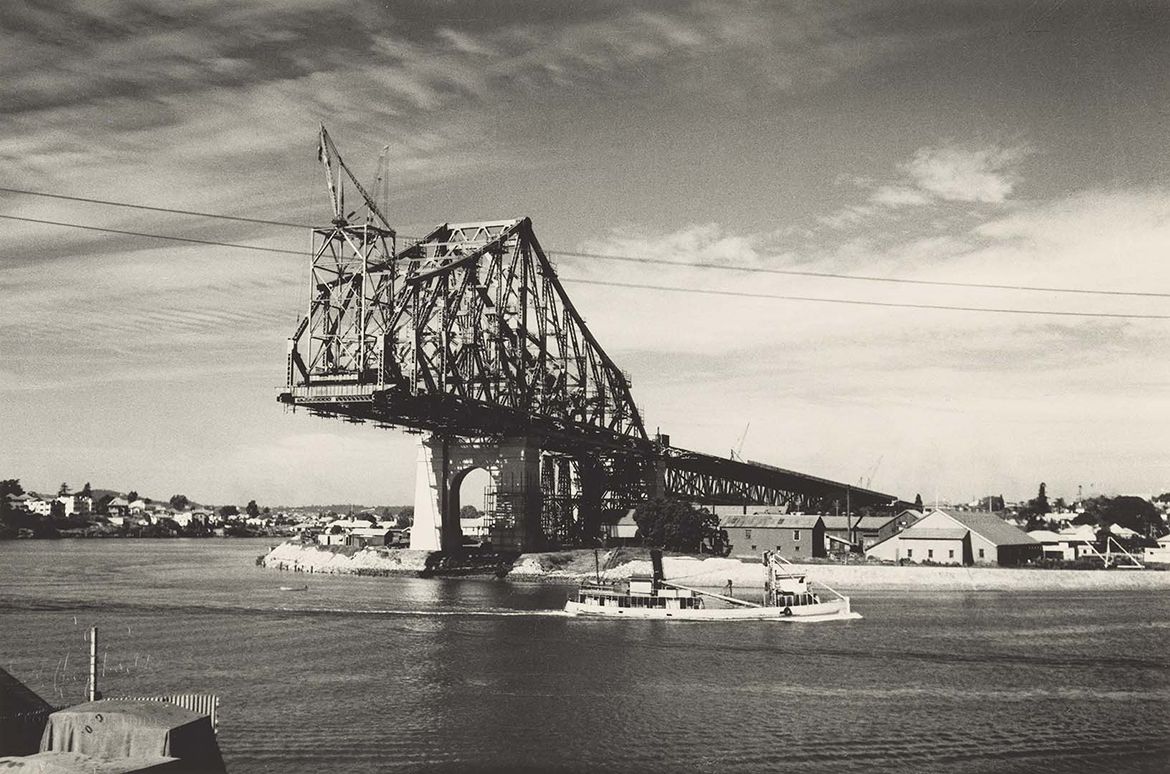
The Bridge was one of a number of infrastructure projects that changed the urban landscapes of Australia's major cities in the 1930s and 40s. Photographers and artists adopted bridges as symbols of this change, using them to signify modernisation and hope during the interwar period. In many representations from this era, artists exaggerated the size and significance of a bridge through compositional devices such as a low point of view. Geoffrey Powell's (13 January 1918-89) treatment of the Story Bridge contrasts with this approach — he avoids monumentalising the structure by adopting a more sober and objective documentary style. This photograph was taken during Powell's stay in Brisbane in 1939, when he worked as a freelance photographer and journalist.
Geoffrey Powell (Construction of Story Bridge, Brisbane) 1939

Geoffrey Powell, Australia 1918-89 / (Construction of Story Bridge, Brisbane) 1939, printed 2005 / Gelatin silver photograph on paper / 50.5 x 39.5cm / Purchased 2005 / Collection: Queensland Art Gallery | Gallery of Modern Art / © Estate of Geoffrey Powell / View full image
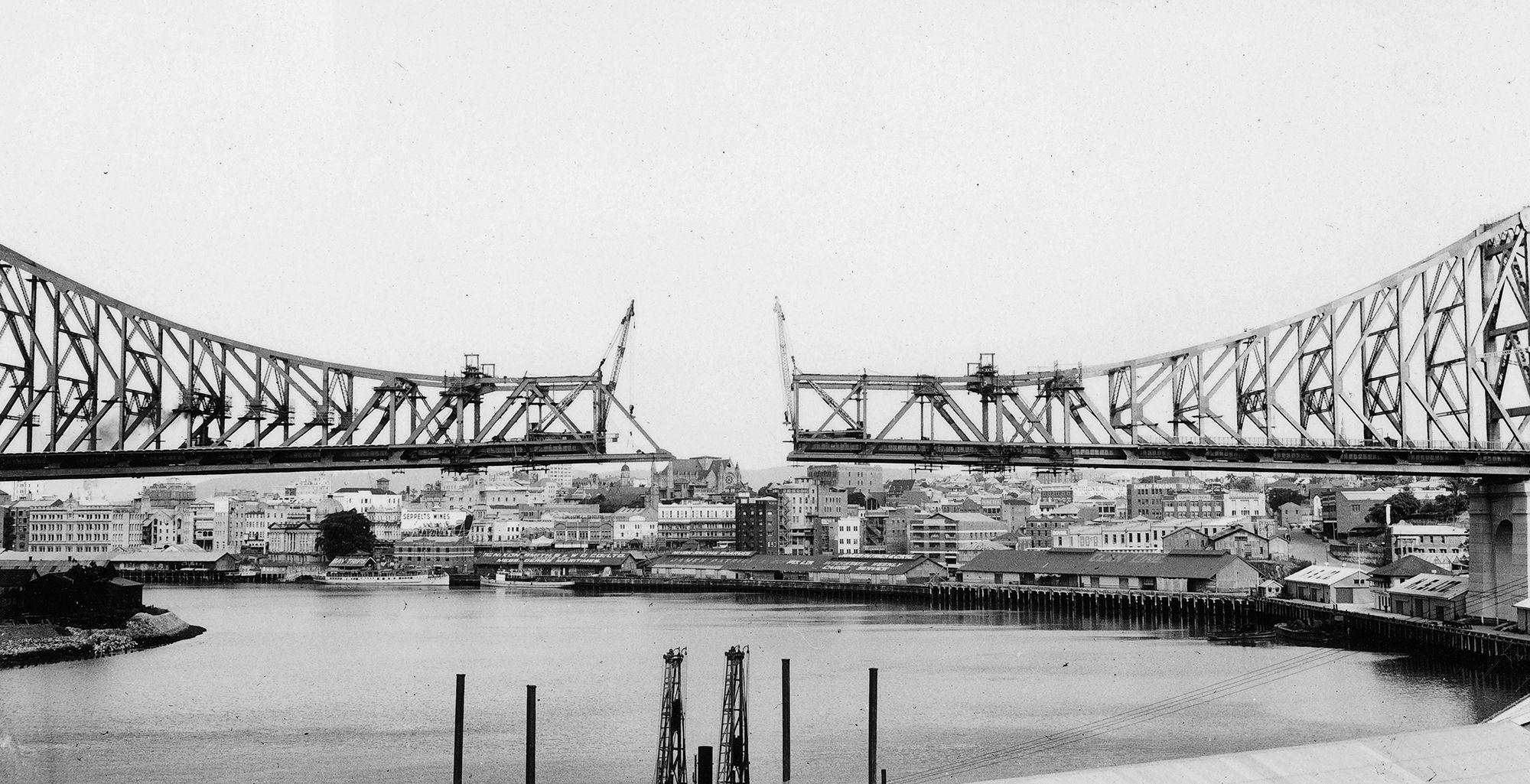
Story Bridge under construction, 1939

Construction of the Story Bridge, 16 October 1939 / 99183874777702061 / Courtesy: John Oxley Library, State Library of Queensland, Brisbane / View full image
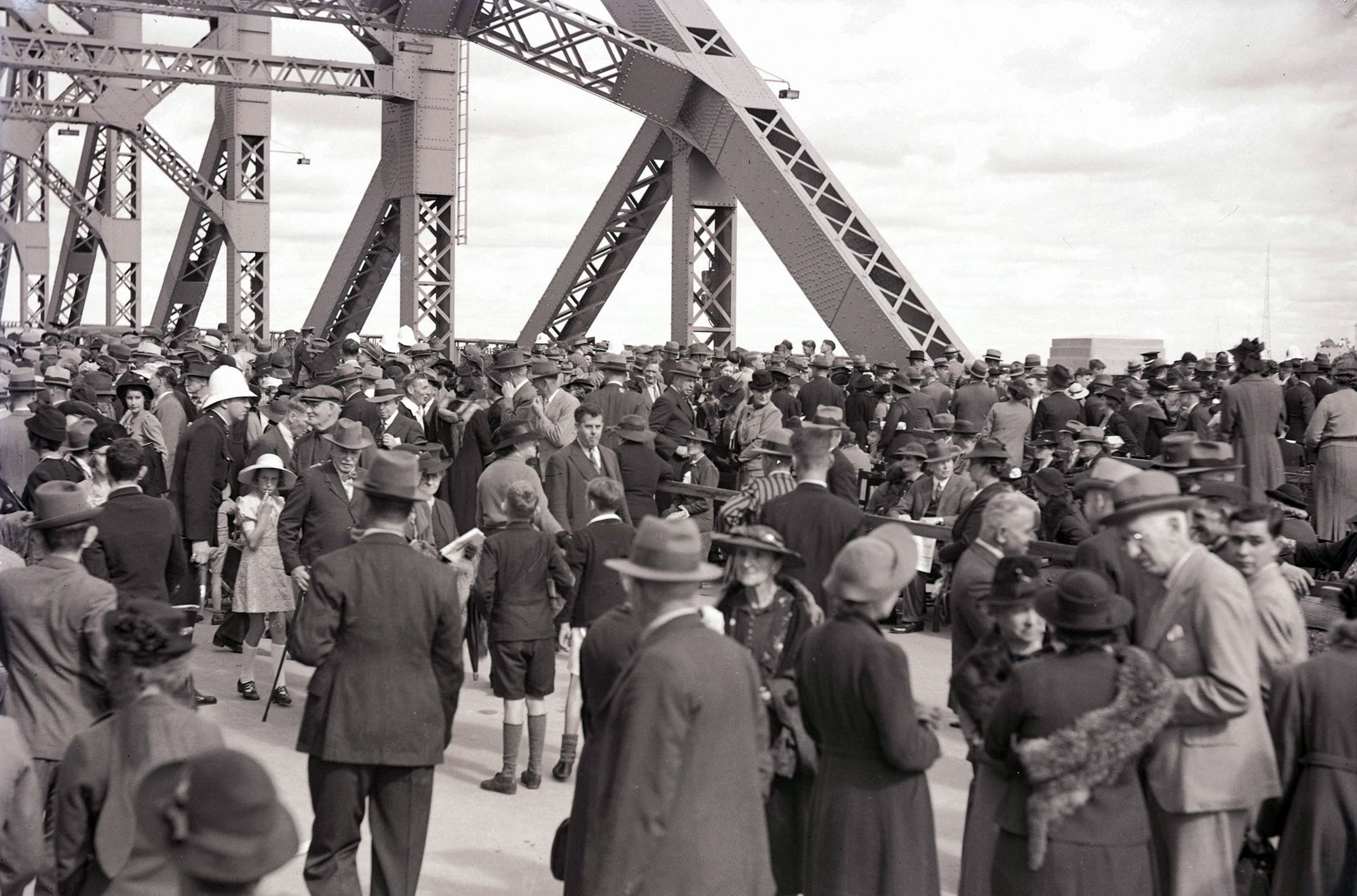
Official opening of the Story Bridge, 1940

Crowds of people gathered for the opening of the Story Bridge, 1940 / PR1820952 Neg 0941N / Courtesy: State Archives of Queensland / View full image
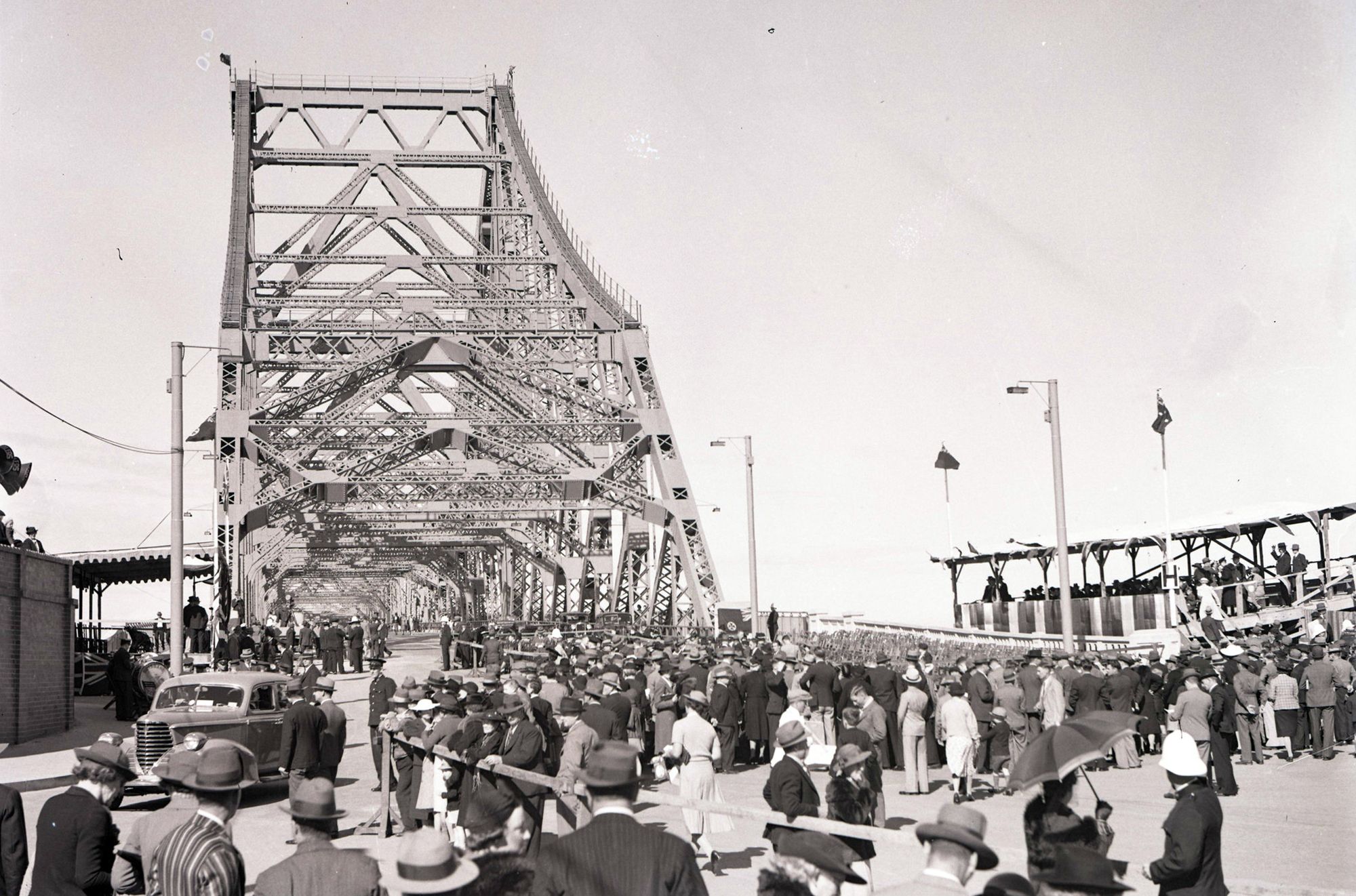

Crowds of people gathered for the opening of the Story Bridge, 1940 / PR1820954 Neg 0943N / Courtesy: State Archives of Queensland / View full image

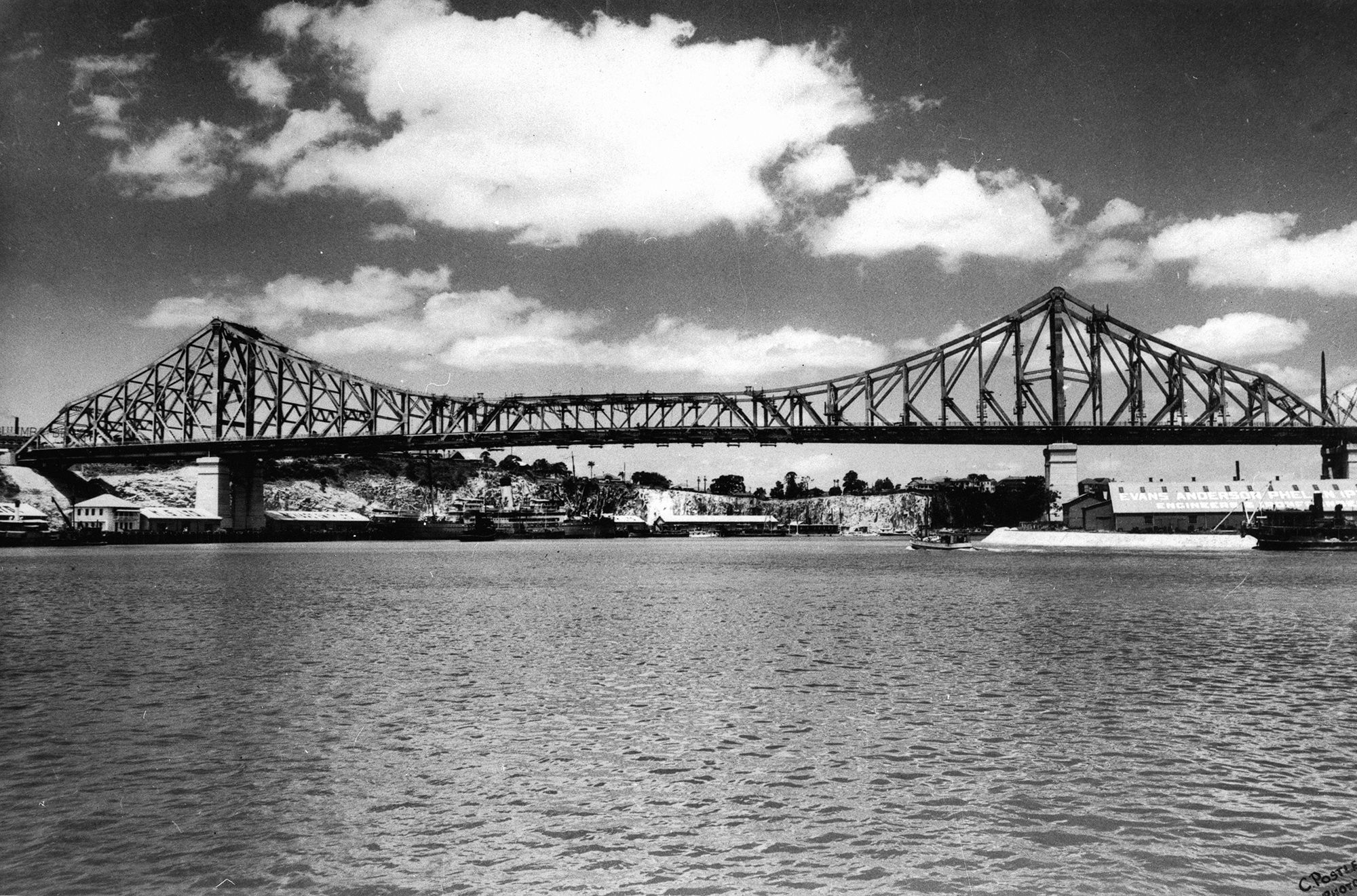
Story Bridge, 1940 / 99183513255202061 / Courtesy: John Oxley Library, State Library of Queensland, Brisbane / View full image
Curatorial extracts, research and supplementary material sourced and compiled by Elliott Murray, Senior Digital Marketing Officer, QAGOMA
Edited extracts from ‘Painting a Symphony. Roland Wakelin: The Bridge under construction‘ by Dr Candice Bruce from Brought to Light: Australian Art 1850-1965, Queensland Art Gallery, 1998; and Under a Modern Sun: Art in Queensland 1930s–1950s, Queensland Art Gallery | Gallery of Modern Art, 2025 by Samantha Littley, Curator, Australian Art.
Go back in time to discover Brisbane’s forgotten landmarks, delve into our historical past, and uncover unique stories through the work of Australian artists in QAGOMA’s Collection.
Queensland Art Gallery | Gallery of Modern Art (QAGOMA)
Brisbane, Australia