
Go back in time to a busy corner of the Brisbane River

George Wishart, Australia/Queensland 1872-1921 / A busy corner of the Brisbane River 1897 / Oil on canvas / 76 x 101.5cm / Acquired before 1962 / Collection: Queensland Art Gallery | Gallery of Modern Art / View full image
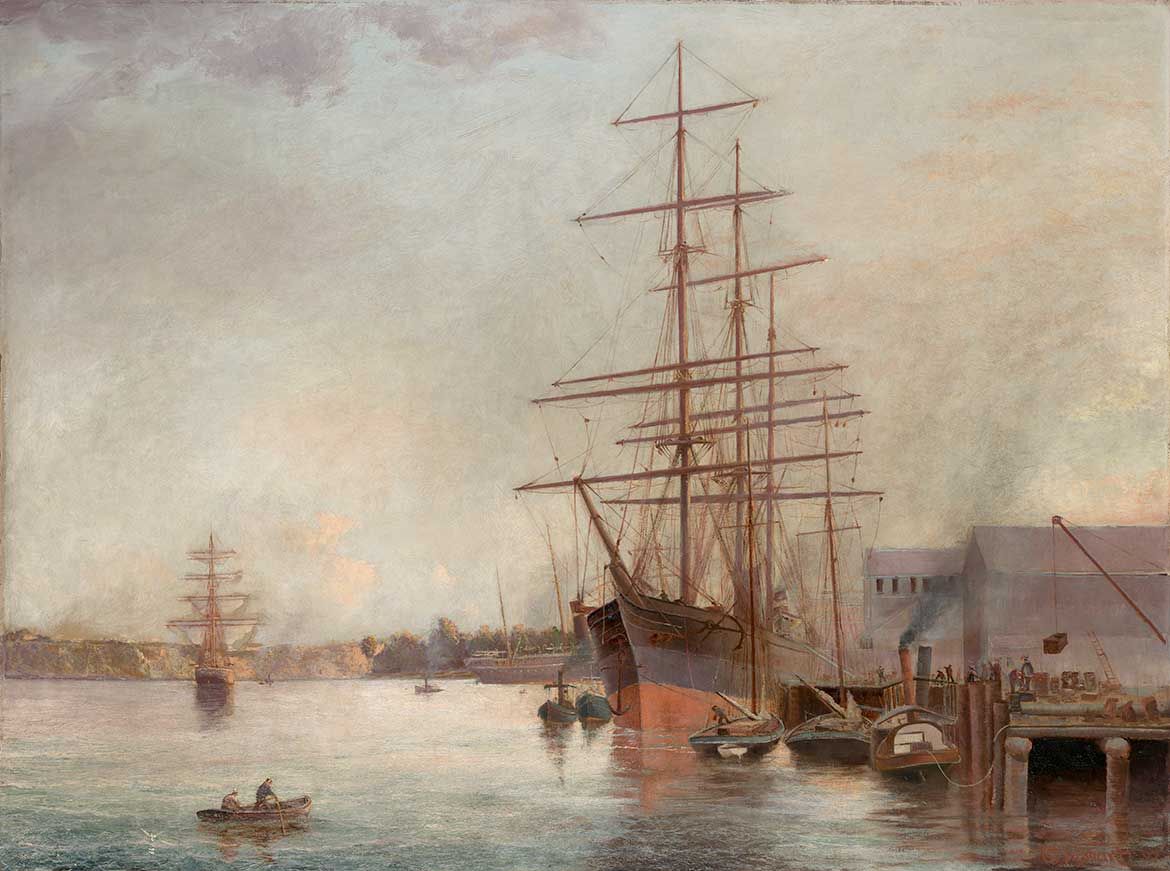
We take an in-depth look at George Wishart's (1872-1921) painting A busy corner of the Brisbane River 1897, its secrets uncovered during conservation, and highlight what was happening in Brisbane at the time.
Wishart was born in Brisbane and was taught painting by Isaac Walter Jenner (1836-1902), Brisbane’s foremost marine painter. Wishart also worked professionally as a photographer and was associated with local firm Thomas Mathewson Photographic Studio.
Wishart’s painting is of considerable interest and importance as paintings which represent the commercial activity on the Brisbane River are extremely rare.
George Wishart A busy corner of the Brisbane River 1897

George Wishart, Australia/Queensland 1872-1921 / A busy corner of the Brisbane River 1897 / Oil on canvas / 76 x 101.5cm / Acquired before 1962 / Collection: Queensland Art Gallery | Gallery of Modern Art / View full image
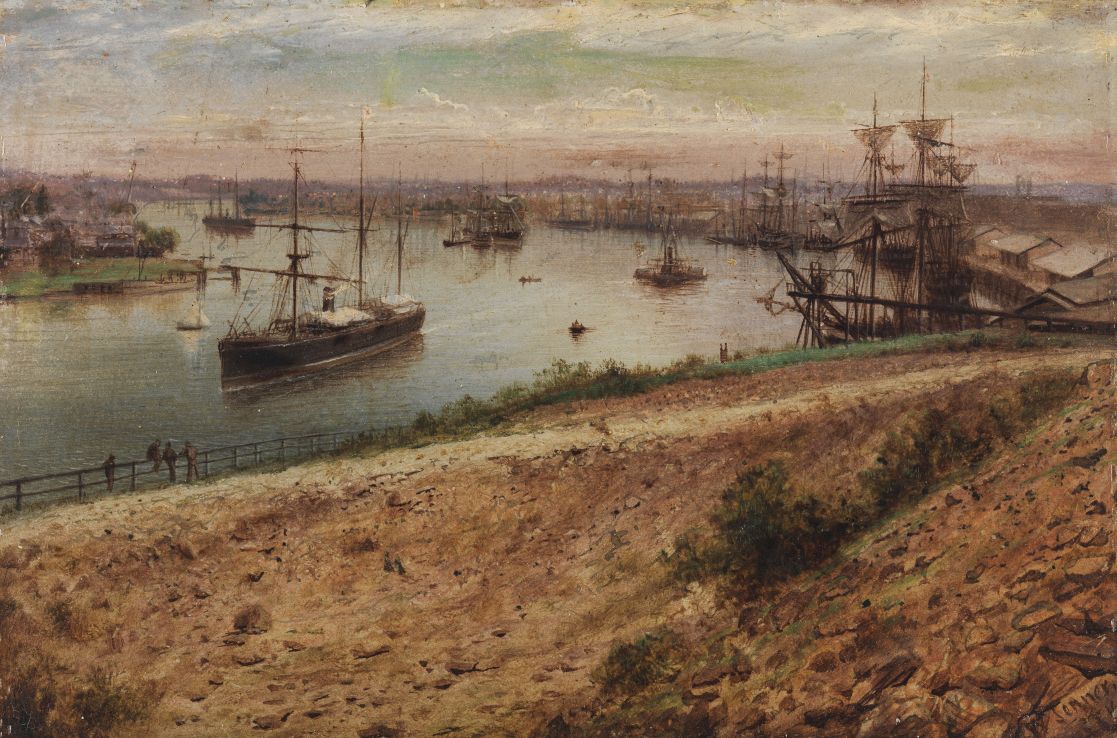
Isaac Walter Jenner Brisbane from Bowen Terrace, New Farm 1888

Isaac Walter Jenner, England/Australia 1836-1902 / Brisbane from Bowen Terrace, New Farm 1888 / Oil on board / 14.5 x 21.8cm / Purchased 1995. QAG Foundation / Collection: Queensland Art Gallery | Gallery of Modern Art / View full image
Wishart mainly painted scenes of Moreton Bay and the Brisbane River. A busy corner of the Brisbane River is the most significant of his works, when it was first exhibited at the Queensland International Exhibition in 1897 it was highly praised as ‘decidedly one of the attractions of the gallery’. The reviewer from The Queenslander on 15 May that year continued: ‘The monotony of colour noticed in many of Wishart’s early works, suggesting that photography and imagination took the place of a close study of the ever-varying and always perfect colouring of nature, has in this work entirely disappeared. All those accidental lights and tints of nature are beautifully reproduced’, with the reviewer commenting on the ‘brilliant and sunny’ depiction of Brisbane’s wharf-side activity.
The enthusiasm of the reviewer most probably indicates that the work’s tonal values have been much reduced in the intervening century, however the painting has since undergone major conservation.
Go behind-the-scenes as we delve into the painting's secrets
As a late 19th century painting, it has special conservation needs, these are mostly due to the difficulty of removing stubborn wax and varnish layers from thinly painted, sometimes solvent sensitive paint, in areas such as the rigging. The varnish had become yellowed and some of the in-painting which had been completed to reinstate or restore damaged areas had discoloured.
Infrared images of the painting indicate that Wichart prepared a very careful under-drawing, we can see exquisite outlining of the large ships and their rigging, as well as free sketching of figures and cargo, and the horizon of the Kangaroo Point cliffs.
Also revealed are many small changes, examination shows that the small boat in the foreground of the completed painting was an afterthought, as seen in the X-ray, the river continues through the boat design, and there is no sketch of it in the original composition.
Watch | Secrets revealed through art conservation
Eagle Street Wharves
A busy corner of the Brisbane River records the commercial activity at the Eagle Street Wharves, now part of Brisbane’s Central Business District. Towards the background, Wishart has captured the Bunya Pines in the Brisbane Botanic Gardens and further back, the light strikes the cliffs at Kangaroo Point.
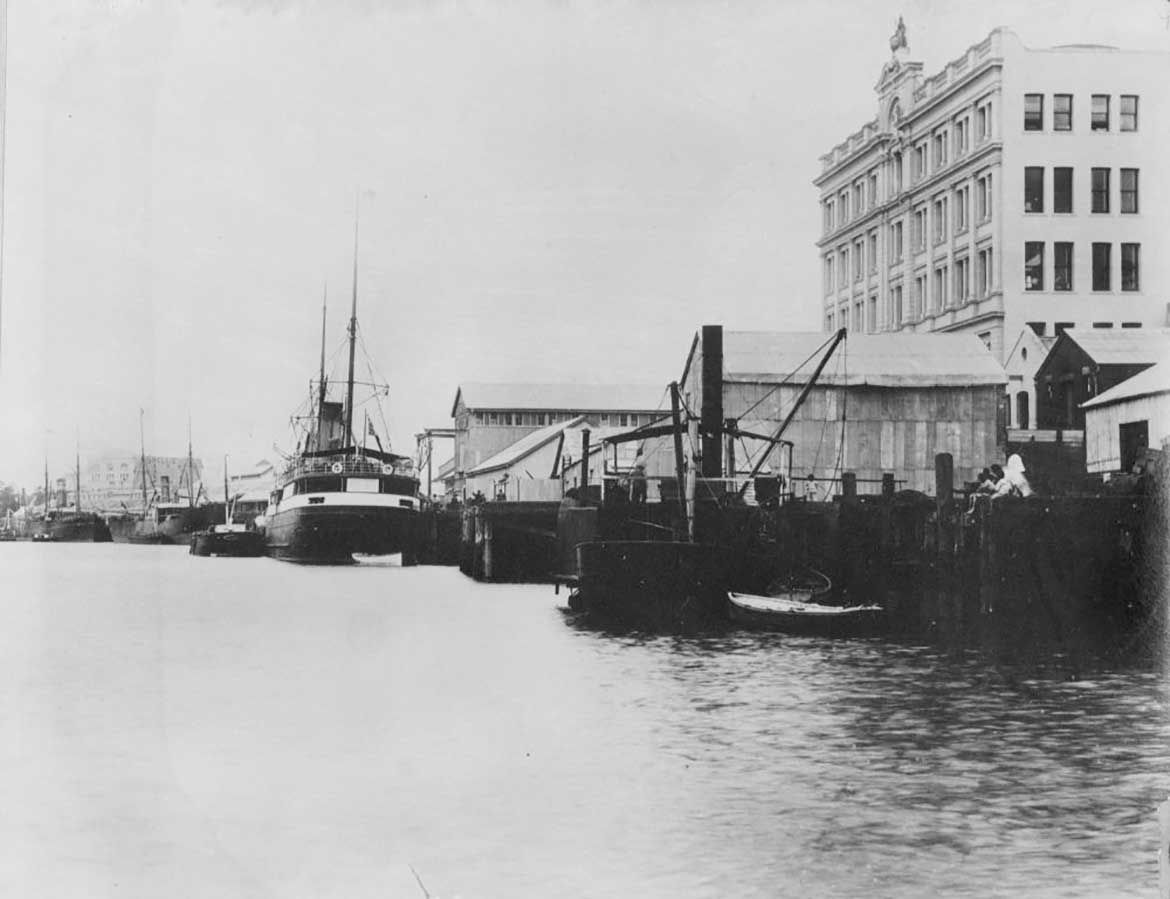
A photograph of the Australasian United Steam Navigation Company's (AUSN) Eagle Street Wharves and Thomas Browns & Sons building from 1898 (illustrated) shows the two galvanised iron covered warehouses that Wishart depicts, the row of windows set just below the roof-line in the distant building is particularly distinctive.
Eagle Street Wharves (AUSN Wharf and Thomas Browns & Sons Building), c.1898

Eagle Street Wharves (Australasian United Steam Navigation Company (AUSN) Wharf; Thomas Browns & Sons Building), Brisbane, c.1898 / Courtesy: John Oxley Library, State Library of Queensland, Brisbane / View full image
Eagle Street Wharves, 1880s

Raff’s Wharf, Eagle Street, Brisbane, c.1880 / 99183507784002061 / Courtesy: John Oxley Library, State Library of Queensland, Brisbane / View full image

Australasian United Steam Navigation Company
The first wharf along Eagle Street was built in 1859 by the Australasian Steam Navigation Company (ASN) where passenger and cargo ships would dock in Brisbane. By 1864, the wharves were expanded and extended in both directions, upstream and downstream.
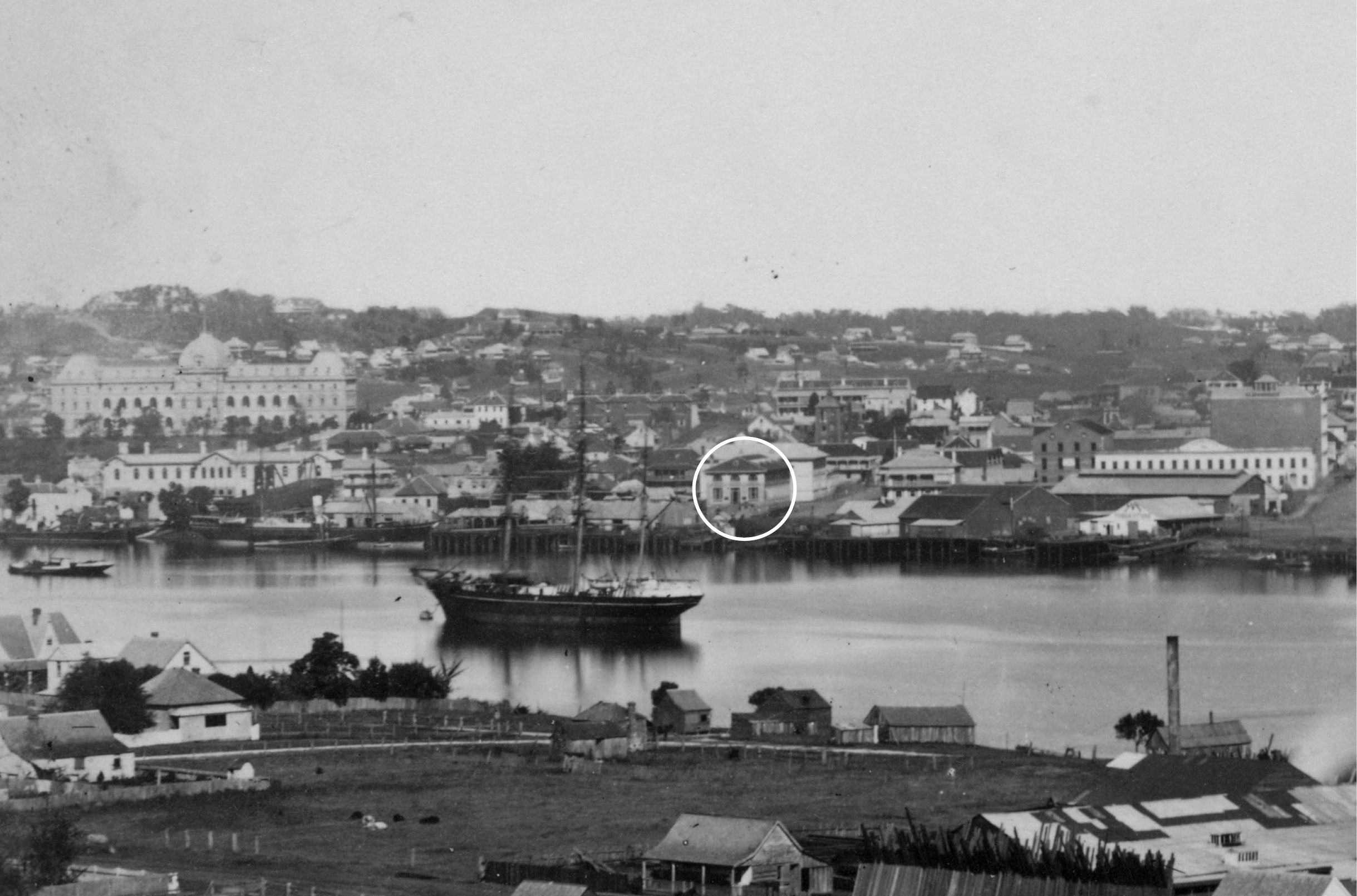
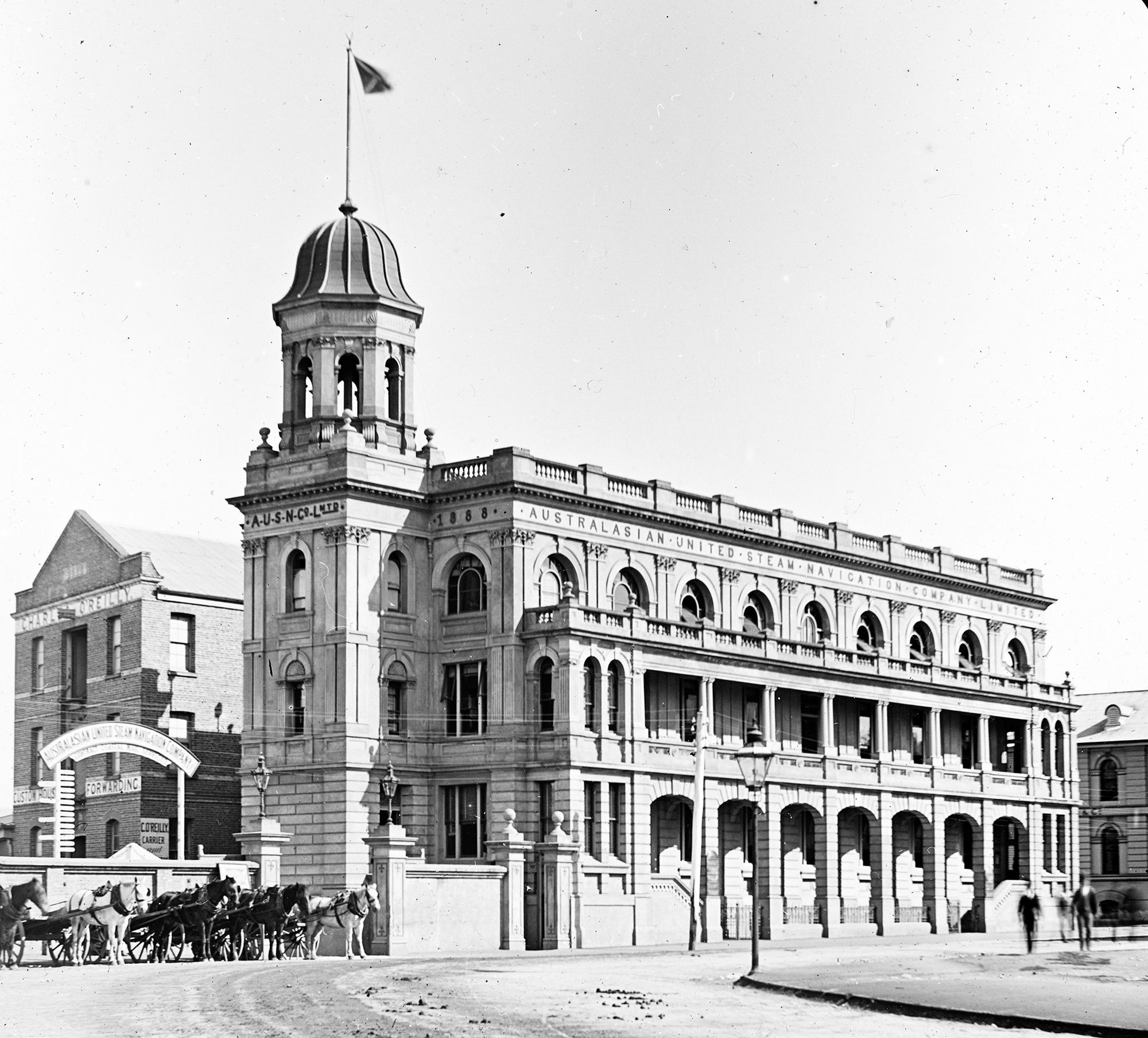
The ASN building that still sits on Mary Street was constructed in 1864 (illustrated), extended to Felix Street (1875–78), then substantially rebuilt with the upper level demolished and two floors added; along with the distinctive corner tower and cupola, an addition to represent the company's status; and a balcony onto Mary Street (1888–89).
In the mid-1880s ASN amalgamated with several other shipping companies to form the Australasian United Steam Navigation Company (AUSN) which became a dominant force in Queensland shipping. In 1914, MacDonald Hamilton & Co became agents for AUSN, they were responsible for the name change to Naldham House which was the firm's telex address, derived from the middle letters of their name: ‘macdoNALD+HAMilton’
Brisbane panorama featuring the Australasian Steam Navigation Company building, c.1880

Brisbane panorama (detail) c.1880 / Albumen photograph on paper / Two panels: 20.3 x 24.8cm (each) / Purchased 2002. Queensland Art Gallery Foundation / Collection: Queensland Art Gallery | Gallery of Modern Art / View full image
Australasian United Steam Navigation Company, c.1889

Office of the Australasian Steam Navigation Company, Mary Street, Brisbane c.1889 / 1344548 / Courtesy: State Library New South Wales / View full image
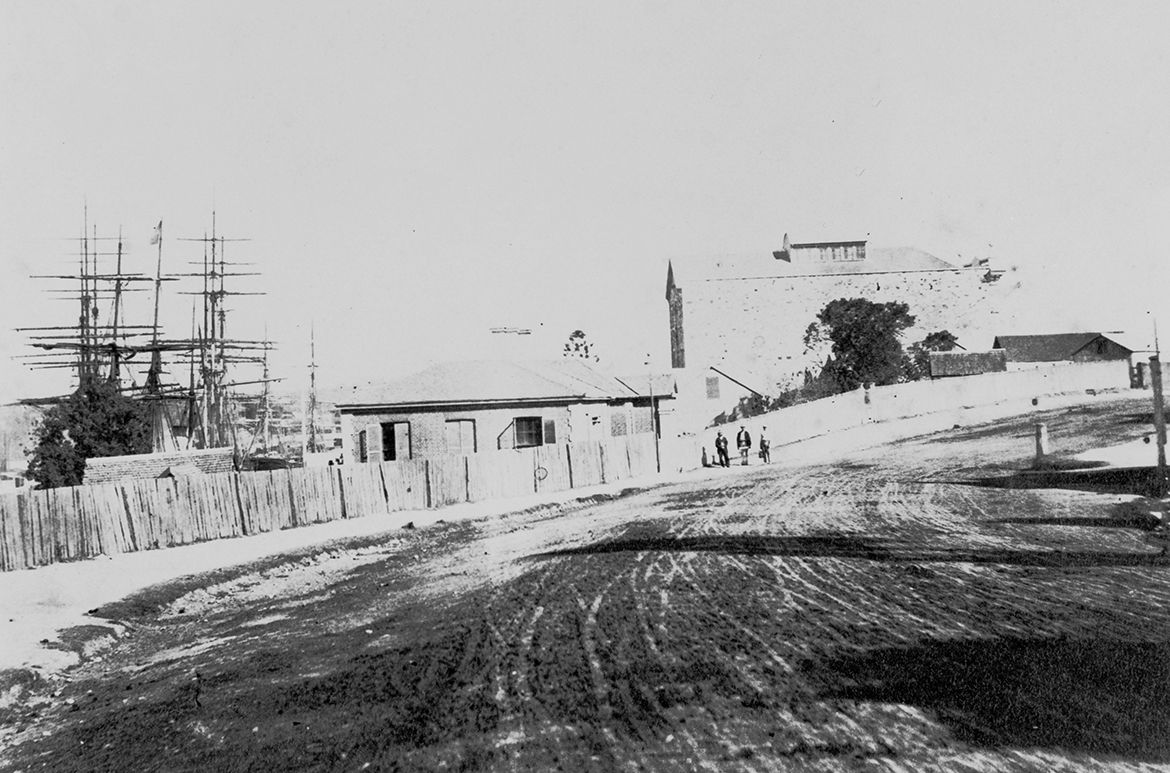
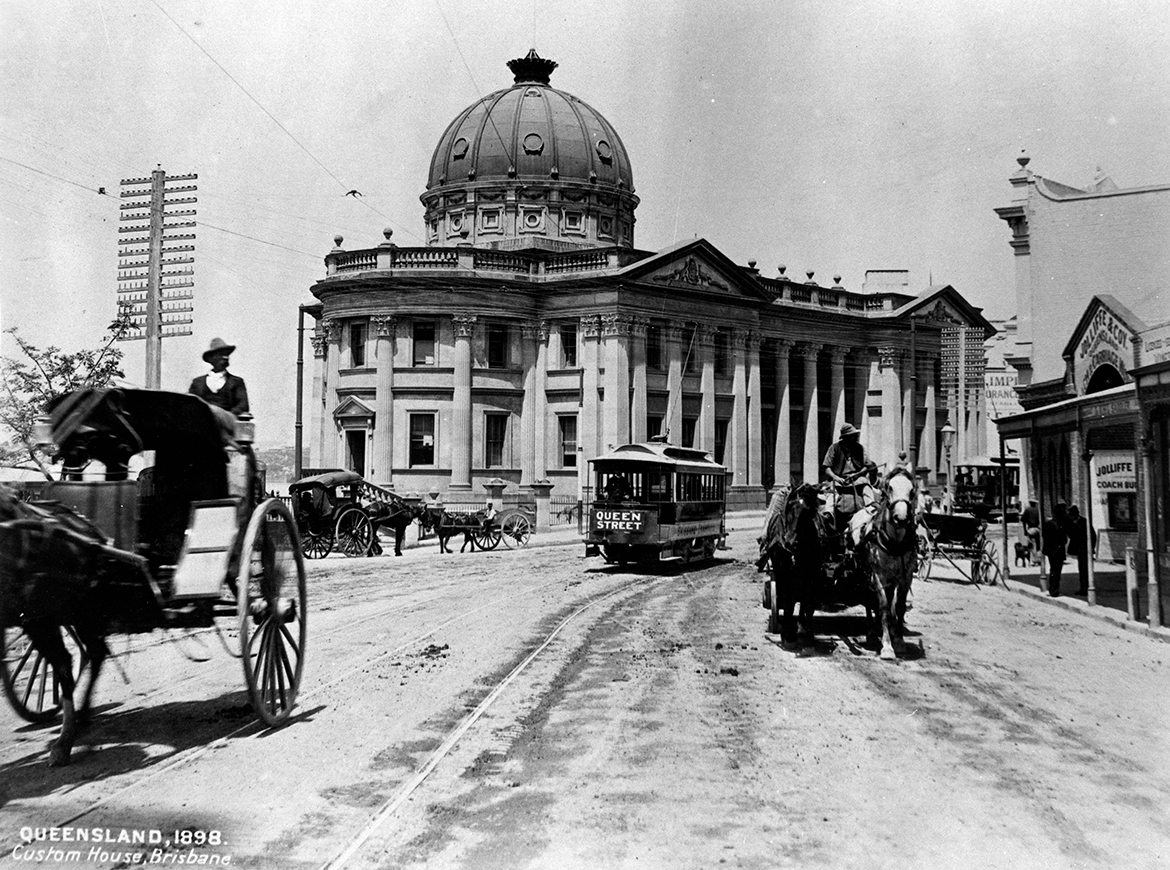
The construction of the second Customs House on Queen Street (illustrated) with river frontage, stimulated wharf development around the Eagle Street Wharves with the grand new building opening on the site of its predecessor (illustrated) in 1889. This confirmed that the Petrie Bight area was still the heart of the port of Brisbane for some time.
(First) Customs House, c.1873

First Customs House on the Brisbane River, c.1873 / 99183506729102061 / Courtesy: John Oxley Library, State Library of Queensland, Brisbane / View full image
(Second) Customs House, 1898

(Second) Customs House, Brisbane, 1898 / 65241 / Courtesy: John Oxley Library, State Library of Queensland, Brisbane / View full image
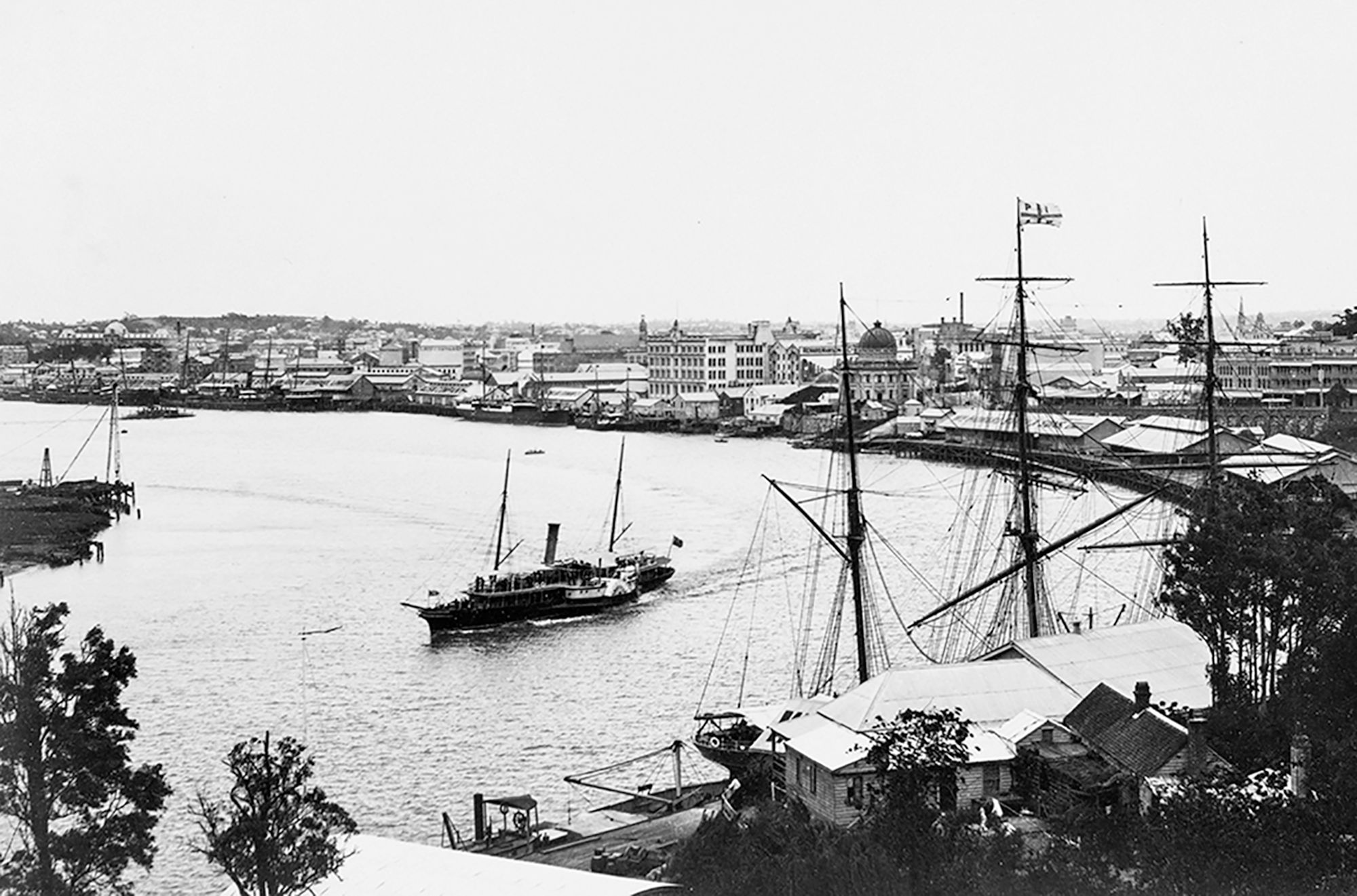
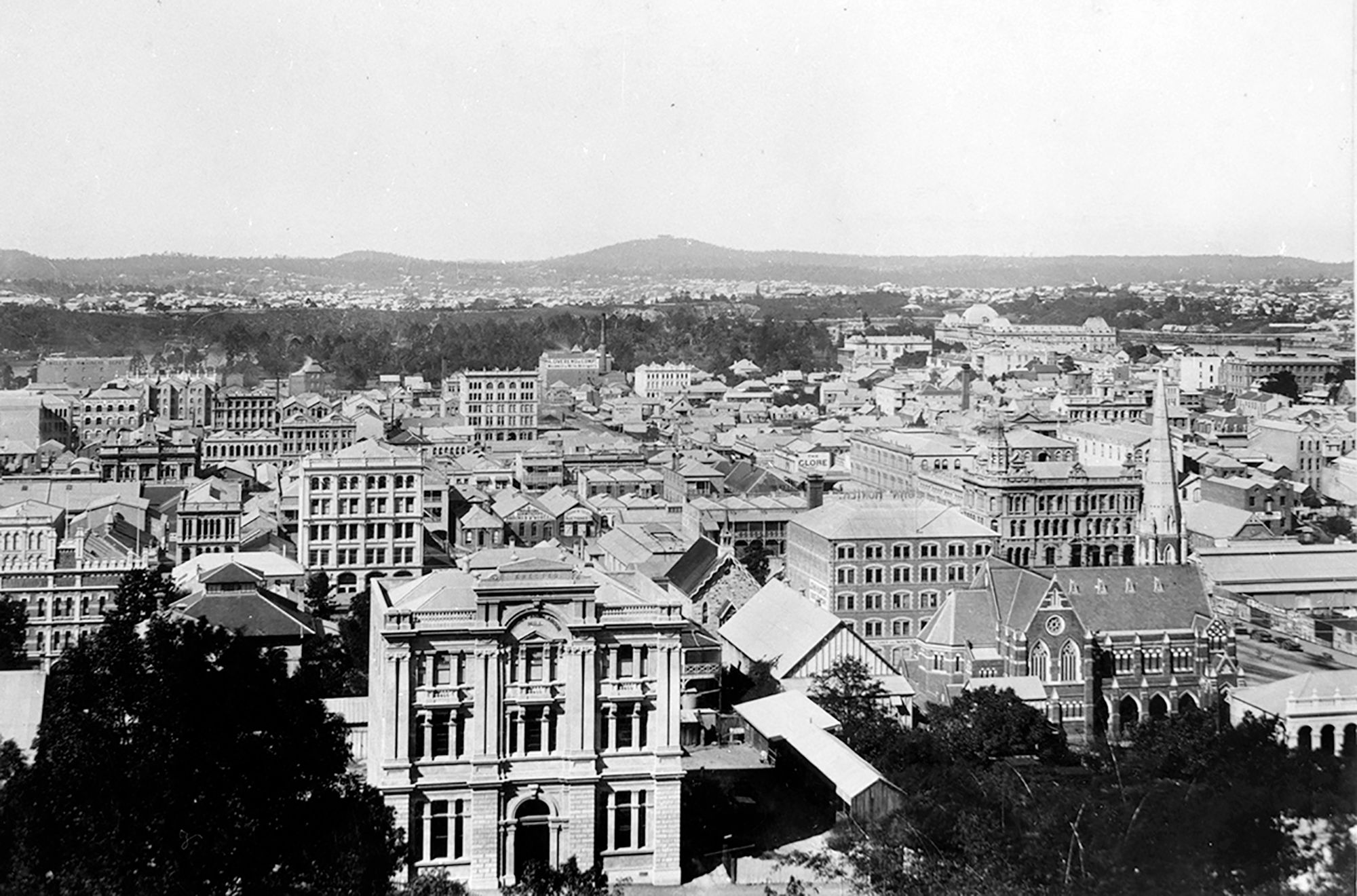
Downstream from the Customs House, wharf development occurred a little later, extending towards the bend of the river opposite Kangaroo Point below Bowen Terrace (illustrated), then further downstream around Newstead.
Today, the original Eagle Street Wharf is home to waterfront dining, with the Eagle Street Pier further enhanced by the Howard Smith Wharves entertainment precinct downstream under the Story Bridge.
Brisbane viewed from Bowen Terrace, 1897

Brisbane viewed from Bowen Terrace, 1897 / 99184501138102061 / Courtesy: John Oxley Library, State Library of Queensland, Brisbane / View full image
Wishart’s A busy corner of the Brisbane River was painted when Brisbane marked a significant shift towards modernisation, recovery, and the rise of local manufacturing, moving from its colonial originals toward a modern, connected city.
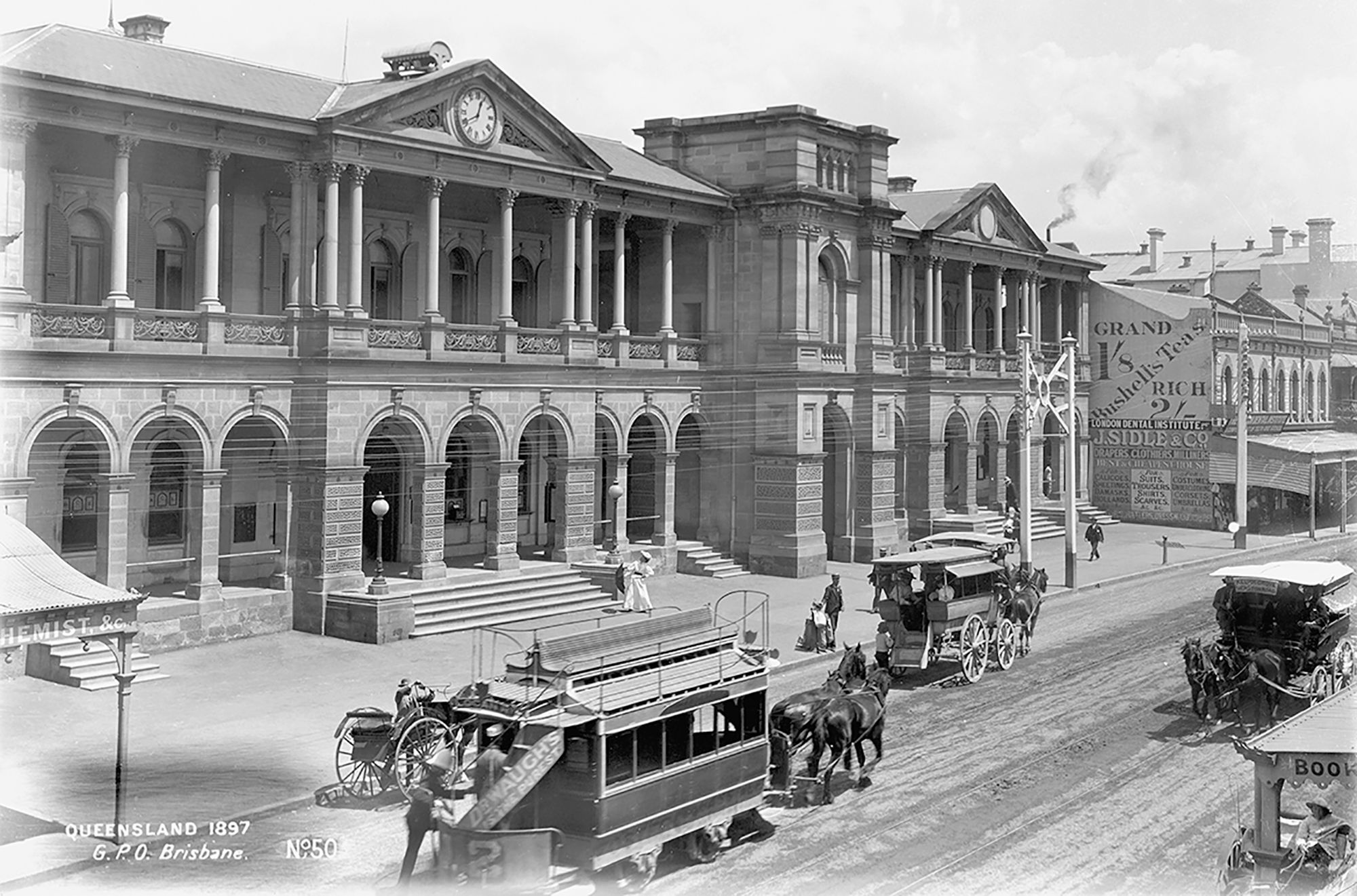
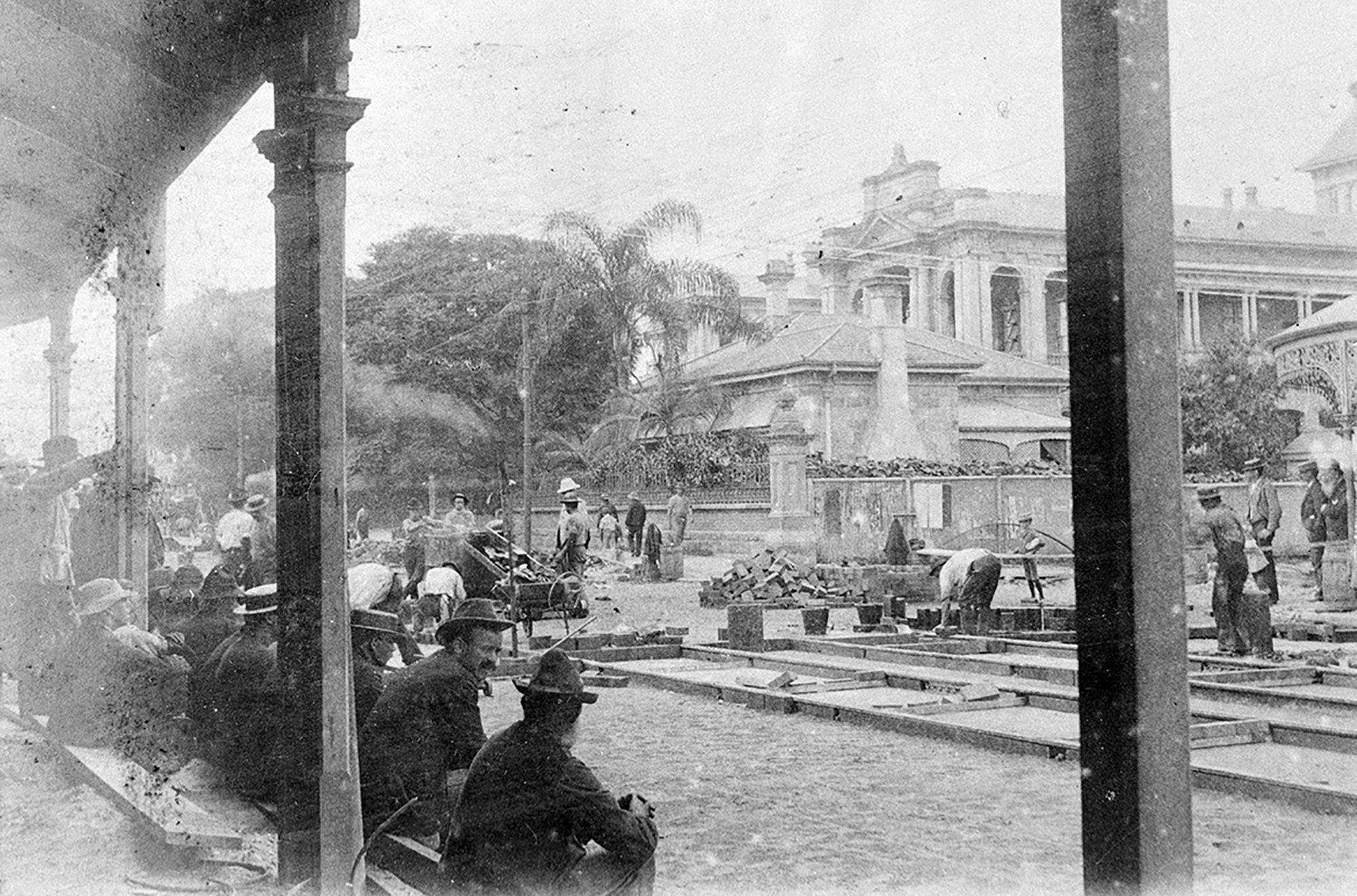
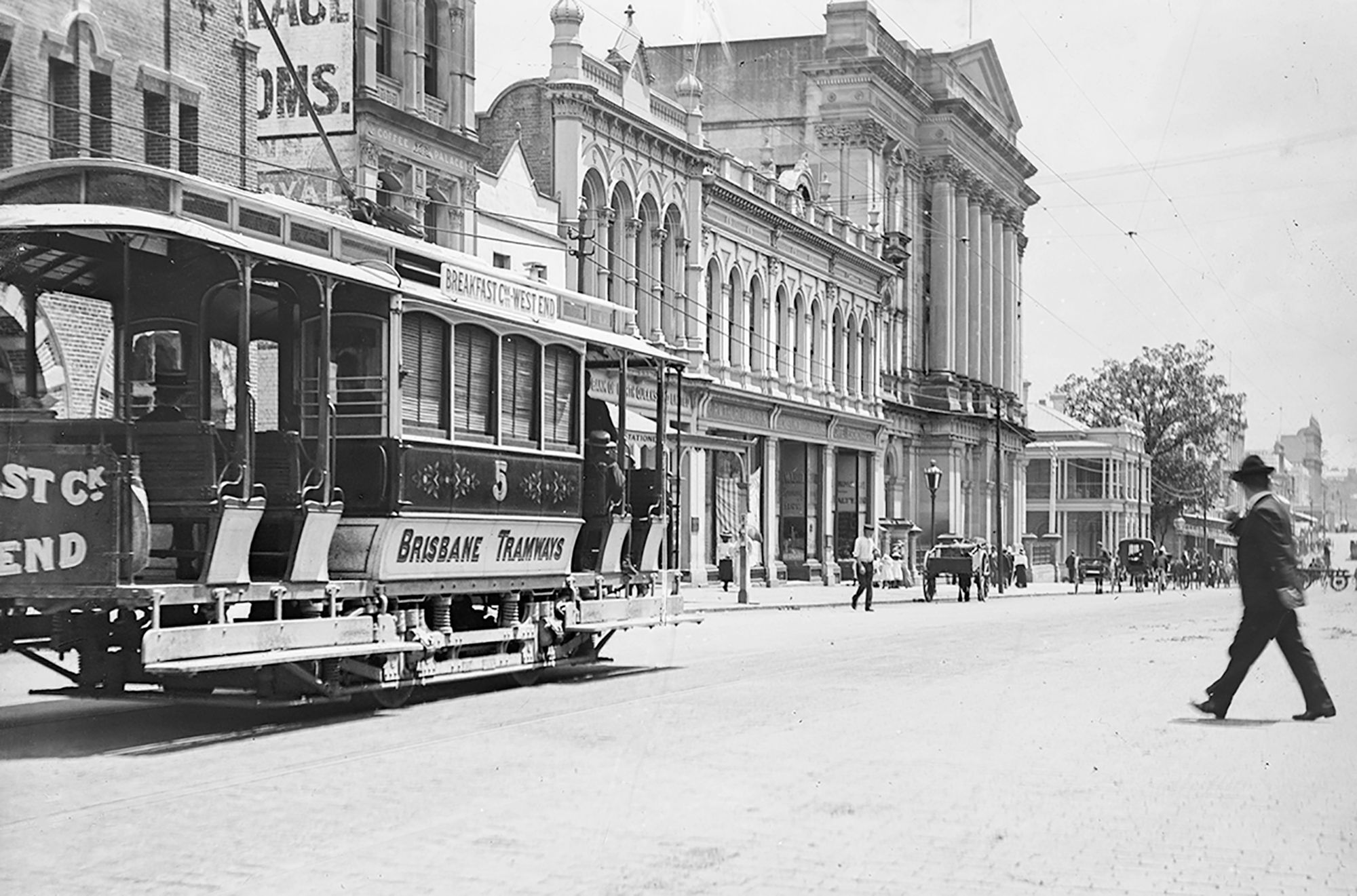
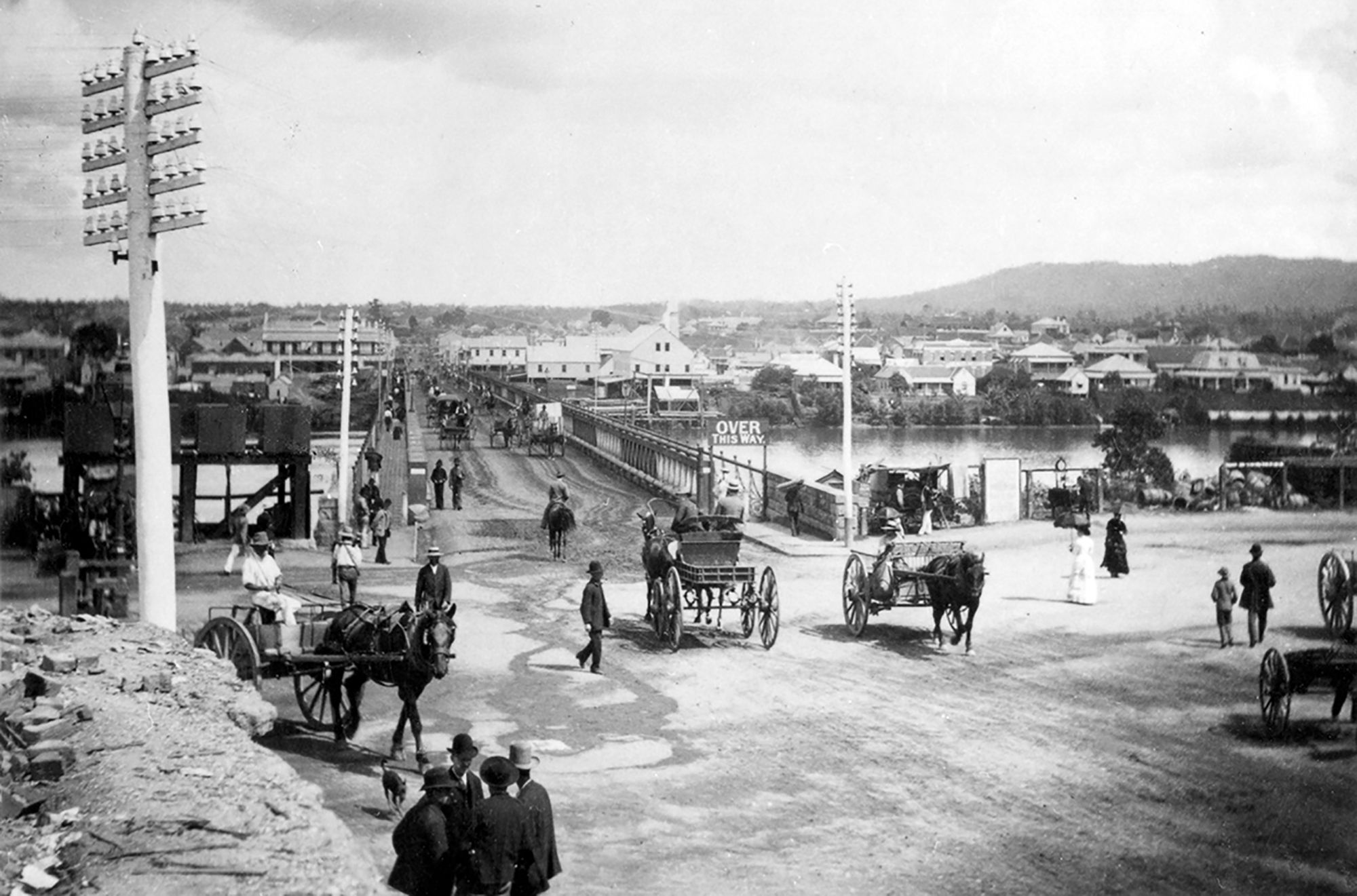
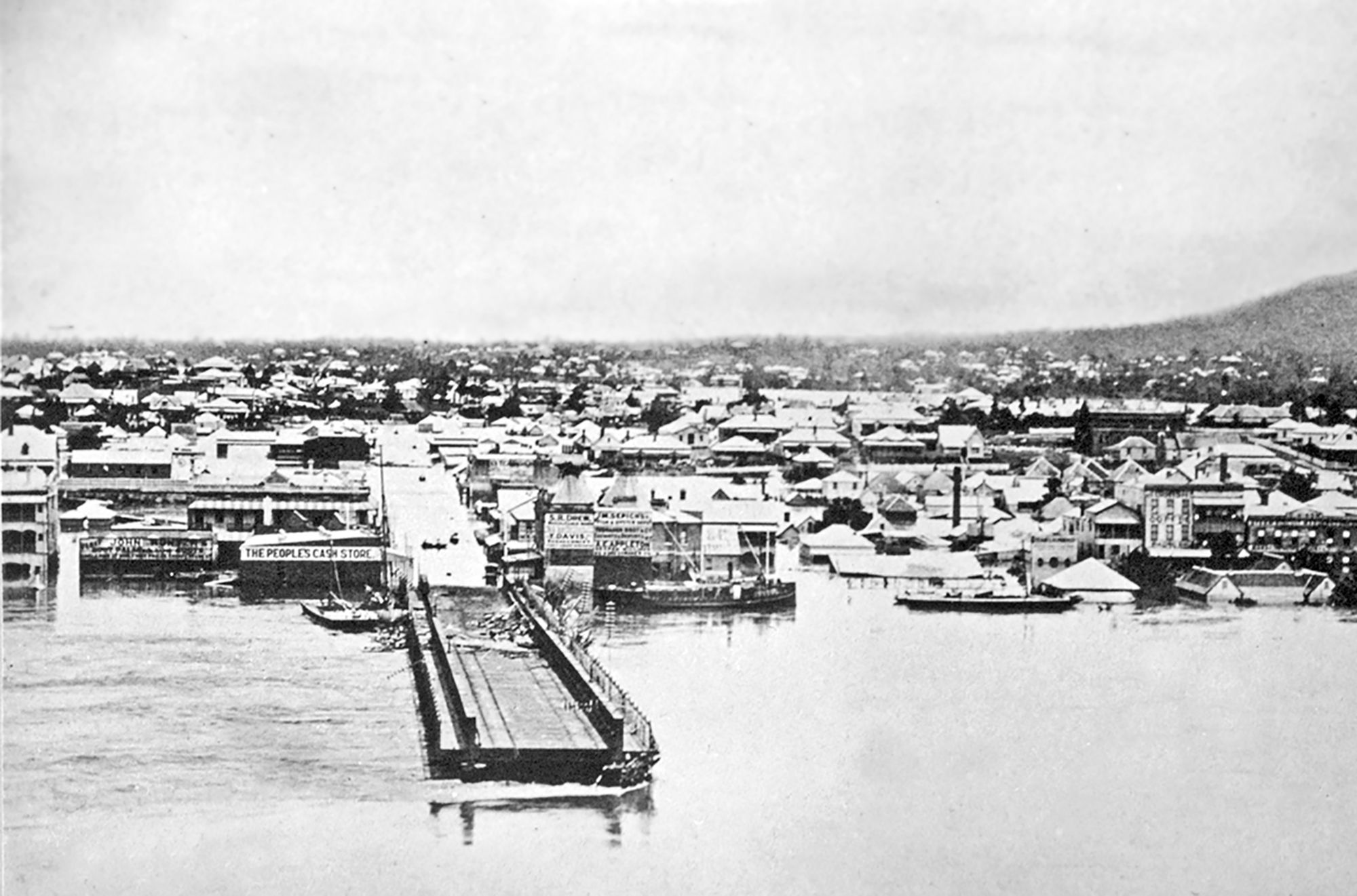
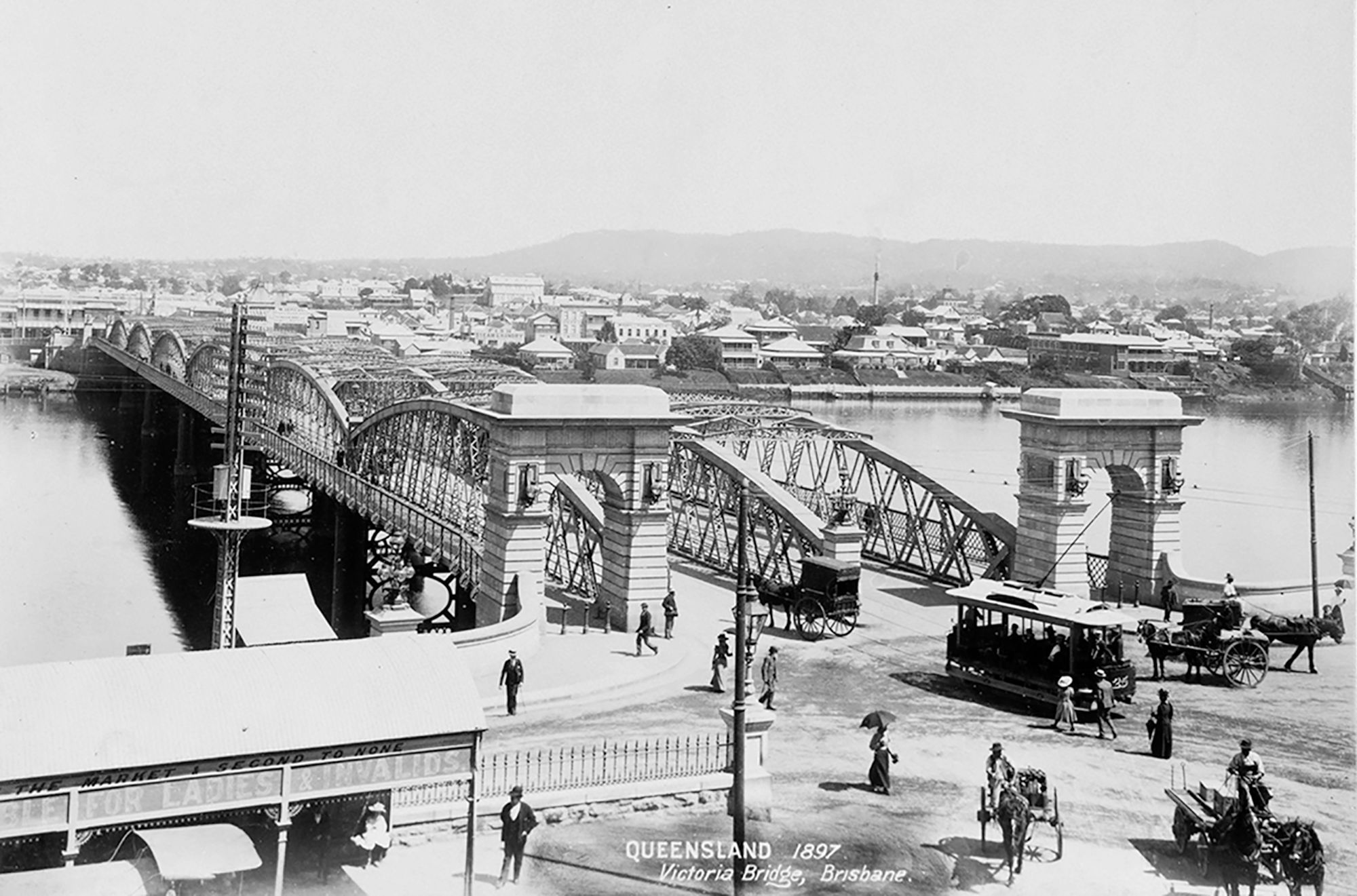
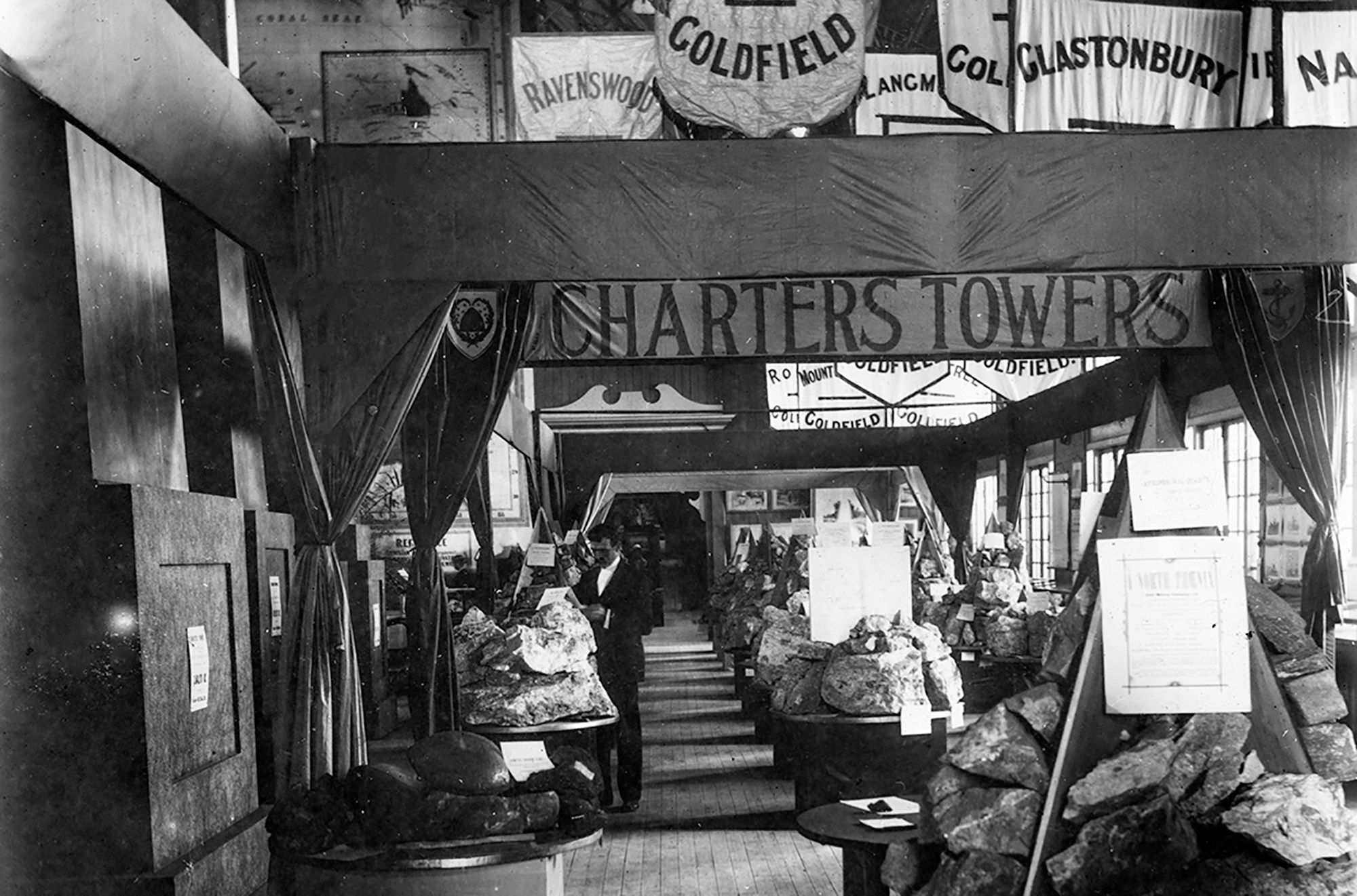
Highlights of the year included the introduction of electric trams replacing horse-drawn trams (illustrated); the opening of a new iron bridge — the second Victoria Bridge linking South Brisbane with North Quay and the town’s business district — replacing the previous bridge partially destroyed by the 1893 floods (illustrated); and the Queensland International Exhibition, celebrating the state’s economic recovery from the early 1890s depression showcasing mining and agricultural courts including international exhibits (illustrated). By 1897 Charters Towers in North Queensland had established itself as the richest goldfield in Australia as well as an internationally-noted goldfield for many years.
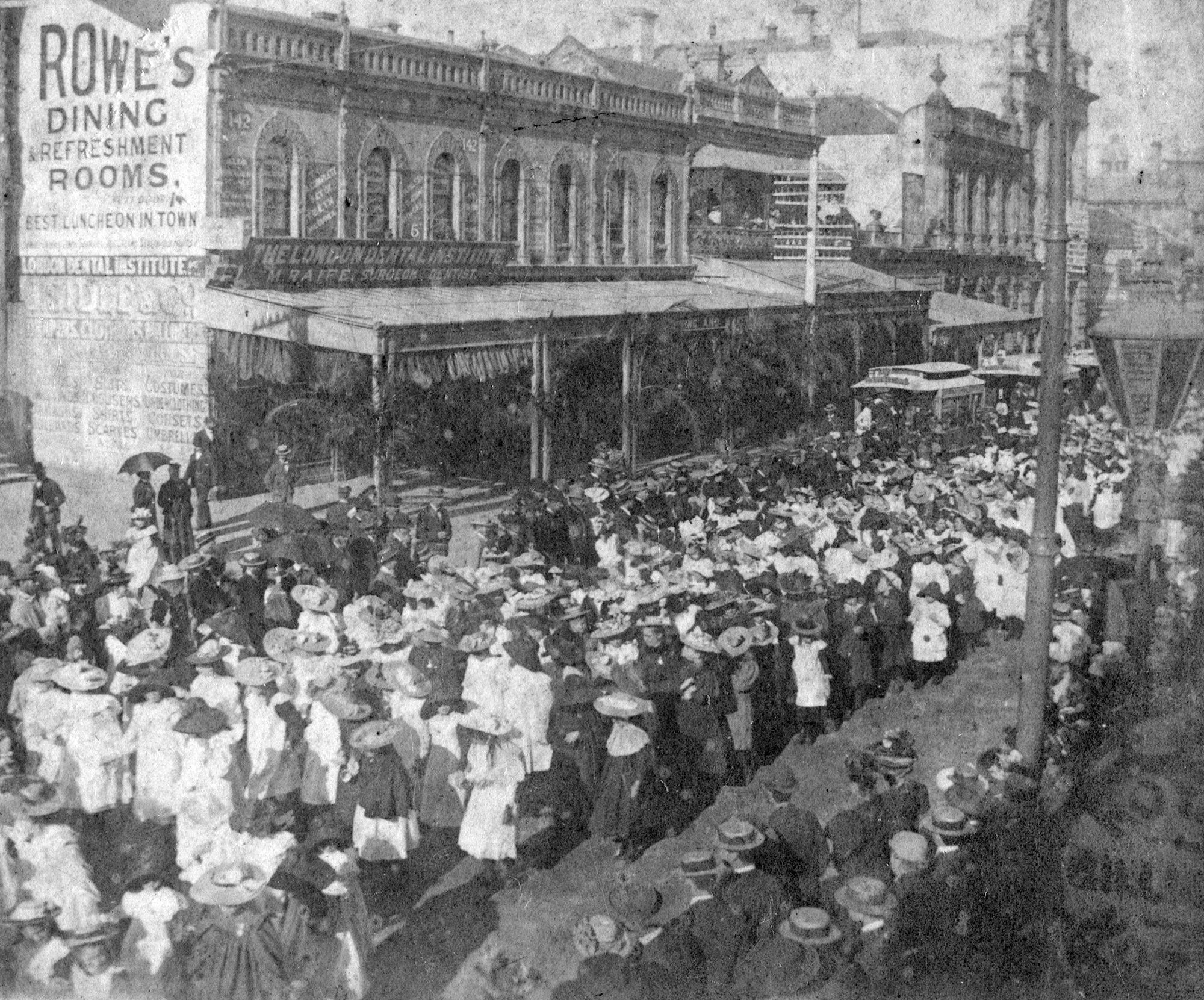
Celebrating Queen Victoria’s Diamond (60th) Jubilee with widespread public celebrations including a procession with an estimated 15,000 schoolchildren, teachers, and civic leaders that marched from Queen Street to the Exhibition Ground on Gregory Terrace, with around 40,000 people present for the festivities (illustrated).
We must also look at this painting considering coal-fired steamships — and early steamers which carried a full set of sails — started replacing sailing ships as the dominant mode of transport for passengers and cargo in Australia from the 1880s with the introduction of more efficient engines. We can see a nod to the future as Wishart has painted a steamship with its smokestack just in view behind the imposing fully rigged sailing ship in the foreground.
Brisbane's Central Business District, c.1897

Central Business District, Brisbane, c.1897 / 99183787998102061 / Courtesy: John Oxley Library, State Library of Queensland, Brisbane / View full image
Horse-drawn trams passing along Queen Street, 1897

Queen Street, Brisbane, 1897 / ID ITM1108377 / Courtesy: Queensland State Archives / View full image
Workers laying tramway tracks, 1897

Workers laying tramway tracks at the intersection of George and Ann Streets, Brisbane, 1897 / 99183506083802061 / Courtesy: John Oxley Library, State Library of Queensland, Brisbane / View full image
Tramway passing along Queen Street, c.1897

Brisbane Tramways, Tram Number 5 passing along Queen Street, Brisbane, c.1897 / 99184501132302061 / Courtesy: John Oxley Library, State Library of Queensland, Brisbane / View full image
First Victoria Bridge, North Quay, c.1880

First permament Victoria Bridge, North Quay, Brisbane, c.1880 / ID ITM1443237 / Courtesy: Queensland State Archives / View full image
First Victoria Bridge destroyed by flood, 1893

First permanent Victoria Bridge destroyed by flood, 1893 / ID ITM1019118 / Courtesy: Queensland State Archives / View full image
Second Victoria Bridge, North Quay, 1897

Victoria Bridge at North Quay, Brisbane, 1897 / 99184501137502061 / Courtesy: John Oxley Library, State Library of Queensland, Brisbane / View full image
Display of Charters Towers gold, Queensland International Exhibition, 1897

Specimens from Charters Towers gold fields, Queensland International Exhibition, 1897 / 99184330014702061 / Courtesy: John Oxley Library, State Library of Queensland, Brisbane / View full image
Jubilee Procession, Queen Street, 1897

Jubilee Procession, Brisbane, 1897 / 99183506771402061 / Courtesy: John Oxley Library, State Library of Queensland, Brisbane / View full image
Curatorial and Conservation extracts, research and supplementary material sourced and compiled by Elliott Murray, Senior Digital Marketing Officer, QAGOMA
Go back in time to discover Brisbane’s forgotten landmarks, delve into our historical past, and uncover unique stories through the work of Australian artists in QAGOMA’s Collection.
On display in Australian Art Collection
Queensland Art Gallery
Galleries 10, 11, 12 & 13 (Josephine Ulrick and Win Schubert Galleries)
Queensland Art Gallery | Gallery of Modern Art (QAGOMA)
Brisbane, Australia