
Edgar Degas captures the character of the modern age

(l-r) after Edgar Degas, Artist, France 1834-1917 / Georges William Thornley, Lithographer, 1857-1935 / Les Jockeys (The jockeys) c.1888-89 / Le Bain (The bath) c.1888 / Collection: Queensland Art Gallery | Gallery of Modern Art / View full image
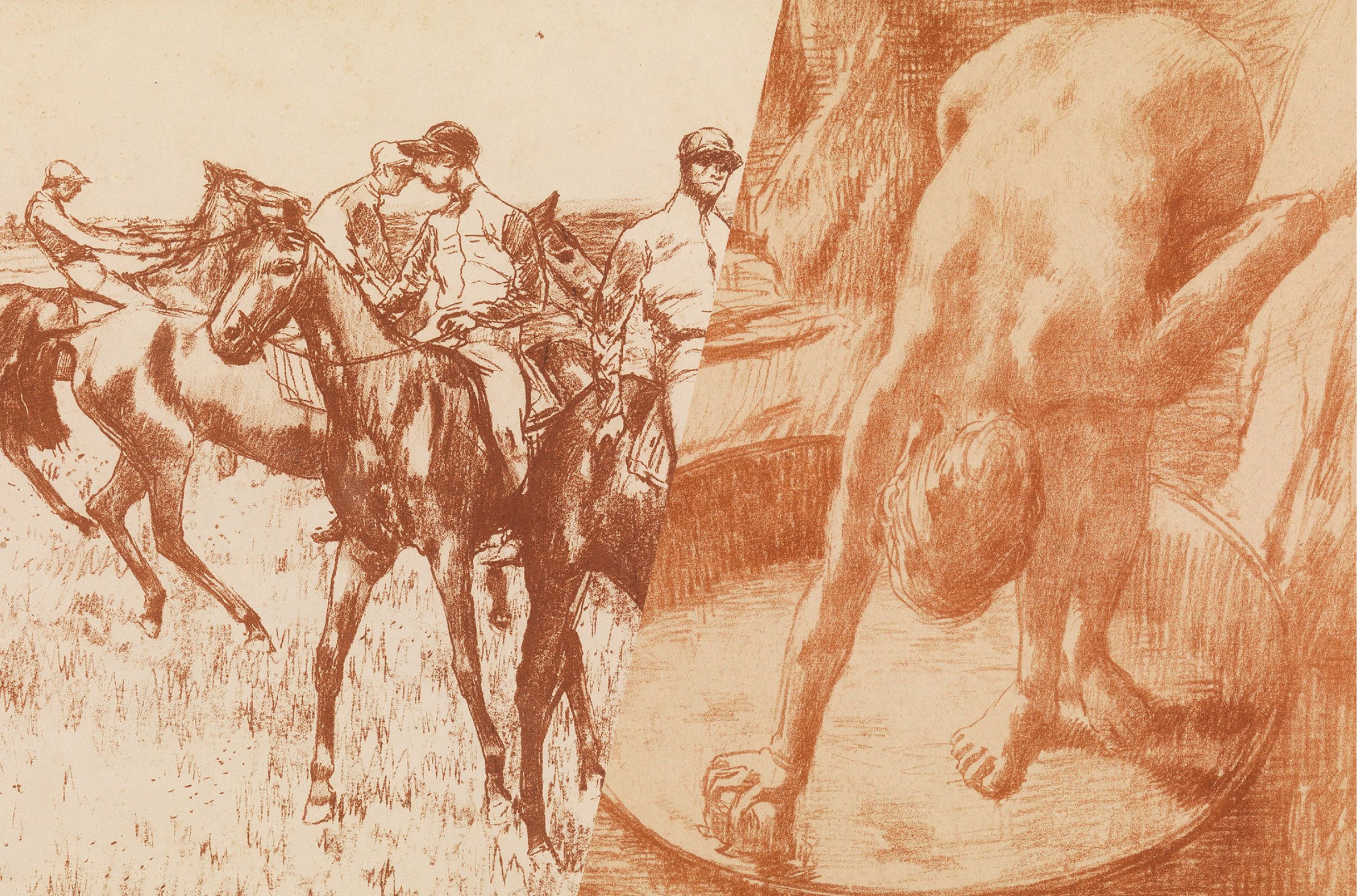
Two lithographs after Edgar Degas (19 July 1834–1917) introduce two themes of interest to the great French impressionist — horse racing, and capturing his subjects in natural or unguarded moments.
Images of horse racing were a primary focus for Degas throughout his career. The spectacle of the race itself was a relatively modern phenomenon in France in the mid to late 1800s.
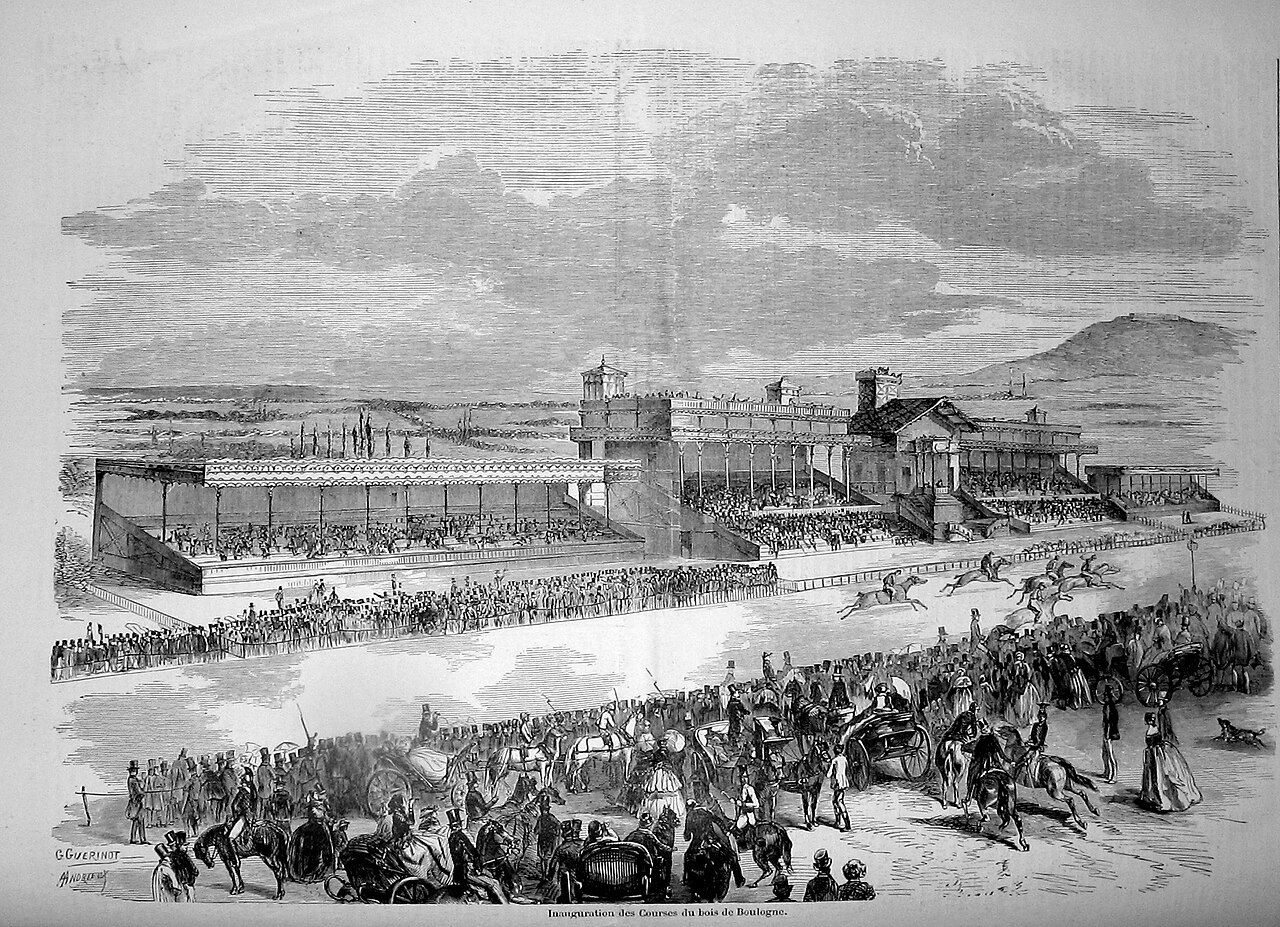
The Hippodrome de Longchamp in the Bois de Boulogne in the outskirts of Paris opened in 1857 (illustrated), with its spring racing season becoming an important event in the social calendar of Parisian society, and the movement, colour and glamour of Longchamp became the subject matter for Degas’s equestrian scenes, which typified a modern urban landscape of leisure and novelty.
Hippodrome de Longchamp, 1857

Hippodrome de Longchamp / Inauguration des Courses du bois de Boulogne (Inauguration of the Bois de Boulogne Races) / Published in the 2 May, 1857 edition of the French weekly magazine Le Monde illustré featuring the horse races at the Bois de Boulogne shortly before the formal opening of the Longchamp Hippodrome / View full image
(after Edgar Degas) Georges William Thornley Les Jockeys c.1888-89

after Edgar Degas, Artist, France 1834-1917 / Georges William Thornley, Lithographer, 1857-1935 / Les Jockeys (The jockeys) c.1888-89 / Crayon manner lithograph (from transfer paper); printed in red/brown ink on paper (chine collé), laid down on green paper backing sheet / 20.9 x 24.4cm (comp.) / Gift of the Margaret Olley Art Trust through the QAG Foundation 2012 / Collection: Queensland Art Gallery | Gallery of Modern Art / View full image
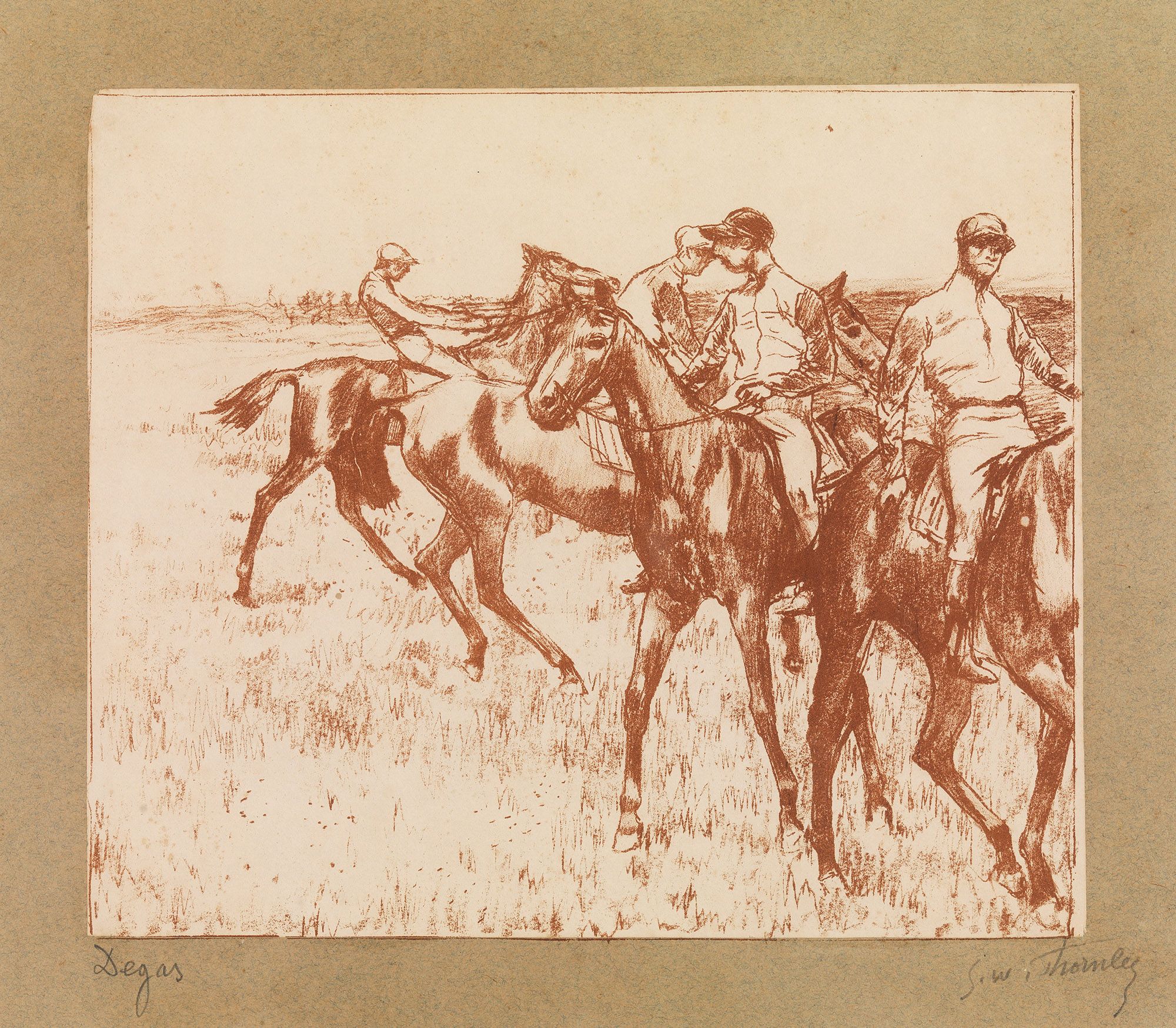
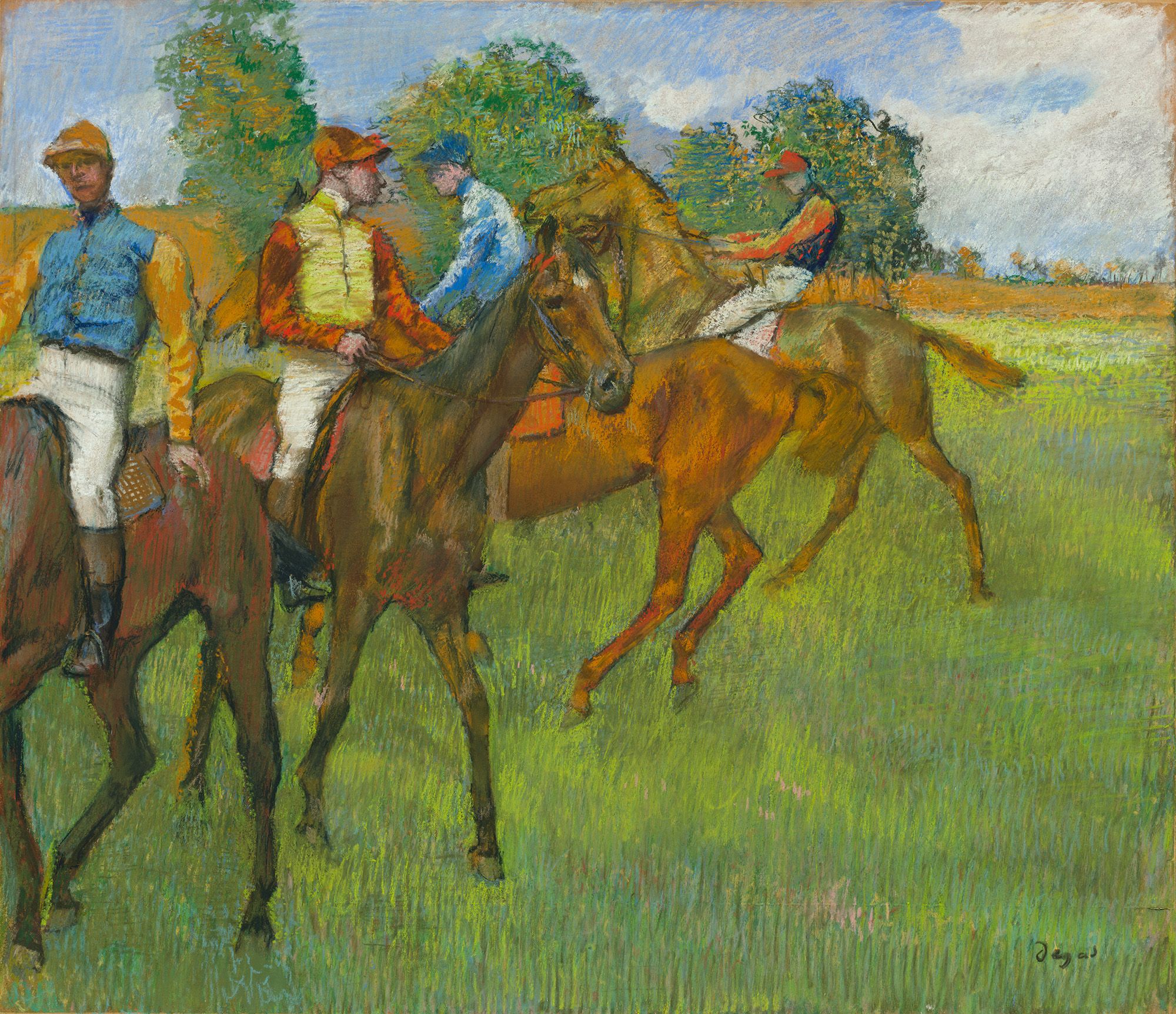
In the mid 1880s, Degas became involved with a number of professional printers working in Paris. Notable among them was lithographer Georges William Thornley (2 May 1857–1935), and his Les Jockeys (The jockeys) c.1888–89 is a copy in reverse after Degas’s pastel drawing Before the race c.1887–89, in the collection of the Cleveland Museum of Art, Ohio (illustrated).
It is a proof ‘before letters’, signed by both Degas and Thornley, and was published in Quinze lithographies d’après Degas (1889) by Boussod, Valadon & Cie (19 Boulevard Montmatre, Paris) in 1889, in an edition of 100 impressions (plus 25 proofs).
Edgar Degas Before the Race c.1887–89

Edgar Degas, France 1834–1917 / Before the Race c.1887–89 / Pastel with charcoal underdrawing on tracing paper mounted on cardboard / 57.5 x 65.4 cm / Bequest of Leonard C. Hanna Jr. 1958 / Collection: Cleveland Museum of Art, Ohio / View full image
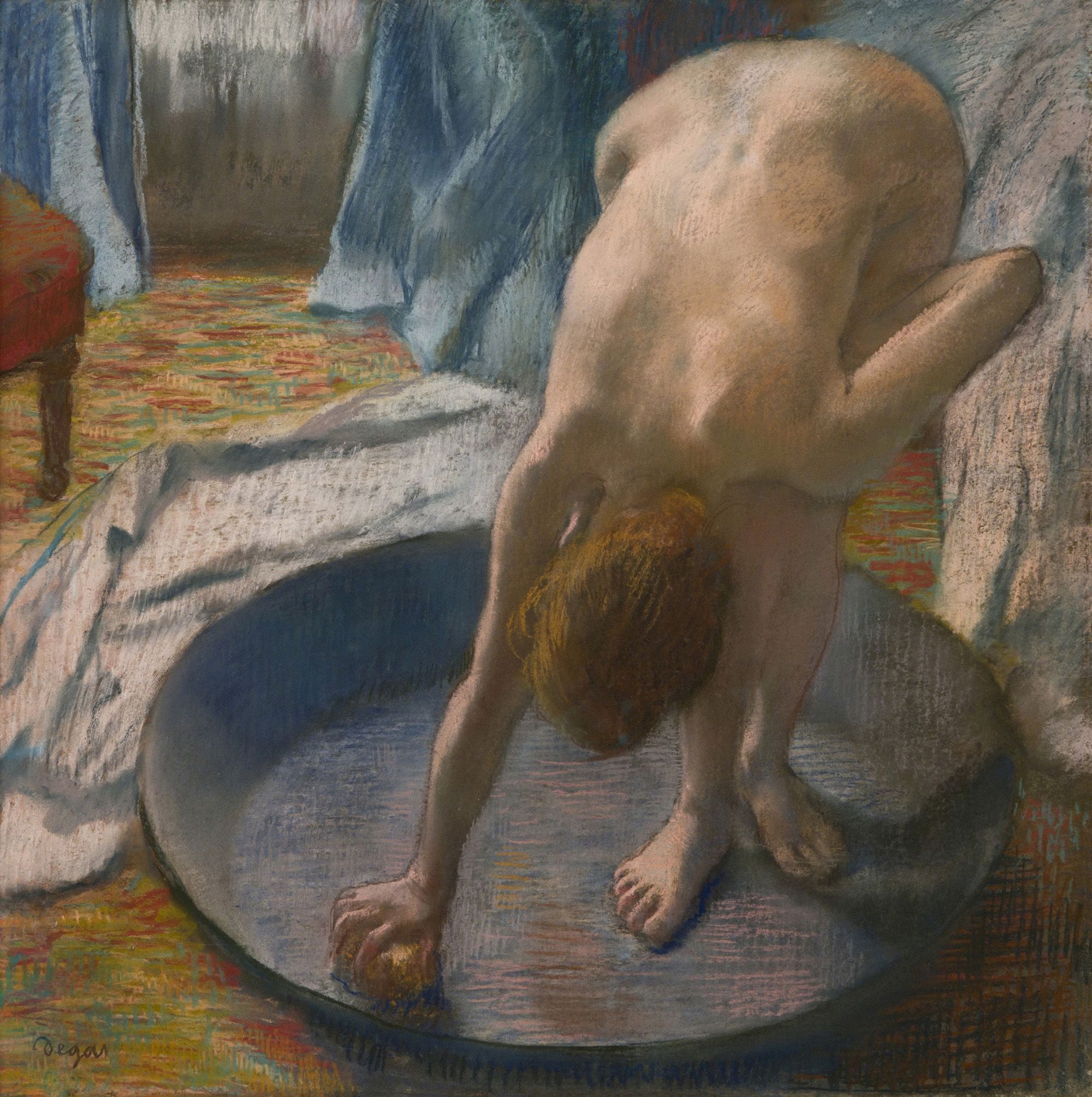
Le Bain (The tub) c.1888 is after Degas’s pastel drawing Le tub 1886, in the collection of Hill-Stead Museum in Farmington, Connecticut (illustrated), and was made for the same portfolio. The print is signed, on the stone, by Thornley and inscribed with the publication details, including the publisher’s name and address and the printer, ‘Becquet’, a Parisian printing studio established in the 1830s.
(after Edgar Degas) Georges William Thornley Le Bain c.1888

after Edgar Degas, Artist, France 1834-1917 / Georges William Thornley, Lithographer, 1857-1935 / Le Bain (The bath) c.1888, published 1889 (in ‘Quinze lithographies d’après Degas’ (Paris: Boussod & Valadon)) / Crayon manner lithograph (from transfer paper); printed in red/brown ink on paper (chine collé), laid down on green paper backing sheet / 20.3 x 20.2cm (comp.) / Gift of the Margaret Olley Art Trust through the QAG Foundation 2012 / Collection: Queensland Art Gallery | Gallery of Modern Art / View full image
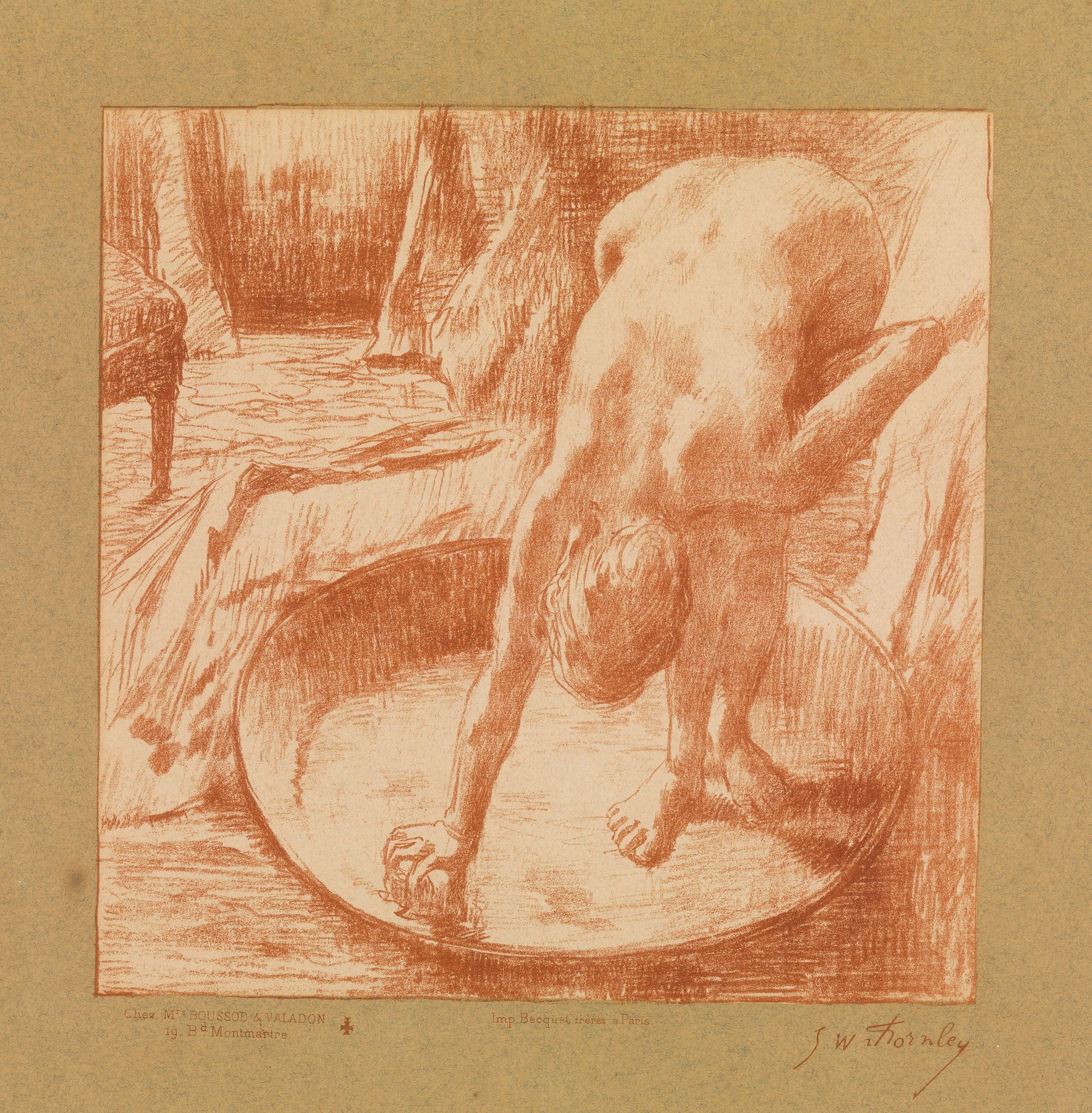
From the 1880s on, Degas became increasingly focused on the figure in his compositions. Known for his realist tendencies, an essential part of the artist’s work was his attempt to capture people in natural or unguarded moments. In a significant series of pastels created in the 1880s, Degas depicted women bathing or at their toilette.
In these works, Degas rejected the conventional poses of the academic nude and showed the figure ‘preoccupied with herself’, as though unaware of being observed. These prints by Thornley reveal Degas’s extraordinarily modern attitude towards how his work should be viewed, reproduced and distributed.
Edgar Degas The tub 1886

Edgar Degas, France 1834–1917 / The tub 1886 / Pastel on blue-grey paper / 69.9 x 69.9 / Collection: Hill-Stead Museum / View full image
Le Bain makes an interesting partner to the superb bronze sculpture Danseuse regardant la plante de son pied droit (Dancer looking at the sole of her right foot) c.1882-1900 in the QAGOMA Collection. Both depict a woman ‘caught unawares’ in an unusual pose. Both print and sculpture are intriguing examples of Degas’s ambivalent attitude to female beauty, as well as his interest in suggesting, through unconventional viewpoints, the character of the modern age.
Edgar Degas Danseuse regardant la plante de son pied droit c.1882-1900

Edgar Degas, France 1834-1917 / Danseuse regardant la plante de son pied droit, quatrième étude (Dancer looking at the sole of her right foot, fourth study) c.1882-1900, cast before 1954 / Bronze, dark brown and green patina / 46.2 x 25 x 18cm / Gift of Philip Bacon AM, in memory of Margaret Olley AC, through the QAG Foundation 2012. Donated through the Australian Government’s Cultural Gifts Program / Collection: Queensland Art Gallery | Gallery of Modern Art / View full image
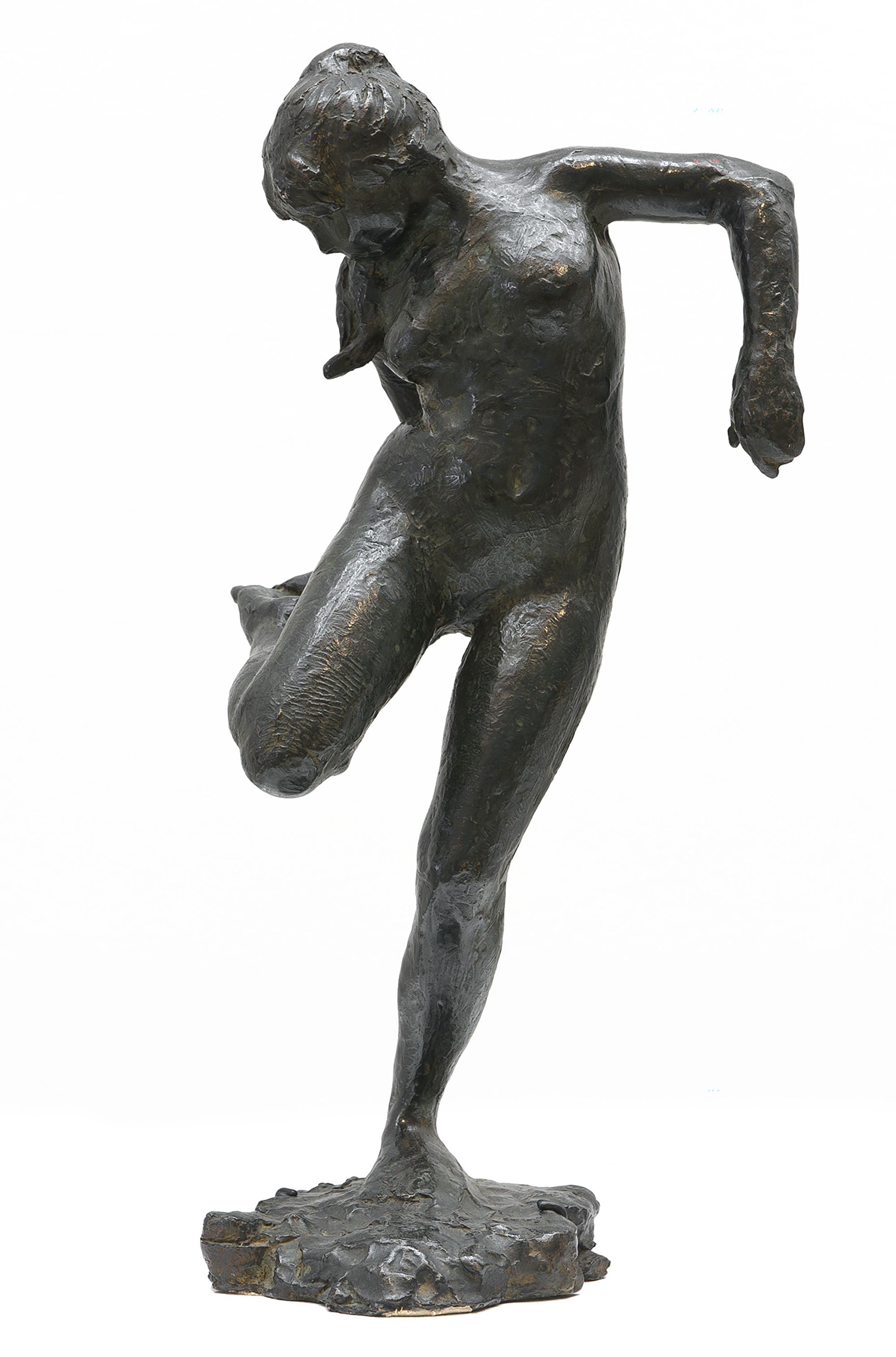

Edgar Degas, France 1834-1917 / Danseuse regardant la plante de son pied droit, quatrième étude (Dancer looking at the sole of her right foot, fourth study) c.1882-1900, cast before 1954 / Bronze, dark brown and green patina / 46.2 x 25 x 18cm / Gift of Philip Bacon AM in memory of Margaret Olley AC through the QAGOMA Foundation 2012. Donated through the Australian Government’s Cultural Gifts Program / Collection: Queensland Art Gallery | Gallery of Modern Art / View full image
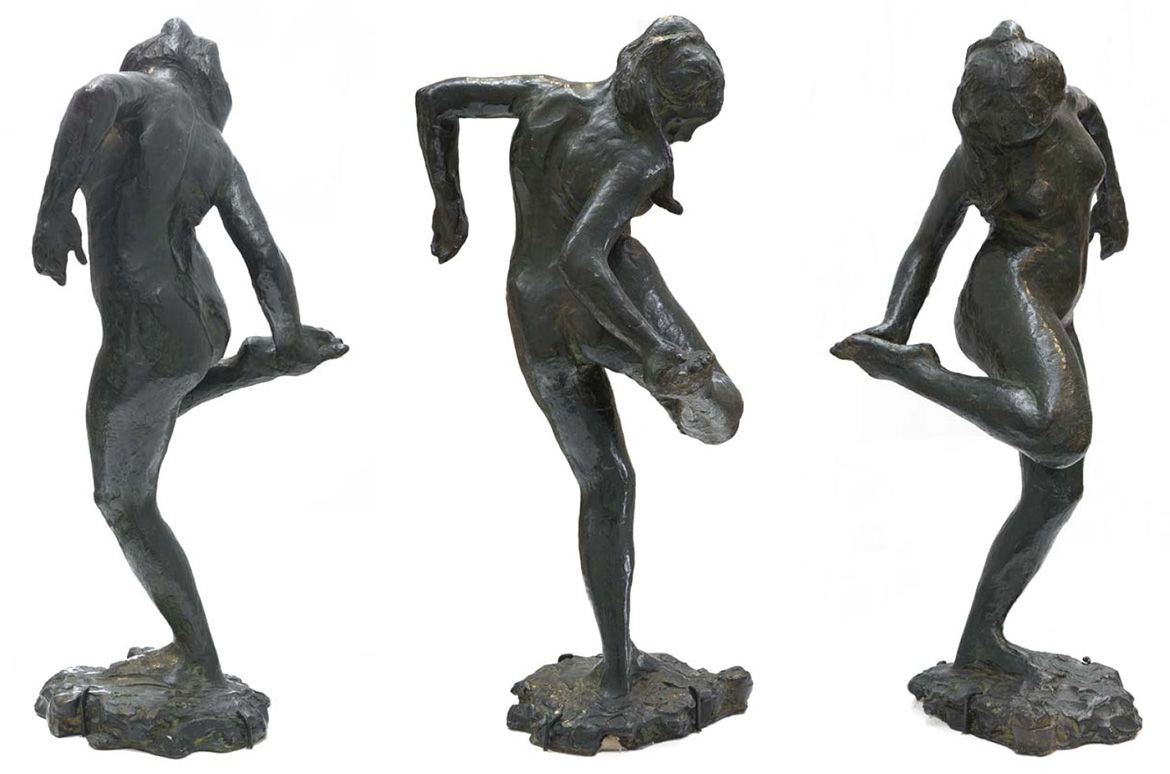
(Dancer looking at the sole of her right foot, fourth study) c.1882-1900 is on display in the International Art Collection
Queensland Art Gallery
Galleries 7, 8 & 9 (Philip Bacon Galleries)
Queensland Art Gallery | Gallery of Modern Art (QAGOMA)
Brisbane, Australia