
Charles Blackman’s time in the Queensland sun

Charles Blackman, Australia 1928–2018 / The Blue Alice 1956-57 / Tempera, oil and household enamel on composition board / 122 x 122cm / Purchased 2000. The Queensland Government's special Centenary Fund / Collection: Queensland Art Gallery | Gallery of Modern Art / © Charles Blackman/Copyright Agency / View full image
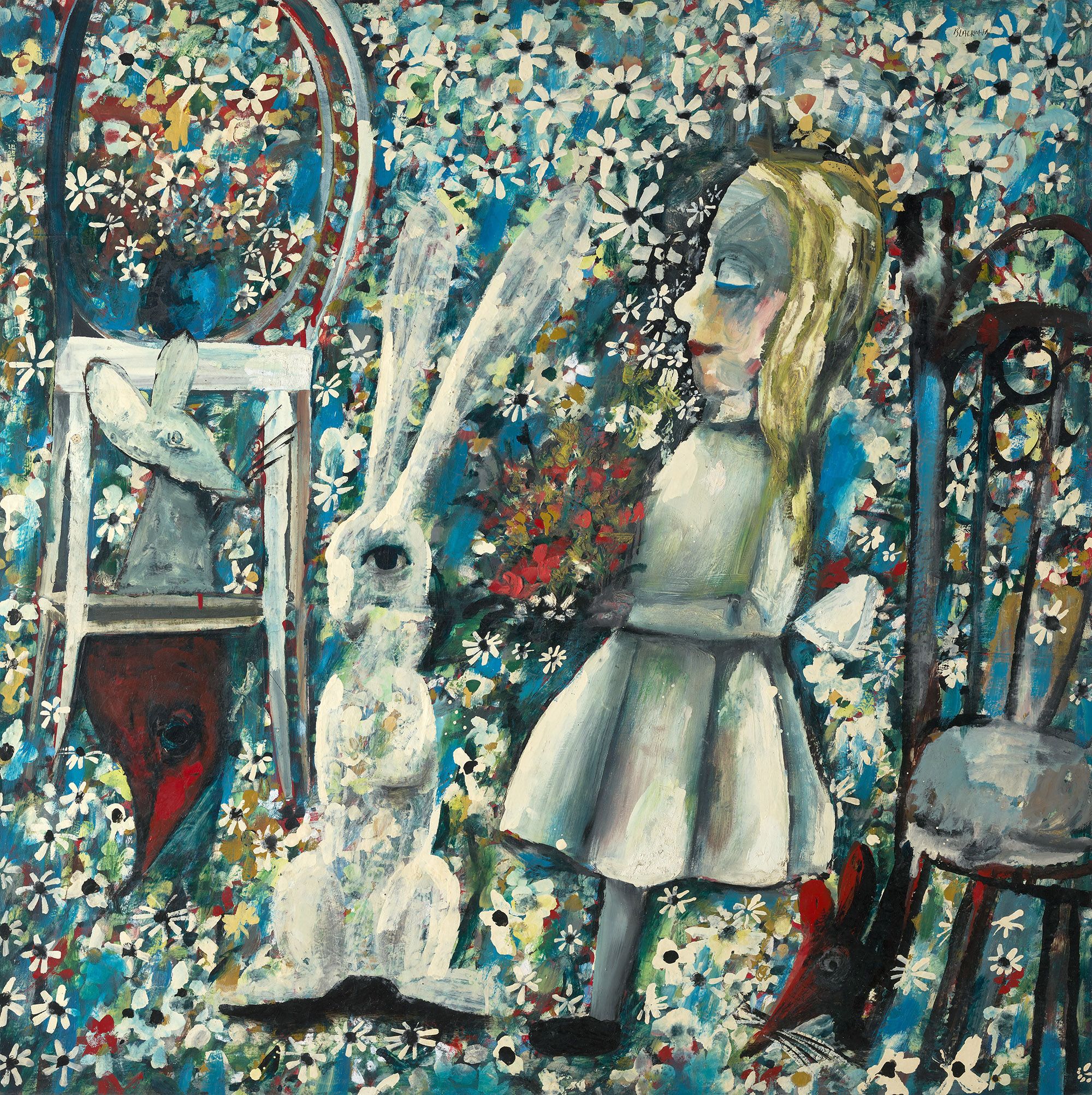
When Sydney-born Charles Blackman (12 August 1928–2018) first ventured across the border into Queensland in the late 1940s he was welcomed by several notable friends and creative locals who encouraged him to do some of his most innovative work, including future wife, writer and poet Barbara Patterson (1928–2024), who he married in 1951.
These friendships and connections had a lasting influence on self-taught Blackman’s creative oeuvre and his practice from this period, particularly poet Judith Wright and her philosopher husband Jack McKinney. Wright and McKinney had a considerable effect on Blackman, coming to know him through Barbara, who had developed a connection with Judith. Barbara recalls their first meeting, at which she and Blackman were the guests of a group of young Brisbane writers who produced the literary magazine Barjai:
. . . of all the Barjai guests, two magnetised me. Judith Wright, almost twice my young age, deaf with her awkward off-range voice . . . read her first book of unpublished poems, and JP McKinney, non-academic philosopher, gave a paper on ‘emotional honesty’. Both lifted me sky high and thereafter Jack-n-Judith became lifetime friends.[1]
Blackman maintained a significant connection with Queensland since his first visit and Brisbane remained an important influence later in his career with Brisbane-inspired works: ‘Schoolgirl’ series painted between 1952 and 1955; ‘Faces and flowers’ series painted between 1955 and 1958; and the ‘Alice’ series completed in Brisbane in 1957.
Blackman first encountered Alice’s Adventures in Wonderland (1865) and its sequel Through the Looking-Glass, and What Alice Found There (1872) through Barbara whose progressive blindness led her to listen to recordings of the stories read by BBC announcer Robin Holmes. Barbara was diagnosed with optic atrophy and declared legally blind in 1950 at the age of 22.
The Blue Alice 1956-57

Charles Blackman, Australia 1928–2018 / The Blue Alice 1956-57 / Tempera, oil and household enamel on composition board / 122 x 122cm / Purchased 2000. The Queensland Government's special Centenary Fund / Collection: Queensland Art Gallery | Gallery of Modern Art / © Charles Blackman/Copyright Agency / View full image
Inspired by the visual imagery produced by Lewis Carroll’s whimsical wordplay (rather than the book’s famous illustrations by John Tenniel, which the artist had not seen), Blackman began to draw parallels between Alice’s nonsensical and unpredictable encounters and the real-world challenges he and his wife faced as a young couple, partly helped because of Barbara's flowing blonde locks.
Barbara's courageous struggle with her progressive blindness deeply impressed the painter, who saw her attempts to interpret the world as parallel to Alice's efforts to conquer the mysterious circumstances in which she found herself. As Barbara herself wrote:
Alice was moving enquiringly, questioningly, trustfully, bemusedly, changefully, into a new and strange world, trying with good sense and honesty to get her bearings in it.[2]
In addition to Barbara’s failing eyesight, an impending baby and changes in their financial circumstances influenced the development of Blackman’s series of 41 paintings. Blackman was continually racing between home, studio and work as a cook. The frantic pace recalled the lightning appearances and disappearances of characters in Alice in Wonderland. As Blackman commented:
I went to work in a restaurant at 5pm that finished at 12 and then came home and my head was full of spinning plates and teacups and Barbara would say I brought the rabbit into the restaurant at night and it would help me do the work, and next day I would paint it all.[3]
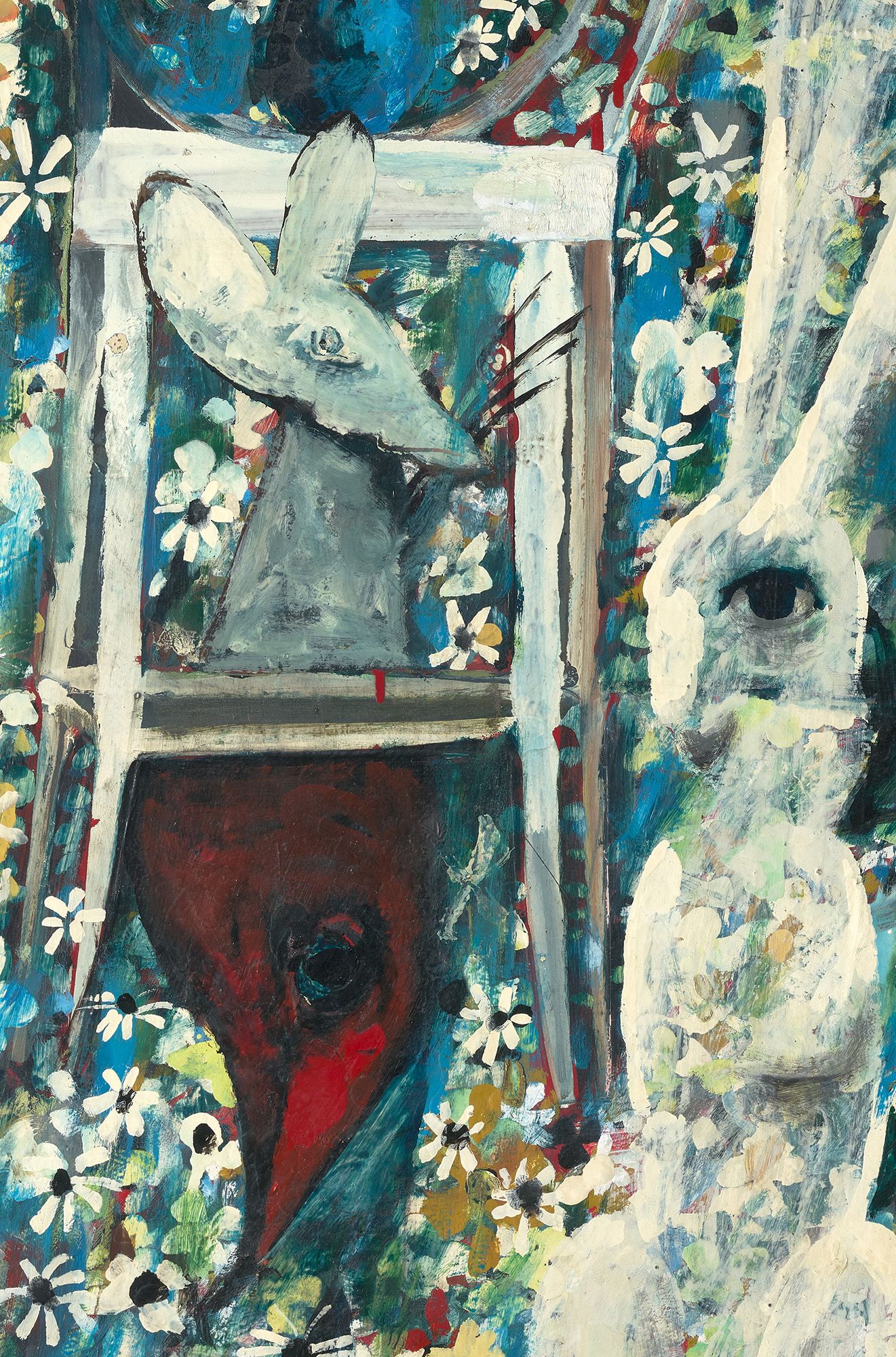
The Blue Alice 1956, not identified with any specific episode from the books sees Alice (Barbara) and the White Rabbit (Blackman) being wed by the story’s Dormouse. The White Rabbit has the long ears of the March Hare; The Dormouse is visible in three places: just behind Alice on the right, sitting on the chair on the left, and, again, in a fragmentary and monstrous form, underneath the same chair; Alice floats in a sea of brilliant white flowers and like many of the female characters in Blackman’s paintings, Alice’s eyes are closed, giving reference to his wife’s blindness. Across the series, the integration of the Blackmans’ personal experiences with those of Alice offers a whimsical transformation of the tale from fiction to reality.

Charles Blackman, Australia 1928–2018 / The Blue Alice (detail) 1956-57 / Tempera, oil and household enamel on composition board / 122 x 122cm / Purchased 2000. The Queensland Government's special Centenary Fund / Collection: Queensland Art Gallery | Gallery of Modern Art / © Charles Blackman/Copyright Agency / View full image
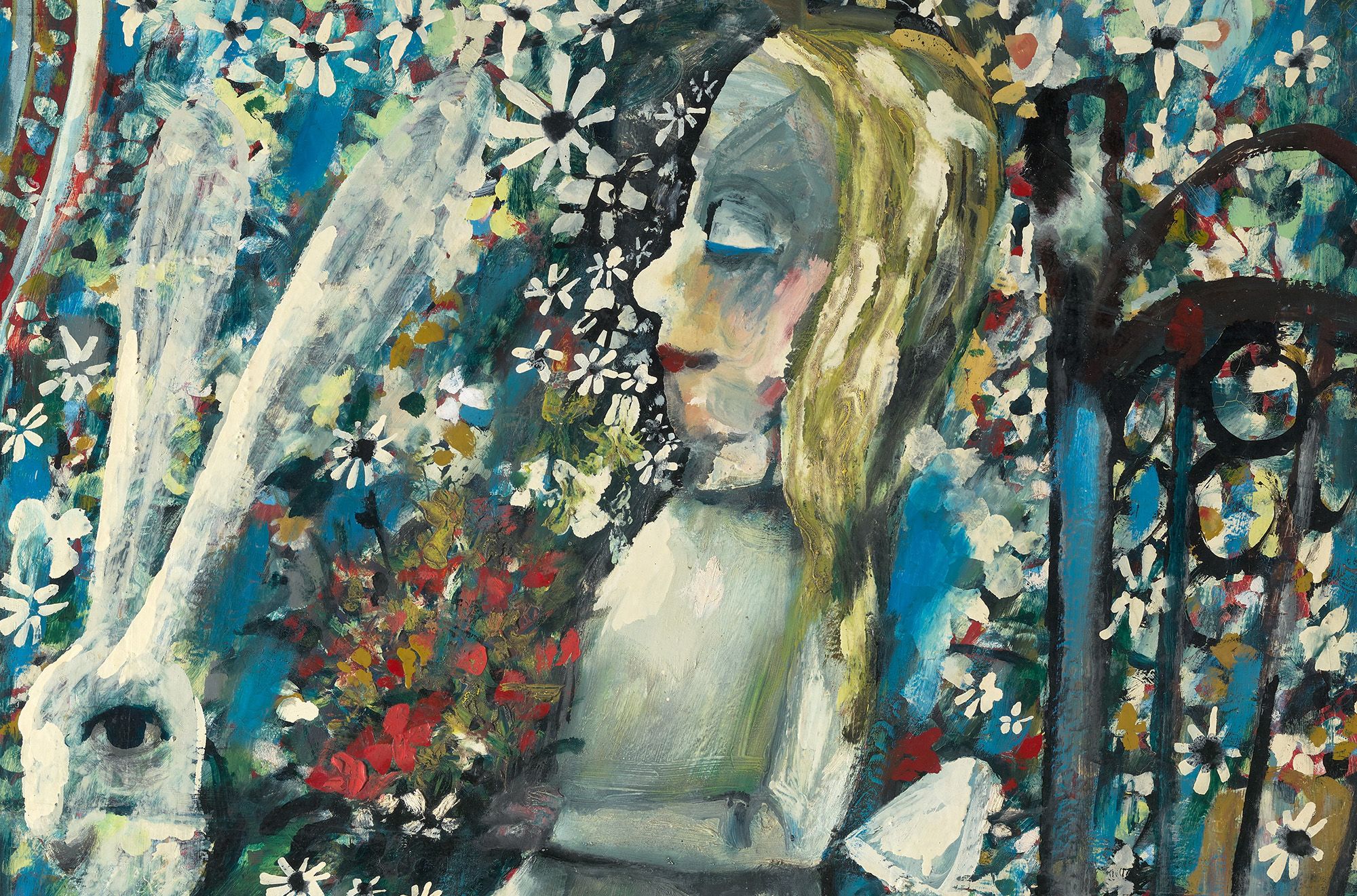

Charles Blackman, Australia 1928–2018 / The Blue Alice (detail) 1956-57 / Tempera, oil and household enamel on composition board / 122 x 122cm / Purchased 2000. The Queensland Government's special Centenary Fund / Collection: Queensland Art Gallery | Gallery of Modern Art / © Charles Blackman/Copyright Agency / View full image
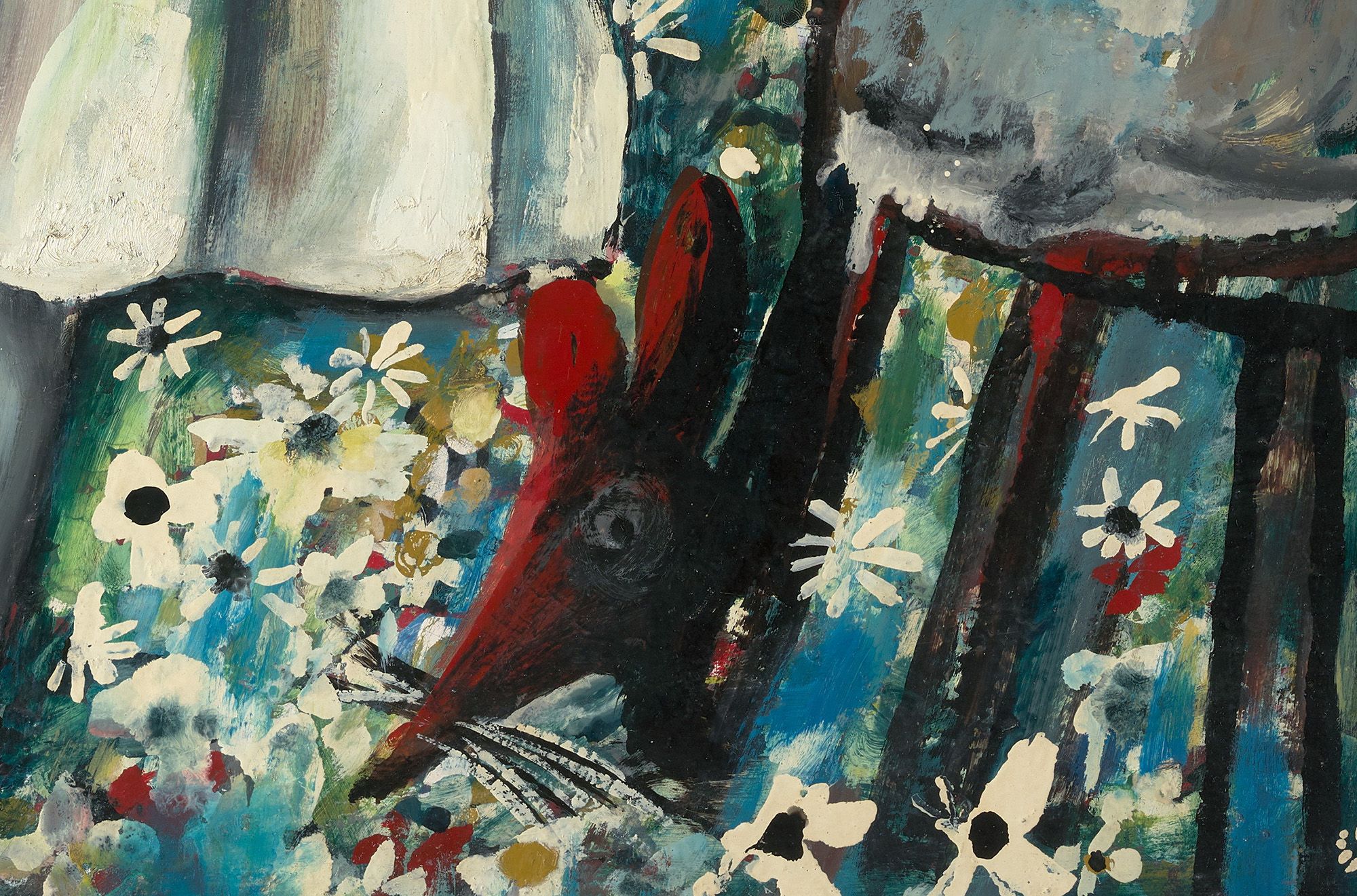

Charles Blackman, Australia 1928–2018 / The Blue Alice (detail) 1956-57 / Tempera, oil and household enamel on composition board / 122 x 122cm / Purchased 2000. The Queensland Government's special Centenary Fund / Collection: Queensland Art Gallery | Gallery of Modern Art / © Charles Blackman/Copyright Agency / View full image
On display in the Australian Art Collection
Queensland Art Gallery
Galleries 10, 11, 12 & 13 (Josephine Ulrick and Win Schubert Galleries)
Queensland Art Gallery | Gallery of Modern Art (QAGOMA)
Brisbane, Australia
Endnotes
- ^ Blackman, Barbara, Glass After Glass: Autobiographical Reflections, Viking, Penguin Books Australia, Victoria, 1997.
- ^ St. John Moore, Felicity, 'Charles Blackman: Schoolgirls and angels’ a retrospective exhibition, NGV, Melbourne, 1993. p.4.
- ^ Blackman, Barbara, Glass After Glass: Autobiographical Reflections, Viking, Penguin Books Australia, Victoria, 1997.