
Art for Parisian dreamers

Rupert Bunny, Australia/France 1864–1947 / Bathers 1906 / Oil on canvas / 229.2 x 250cm / Purchased 1988 / Collection: Queensland Art Gallery | Gallery of Modern Art / View full image
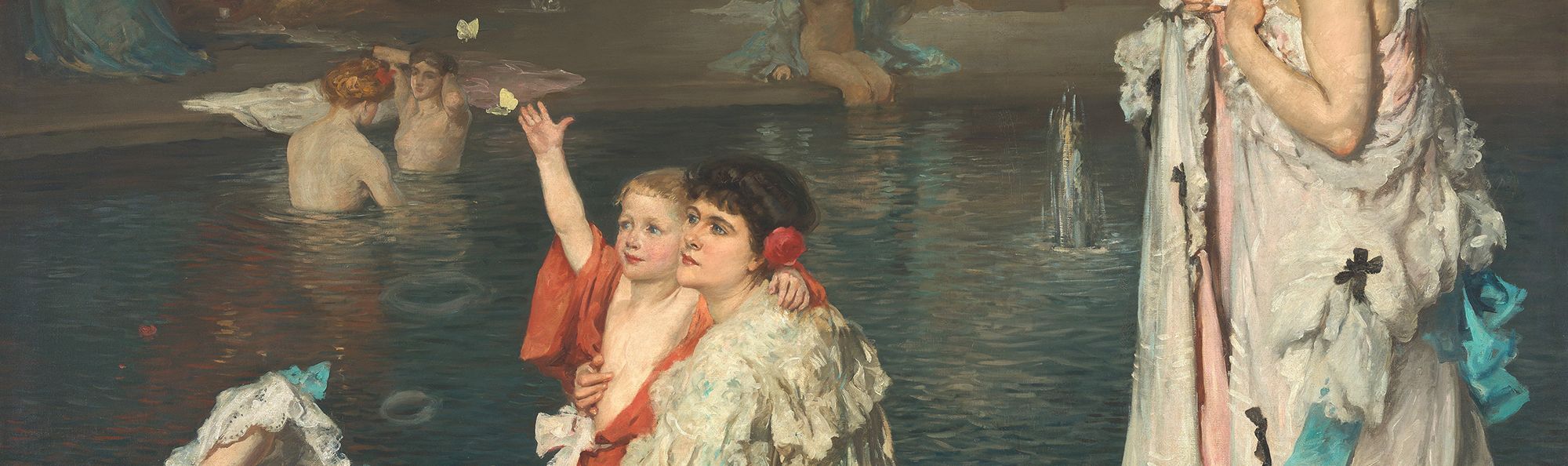
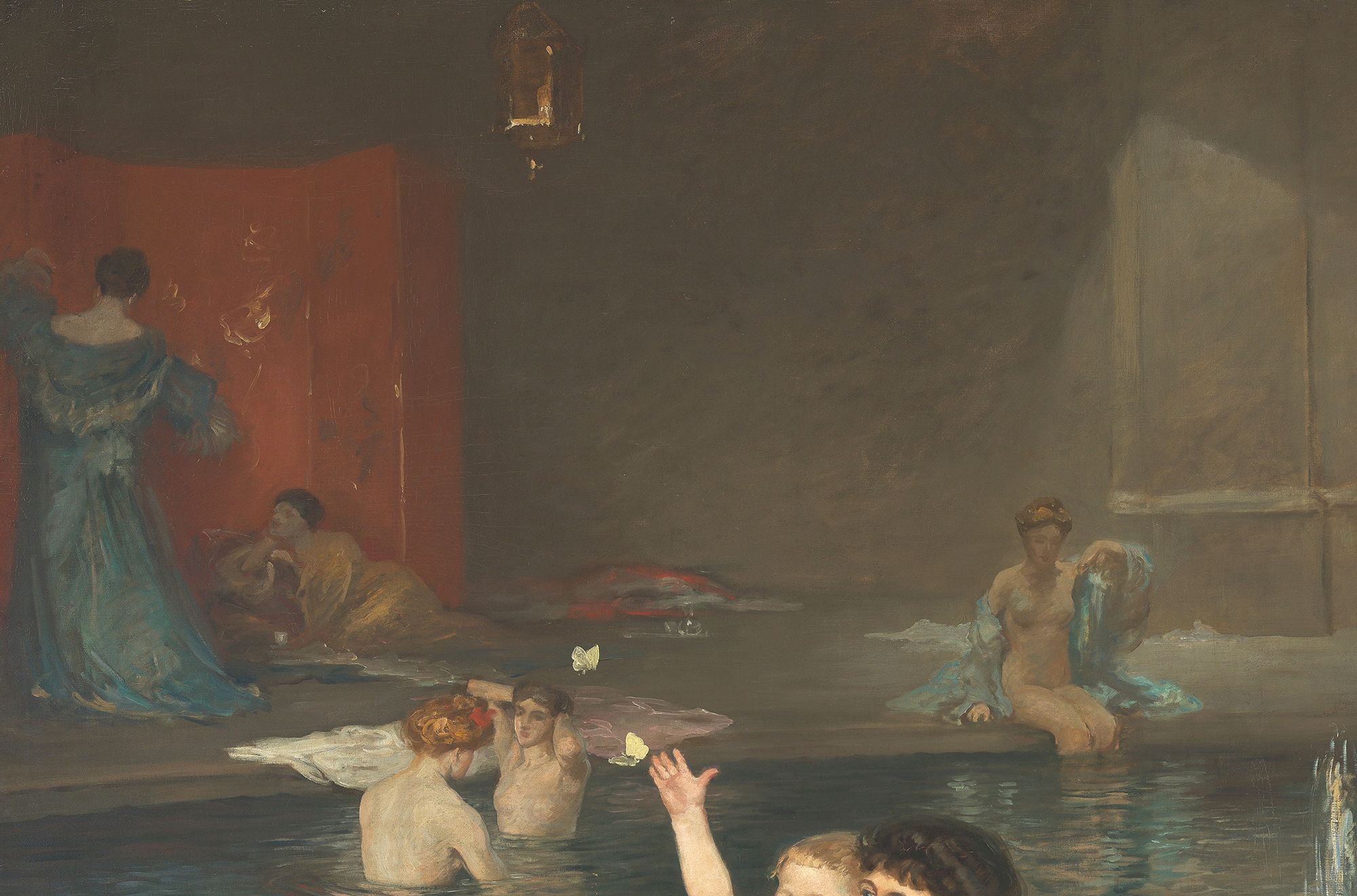
Bathers 1906 is from a series of works featuring women at leisure by Rupert Bunny (29 September 1864–1947), one of the most successful Australian expatriate artists of his generation. The immense work originally exhibited under the title Une Scene au Bain is a fine Edwardian example from the artist's Parisian years during La Belle Epoque (The Beautiful Era). The painting exemplifies the middle period of Bunny's development (1900 to 1911), a work of more subtle and complex tonal methods.
Bunny absorbed traditional and contemporary styles which served as points of departure for his own inclinations, such as his love of colour, the decorative, the theatrical, and the luxurious, with classical mythology, women at leisure, pastoral dances and landscapes — themes that sustained him throughout his career.

Rupert Bunny, Australia/France 1864–1947 / Bathers 1906 / Oil on canvas / 229.2 x 250cm / Purchased 1988 / Collection: Queensland Art Gallery | Gallery of Modern Art / View full image
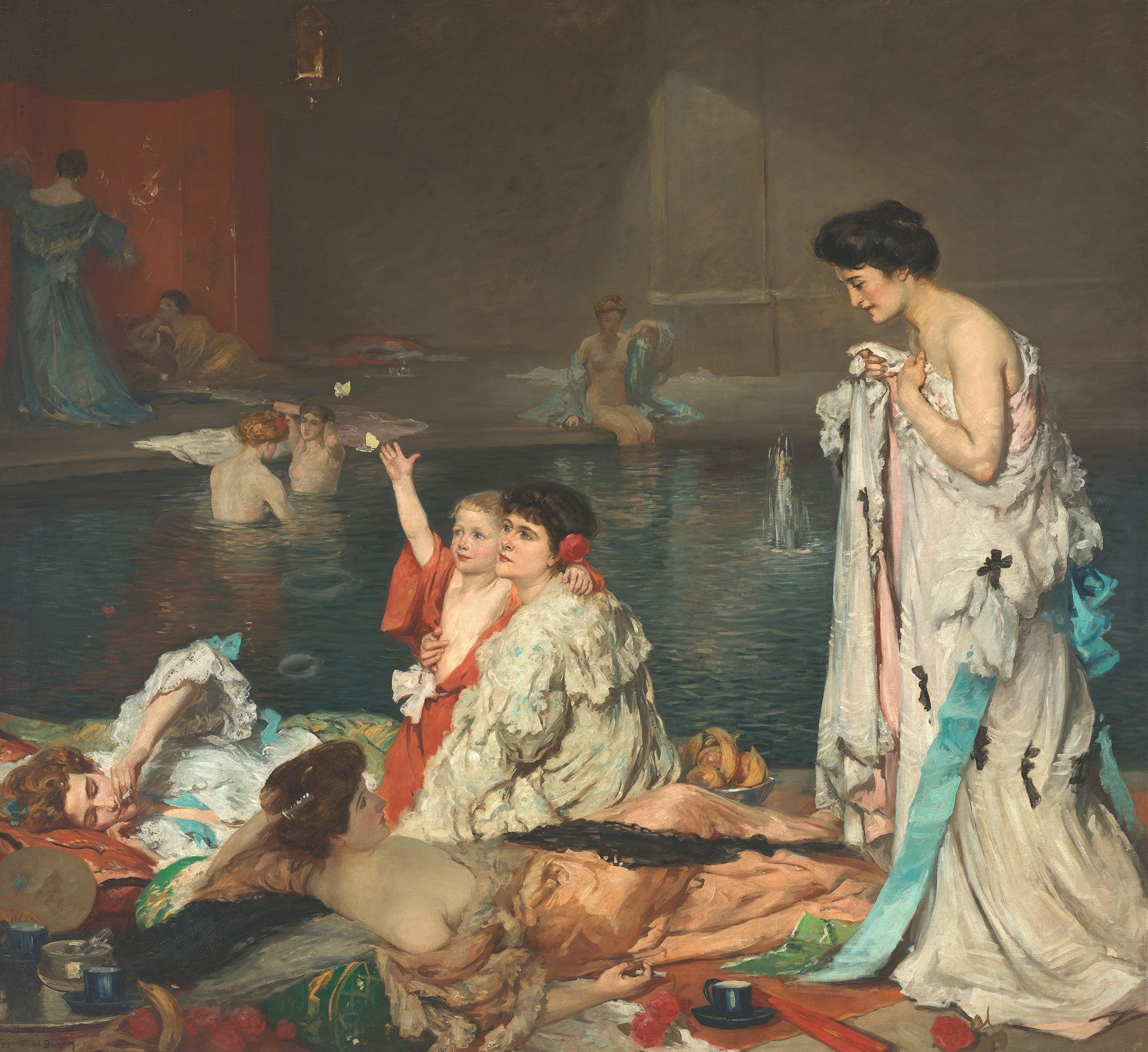
In particular, Bunny concentrated on the depiction of intimate indoor, outdoor and balcony scenes of women at leisure, these paintings have a strong sense of bourgeois grandeur. Bathers is a luxurious rendition of women reclining, set in an interior where nude and partly clothed women are gathered around a bathing pool.
In the foreground a mother and child form the central element. The mother looks piously into the distance while the child she clasps to her side reaches towards two yellow butterflies. Bunny has carefully controlled the shift of our attention from the standing figure, to the child whose hand reaches upwards, this gesture draws the eye across the water and bathers to the figures standing in the distance.

Rupert Bunny, Australia/France 1864–1947 / Bathers (detail) 1906 / Oil on canvas / 229.2 x 250cm / Purchased 1988 / Collection: Queensland Art Gallery | Gallery of Modern Art / View full image
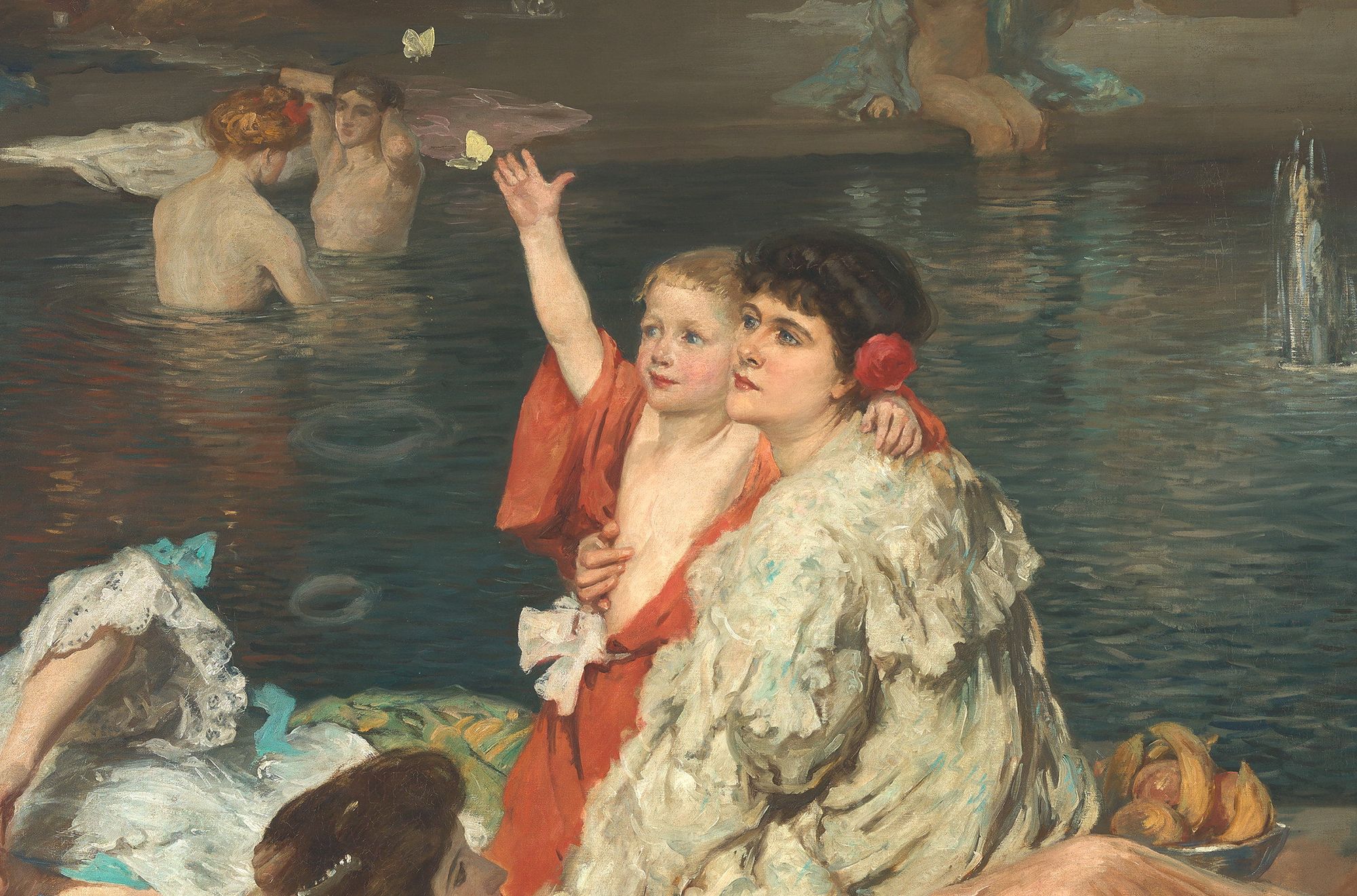
Its opulence and scale (over 2 metres wide and 2.5 metres deep) is typical of salon paintings, containing a profusion of allegorical and art historical allusions and references usually exhibited in The Royal Academy of Arts, London and the Salon de la Société Nationale des Beaux-Arts, Paris (National Society of Fine Arts) where it was shown the year it was painted.
The so-called 'Edwardian Luxe' of the picture resonates with references to Japonisme. The tea and coffee cups, fan, bowl and red lacquer dressing screen are all Japanese and the placement of the two women in front of the screen is reminiscent of Japanese prints. Additional references and layers of meaning with the women congregated around a Roman bath with the display of gestures that were probably appropriated from sources that Bunny had seen in Greek and Roman images. There is a subtle allusion to the harem, however the contemporary dress and make-up of the women is identifiably European rather than 'oriental'. Bunny's idealisation of bourgeois women at leisure remains the dominant theme translating dreamy elegance into a romantic vision, they exist in a timeless, transcendent world, a world where women smoke cigarettes.
Within this arcadian scenario, the primary motif in Bathers is the celebration of motherhood, the central grouping of mother and child is a direct allegory of the Madonna and Child.

Rupert Bunny, Australia/France 1864–1947 / Bathers (detail) 1906 / Oil on canvas / 229.2 x 250cm / Purchased 1988 / Collection: Queensland Art Gallery | Gallery of Modern Art / View full image
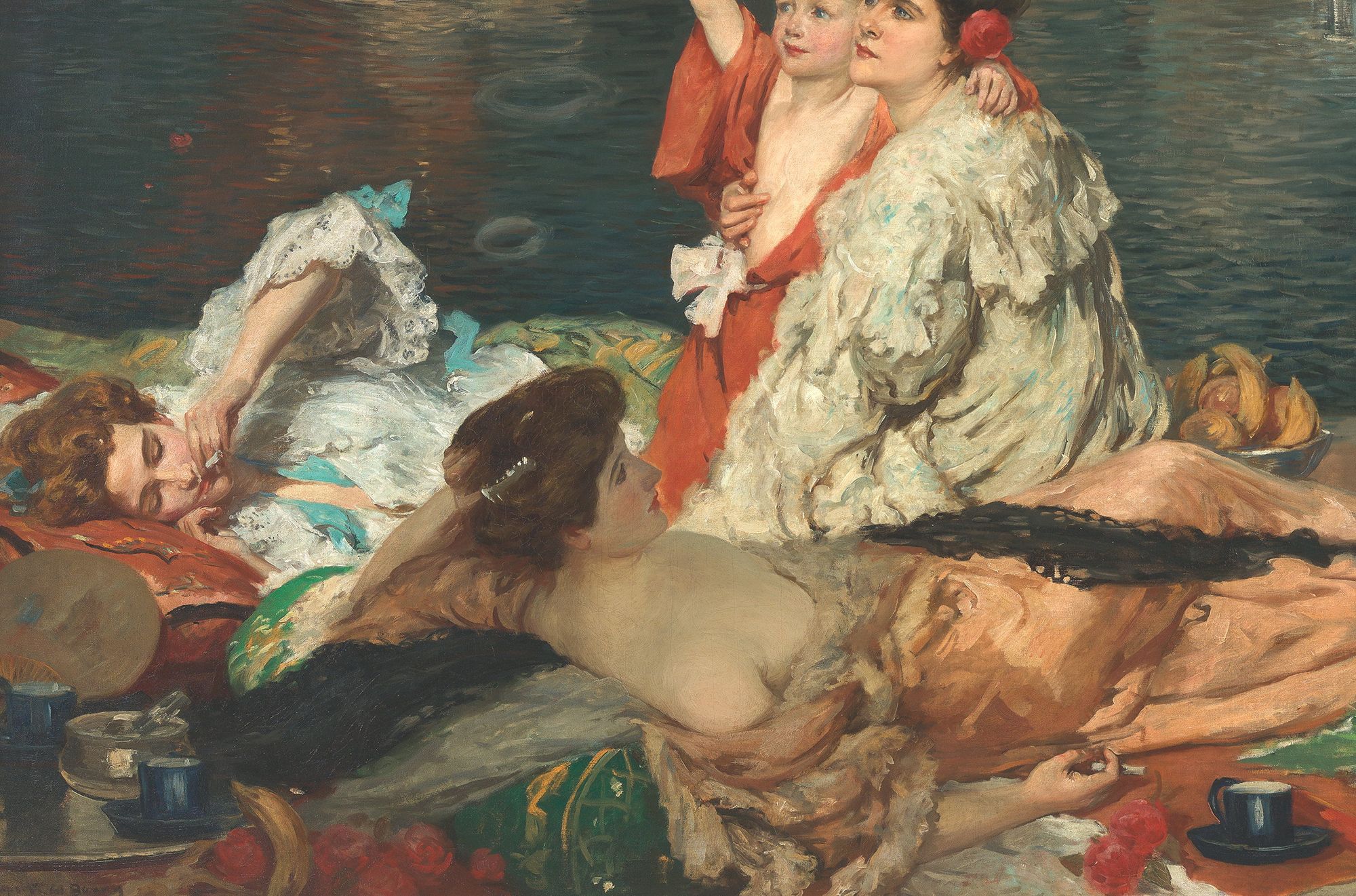

Rupert Bunny, Australia/France 1864–1947 / Bathers (detail) 1906 / Oil on canvas / 229.2 x 250cm / Purchased 1988 / Collection: Queensland Art Gallery | Gallery of Modern Art / View full image
Edited extract from ‘Art for the bourgeois dreamers of Paris: Rupert Bunny Bathers‘ by Mark Pennings from Brought to Light: Australian Art 1850-1965, Queensland Art Gallery, 1998.
On display in Australian Art Collection
Queensland Art Gallery
Galleries 10, 11, 12 & 13 (Josephine Ulrick and Win Schubert Galleries)
Queensland Art Gallery | Gallery of Modern Art (QAGOMA)
Brisbane, Australia